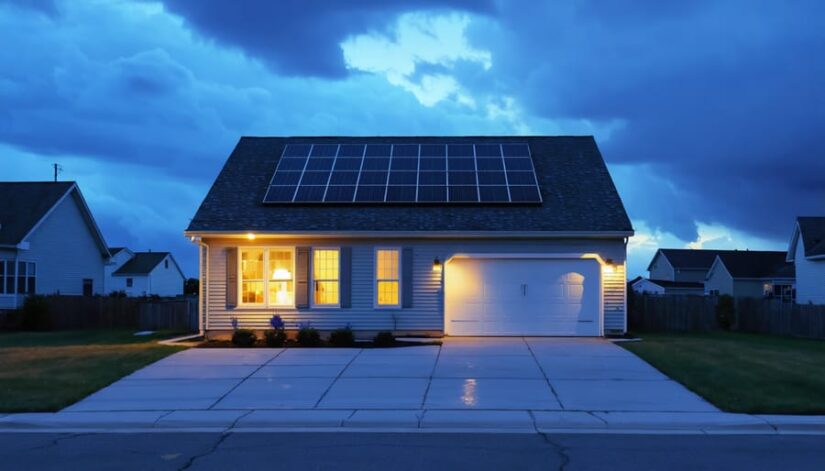
Suburban Illinois house at dusk with rooftop solar panels and a wall-mounted home battery near the garage, warm interior lights glowing as utility poles and bare trees sit in the background.

Why Your Solar Panels Stop Working After Sunset (And How to Fix It)

Solar panels generate electricity when the sun shines, but your home needs power around the clock. This fundamental mismatch creates a critical challenge: without storage, you’ll send excess daytime energy to the grid at lower rates while buying expensive evening power back. Energy storage systems solve this problem by capturing your solar production for use whenever you need it, transforming your panels from a simple utility bill reduction into genuine energy independence.

For Illinois homeowners and businesses, the storage question has become increasingly urgent. Recent grid instability, rising electricity rates, and improved battery technology have shifted the calculation dramatically. What once seemed like an expensive luxury now represents a practical path to controlling energy costs and maintaining power during outages. The federal Investment Tax Credit covers 30% of battery system costs when paired with solar, making storage more accessible than ever before.

The decision isn’t whether storage technology works—it does. The real questions center on which system fits your energy patterns, whether the investment makes financial sense for your situation, and how to navigate Illinois-specific incentives and regulations. Battery costs have dropped 90% since 2010, while capabilities have expanded significantly. Understanding your options requires cutting through marketing claims to examine actual capacity, lifespan, warranty terms, and realistic payback periods based on your consumption patterns and local utility rates.

The Solar Power Problem Nobody Talks About

Solar panels work beautifully when the sun shines. The challenge? They generate the most electricity between 10 AM and 2 PM, but that’s not when most Illinois homes and businesses need power most.

Think about your typical day. You wake up, turn on lights, brew coffee, and maybe run the heating system on a chilly morning. Your solar panels are just starting to wake up too. By mid-afternoon when your panels are producing peak power, you might be at work with minimal electricity use at home. Then evening arrives. You return home, cook dinner, run appliances, and as the sun sets, your heating system kicks in to combat those cold Illinois nights. Your solar panels? They’re done for the day.

This timing mismatch creates a frustrating situation. During summer months, you might generate excess electricity during the day that flows back to the grid, while you pull power from the grid every morning and evening. In winter, the problem intensifies. Illinois experiences shorter days and increased heating demands precisely when solar production drops. Your furnace works hardest between 5 PM and 9 PM, long after sunset.

For businesses, the disconnect can be even more pronounced. Retail stores, restaurants, and manufacturing facilities often operate well into the evening hours. A restaurant’s peak energy consumption happens during dinner service, when solar panels contribute nothing. Manufacturing operations running second and third shifts rely entirely on grid power after dark.

Without energy storage, you’re essentially running two separate systems: solar during the day and grid power during peak usage times. You generate clean energy when you need it least and buy conventional power when you need it most. This fundamental problem is why energy storage has become essential for anyone serious about maximizing their solar investment and achieving true energy independence. Storage bridges the gap, capturing that abundant midday sunshine and releasing it exactly when your Illinois home or business needs it most.

Residential home with solar panels on roof at sunset with interior lights on
Solar panels generate power during the day, but household energy needs often peak during evening hours when the sun has set.

How Energy Storage Transforms Your Solar Investment

Battery Storage Systems: The Most Popular Solution

When it comes to storing solar energy for your Illinois home or business, lithium-ion battery systems have emerged as the clear frontrunner. These are the same proven technology that powers electric vehicles and smartphones, now scaled up to meet your property’s energy needs.

Battery storage systems work by capturing excess electricity your solar panels generate during sunny days and storing it for use when the sun isn’t shining. Instead of sending surplus power back to the grid or losing its value entirely, you can draw from your battery during evening hours, cloudy days, or even during power outages if your system includes backup capabilities.

Understanding battery capacity is straightforward once you know the basics. Capacity is measured in kilowatt-hours (kWh), which tells you how much electricity the battery can store. For example, a 10 kWh battery could power ten 100-watt light bulbs for ten hours, or run your refrigerator, a few lights, and your internet router for most of a day. The typical Illinois home uses about 30 kWh daily, so most homeowners choose batteries ranging from 10 to 15 kWh for partial backup, or multiple units for whole-home coverage.

Installation typically happens alongside your solar panel system, though batteries can be added to existing solar arrays as well. The battery unit connects to your home’s electrical system through an inverter, which manages the flow of electricity between your solar panels, battery, home, and the utility grid. Most systems are about the size of a wall-mounted water heater and can be installed either indoors or outdoors depending on your property layout and local requirements.

How Much Storage Do You Actually Need?

Determining the right battery size depends on three key factors: your energy consumption patterns, backup priorities, and budget constraints.

Start by reviewing your electricity bills to understand your daily usage. Most Illinois households consume between 25-35 kilowatt-hours per day, though this varies significantly by season. Winter heating and summer cooling can push consumption much higher, making seasonal patterns particularly important for our region.

Next, define your backup goals. Do you need whole-home coverage during outages, or just critical loads like refrigeration, heating systems, and lighting? A typical refrigerator uses about 1-2 kWh daily, while essential circuits might require 5-10 kWh. Most homeowners find that 10-15 kWh of storage provides adequate backup for critical needs during typical outages.

For businesses, calculate your daily operational requirements and consider how long you need to maintain operations during grid interruptions. Manufacturing facilities or retail operations may require substantially larger systems than office environments.

Budget also plays a crucial role. Battery costs typically range from $8,000-$15,000 for residential systems. Illinois incentive programs can offset 15-30% of these costs, making storage more accessible than in many states.

Consider Illinois utility rates too. If you’re on ComEd’s time-of-use rates, sizing your battery to shift consumption from peak to off-peak hours can generate additional savings beyond backup protection. Working with a locally owned solar provider familiar with regional utility structures ensures you select appropriately sized storage that balances protection, performance, and investment return.

Energy Storage Technologies That Work With Solar

Lithium-Ion Batteries: The Workhorse of Home Solar

Lithium-ion batteries have become the go-to choice for home solar energy storage, and for good reason. These powerful systems store excess energy your solar panels produce during sunny days, making it available when you need it most—during evening hours, cloudy days, or power outages.

What makes lithium-ion technology particularly attractive for Illinois homeowners and businesses is its impressive efficiency and longevity. These batteries typically last between 10 to 15 years, which aligns well with the lifespan of solar panel systems. They operate at efficiency rates between 90-95%, meaning you lose very little energy in the charging and discharging process. This high efficiency translates to more usable power from your solar investment.

Scalability is another significant advantage. Whether you’re powering a small home or a large commercial facility, lithium-ion systems can be configured to meet your specific energy needs. You can start with a smaller capacity and expand as your requirements grow, making them a flexible solution for various applications.

The technology has proven itself reliable across millions of installations nationwide. While lithium-ion batteries represent a higher upfront investment compared to older technologies, their superior performance, longer lifespan, and minimal maintenance requirements make them cost-effective over time. For Illinois residents looking to maximize their solar energy independence and reduce reliance on grid power, lithium-ion batteries offer a proven, dependable solution that continues to improve as technology advances and costs decline.

Wall-mounted lithium-ion battery storage system in residential garage
Modern lithium-ion battery systems integrate seamlessly with residential solar installations to store excess daytime energy.

Lead-Acid Batteries: The Budget-Friendly Alternative

If you’re looking for a more affordable entry point into solar energy storage, lead-acid batteries remain a viable option. These tried-and-true systems typically cost 50-60% less upfront than lithium-ion alternatives, making them attractive for homeowners and businesses working within tighter budgets.

However, this lower initial investment comes with important trade-offs. Lead-acid batteries generally last 3-7 years compared to 10-15 years for lithium alternatives. They require regular maintenance, including checking water levels in flooded models and ensuring proper ventilation. Their usable capacity is also limited—you can typically only discharge them to about 50% without significantly shortening their lifespan.

Despite these limitations, lead-acid batteries work well in specific situations. They’re ideal for backup power systems that aren’t used daily, seasonal applications like cabins or agricultural operations, and situations where you’re testing solar storage before making a larger investment. For Illinois property owners with intermittent energy needs or those prioritizing immediate affordability, lead-acid systems offer dependable performance at a manageable price point. Just be prepared for more hands-on involvement and eventual replacement sooner than newer technologies.

Flow Batteries and Emerging Technologies

Beyond lithium-ion batteries, several emerging technologies show promise for renewable energy storage, though they’re still developing for mainstream residential and commercial use. Flow batteries, which store energy in liquid electrolytes, offer advantages like longer lifespans and the ability to scale storage capacity independently from power output. These systems are currently more common in utility-scale applications but may become accessible to Illinois businesses as technology advances and costs decrease.

Solid-state batteries represent another frontier, replacing liquid electrolytes with solid materials for potentially safer, more energy-dense storage. While still primarily in development, these could eventually offer homeowners more compact storage solutions.

Alternative battery technologies like zinc-based systems and hydrogen storage systems are also gaining attention for their sustainability and resource abundance. While these innovations aren’t yet widely available for typical solar installations, they’re worth monitoring as the industry evolves. For most Illinois property owners today, proven lithium-ion technology remains the most practical choice, but staying informed about emerging options helps you make future-ready decisions for your renewable energy investment.

Thermal Energy Storage for Larger Operations

For commercial and industrial operations in Illinois, thermal storage options offer a practical way to maximize solar investment while addressing significant heating and cooling demands. Rather than converting excess solar energy into electricity for battery storage, thermal systems capture and store energy as heat or cold in specialized materials for later use.

These systems work by using surplus solar power during peak production hours to heat materials like water, molten salts, or phase-change materials, or to cool substances that maintain low temperatures. When energy demand rises or solar production drops, this stored thermal energy provides heating or cooling without drawing from the grid. This approach is particularly valuable for Illinois businesses with substantial climate control needs, such as manufacturing facilities, food processing plants, warehouses, and large commercial buildings.

Thermal storage systems typically cost less per kilowatt-hour than battery storage and can maintain energy for extended periods with minimal loss. They integrate seamlessly with existing HVAC infrastructure, making them easier to implement than complete electrical system overhauls. For operations that consume more energy for temperature regulation than electrical loads, thermal storage often delivers better returns on investment than traditional battery systems.

Illinois businesses benefit from thermal storage during harsh winter months and humid summers, when heating and cooling costs peak. By storing solar energy thermally, companies reduce grid dependency during expensive demand periods while maintaining comfortable working conditions year-round.

The Real Costs and Savings of Adding Storage to Solar

Federal and Illinois-Specific Incentives

Adding energy storage to your renewable energy system has become significantly more affordable thanks to federal and state-level incentives. Understanding these financial programs can help you make a more informed decision about whether battery storage fits your budget.

The federal Investment Tax Credit (ITC) now extends to standalone battery storage systems, not just those paired with solar panels. This credit allows you to deduct 30% of your battery installation costs from your federal taxes through 2032. For example, if your battery system costs $15,000, you could receive a $4,500 tax credit. This substantial benefit applies to both residential and commercial installations, making energy storage much more accessible for Illinois homeowners and businesses.

Illinois offers additional support through various utility programs. ComEd and Ameren Illinois both provide incentive programs that can further reduce your upfront costs. These utility-specific rebates vary by location and capacity but can amount to several thousand dollars depending on your system size. Some programs also offer performance-based incentives that pay you for allowing your battery to support grid stability during peak demand periods.

The Illinois Shines program, which supports solar adoption throughout the state, also recognizes the value of energy storage in maximizing renewable energy benefits. As Illinois continues advancing its clean energy goals, additional state-level storage incentives may become available. Working with a locally owned solar installer with expertise in Illinois regulations ensures you maximize all available incentives while navigating the application process efficiently.

When Storage Pays for Itself

Understanding when energy storage becomes financially worthwhile requires looking beyond the upfront price tag. In Illinois, several factors influence your payback period and overall return on investment.

For homes and businesses with time-of-use electricity rates, storage systems typically pay for themselves within 10-15 years. These rate structures charge more during peak demand hours, usually late afternoon and evening. By storing solar energy generated during the day and using it during expensive peak periods, you can significantly reduce your electric bills. The savings compound monthly, accelerating your payback timeline.

Grid reliability plays another crucial role in the financial equation. If your business experiences frequent power disruptions, the cost of downtime, spoiled inventory, or lost productivity can quickly justify battery investment. Many Illinois businesses find that avoiding even one or two extended outages per year makes storage worthwhile, regardless of traditional payback calculations.

Storage makes the most financial sense when you have high daytime solar production but evening energy demand, face frequent outages, want protection against rising electricity rates, or value energy independence beyond pure dollars. The ideal scenario combines multiple benefits: you offset peak-rate charges, gain backup power security, and increase your solar self-consumption from around 30% to 70% or higher.

For homeowners prioritizing peace of mind and energy security, the emotional value of independence during storms or grid emergencies often outweighs pure financial metrics. When you factor in both tangible savings and intangible benefits, storage investment becomes compelling for many Illinois property owners ready to maximize their renewable energy systems.

Homeowner reviewing energy storage system costs and savings data on tablet
Understanding system costs and available incentives helps Illinois homeowners make informed decisions about adding battery storage to solar installations.

Making Energy Storage Work in Illinois Weather

Illinois weather presents unique challenges for energy storage systems, but modern battery technology is designed to handle our region’s temperature extremes and seasonal variations. Understanding how these conditions affect performance helps you make informed decisions and set realistic expectations for your investment.

Temperature fluctuations are the primary concern for battery systems in Illinois. Our winters can dip well below freezing, while summer temperatures often exceed 90°F. Most lithium-ion batteries perform optimally between 50°F and 85°F. Outside this range, you may notice reduced capacity and slower charging speeds. However, quality battery systems include thermal management features that maintain safe operating temperatures. Many manufacturers install heating elements for winter operation and cooling systems for summer, ensuring your storage system functions reliably year-round.

The good news is that our extreme temperatures rarely damage properly installed systems. Indoor installations in temperature-controlled spaces, like basements or garages, naturally protect batteries from harsh conditions. Outdoor installations require weatherproof enclosures with active climate control, which reputable installers include as standard equipment.

Seasonal sunlight variations also impact storage performance. Illinois receives abundant sunshine during summer months, allowing your solar panels to fully charge your batteries and potentially export excess power. Winter presents greater challenges, with shorter days and lower sun angles reducing solar production. This means your battery may not fully charge every day during December and January, making it important to size your system appropriately for winter conditions.

Working with a locally owned solar installer who understands Illinois weather patterns ensures your energy storage system is properly specified, installed, and configured for optimal performance throughout our varied seasons.

What to Expect When Adding Storage to Your Solar System

Adding battery storage to your existing solar system is a straightforward process when working with experienced professionals. At Illinois Renewables, we handle every step to ensure your energy storage integration is seamless and hassle-free.

The process begins with a comprehensive site assessment. Our team evaluates your current solar production, energy consumption patterns, and electrical infrastructure to design a storage solution perfectly suited to your needs. We’ll review your utility bills and solar generation data to determine the optimal battery capacity, typically taking one to two weeks for complete system design.

Once you approve the design, we manage all permitting requirements. In Illinois, battery installations require electrical permits and must comply with local building codes. We submit all necessary documentation to your municipality and coordinate with your utility company for interconnection approval. This phase usually takes three to six weeks, depending on local jurisdiction response times.

Installation itself is surprisingly quick. Most residential battery systems can be installed in one to two days. Our certified technicians mount the battery unit, integrate it with your existing solar inverter or install a hybrid inverter if needed, and configure the smart energy management system that controls when your battery charges and discharges.

After installation, we coordinate the final inspection with your local authority and utility company. Once approved, we activate your system and provide comprehensive training on monitoring your battery performance through user-friendly apps. You’ll learn how to track your energy independence, adjust settings for backup priorities, and maximize your savings.

Throughout the entire process, Illinois Renewables serves as your single point of contact. We communicate directly with utilities, inspectors, and manufacturers, keeping you informed at every milestone. From initial consultation to system activation, most projects are completed within eight to twelve weeks, transforming your solar investment into a complete energy independence solution.

Snow-covered solar panels and battery storage system during Illinois winter
Energy storage systems in Illinois must perform reliably through harsh winter conditions including heavy snow, extreme cold, and reduced sunlight hours.

Is Energy Storage Right for Your Property?

Determining whether energy storage makes sense for your property requires honest assessment of several key factors. Start by evaluating your energy goals. Are you seeking backup power during outages, reducing electricity costs through time-of-use optimization, or maximizing the value of your existing solar system? Your primary objective will significantly influence whether storage is a worthwhile investment.

Budget considerations play a crucial role in this decision. While battery technology costs have decreased substantially, energy storage still represents a significant upfront investment. Consider whether you have access to financing options, available tax incentives, or whether your utility offers programs that improve the return on investment. In Illinois, the Adjustable Block Program provides incentives that can help offset initial costs for qualifying systems.

Your property type matters considerably. Commercial properties with high daytime energy consumption and demand charges often see faster returns on battery investments than residential homes. Industrial facilities requiring uninterrupted power for critical operations may find storage essential regardless of payback periods. For residential properties, consider your home’s energy consumption patterns and whether you experience frequent power outages.

Grid reliability in your region is another critical factor. Northern Illinois communities typically experience different outage patterns than southern regions, while rural areas often face more frequent disruptions than urban centers. If your location experiences regular weather-related outages or grid instability, backup power capabilities may justify the investment even without immediate financial returns.

Finally, consider your timeline for staying at your property. Energy storage systems typically achieve payback over several years, making them more suitable for properties you plan to own long-term. Evaluate these factors collectively to determine if energy storage aligns with your situation and goals.

Energy storage fundamentally transforms solar power from an intermittent energy source into a comprehensive, around-the-clock solution for Illinois homes and businesses. By capturing excess solar generation during peak production hours and making it available when the sun isn’t shining, battery systems deliver the energy independence and reliability that today’s property owners demand. This combination addresses the primary limitation of solar panels alone, ensuring your investment provides consistent value regardless of weather conditions or time of day.

The right energy storage solution depends on your unique circumstances, including your energy consumption patterns, budget considerations, and long-term goals for energy independence. Illinois Renewables brings local expertise to this decision-making process, understanding the specific challenges and opportunities that come with our state’s climate and utility landscape. As a locally owned company, we’ve designed countless solar-plus-storage systems that align with Illinois property owners’ needs.

Whether you’re exploring solar for the first time or looking to enhance an existing system, our team can provide a personalized assessment of how energy storage fits into your energy strategy. Contact Illinois Renewables today to discover how a complete solar-plus-storage solution can deliver reliable, clean energy for your property.

Leave a Reply

Your email address will not be published. Required fields are marked *