

How Much Your Solar System Really Costs Over 25 Years
Calculate the total cost of owning a solar system by adding your initial investment, ongoing maintenance expenses, insurance premiums, potential repair costs, and financing interest, then subtract your energy savings, tax incentives, and rebate values over the system’s expected 25-30 year lifespan. This comprehensive approach reveals whether solar makes financial sense for your Illinois property beyond the upfront price tag.
Life-cycle cost analysis transforms solar from an intimidating purchase into a measurable investment decision. Rather than fixating on installation costs alone, this methodology accounts for every dollar that flows in and out related to your solar system from day one through its eventual retirement. For Illinois property owners, this analysis becomes particularly valuable given our state’s specific incentives, net metering policies, and regional maintenance considerations that directly impact long-term returns.
The difference between initial cost and life-cycle cost often surprises homeowners and business owners alike. A $20,000 solar installation might seem expensive until you factor in $40,000 in avoided electricity costs, $6,000 in federal tax credits, Illinois Solar Renewable Energy Credits, and minimal maintenance requirements. Conversely, a cheaper system with lower efficiency or higher maintenance needs might cost more over three decades despite saving money upfront.
Understanding life-cycle costs empowers you to compare proposals accurately, negotiate from an informed position, and select equipment that maximizes value rather than minimizes initial expense. This analytical framework applies whether you’re considering a residential rooftop array or a commercial-scale installation.
What Is Lifecycle Cost Analysis for Solar?
When you’re considering solar energy for your Illinois property, understanding the true cost means looking beyond the initial price tag. Lifecycle cost analysis is a comprehensive method that calculates every expense and saving associated with your solar system from the day of installation through its eventual decommissioning, typically 25 to 30 years later.
Think of it this way: when you buy a car, the sticker price is just the beginning. You’ll also pay for fuel, insurance, maintenance, and repairs over the years you own it. Solar systems work similarly, except they generate savings instead of requiring fuel. Lifecycle cost analysis captures this complete financial picture.
Unlike a simple upfront cost comparison, this method accounts for installation expenses, ongoing maintenance, potential repairs, insurance, financing costs, and energy production degradation over time. More importantly, it also factors in your electricity bill savings, available tax incentives, and any income from net metering programs.
For Illinois property owners, this analysis is particularly valuable because it reveals the true return on investment. A solar system might cost $20,000 upfront, but over its lifetime, it could save you $40,000 or more in electricity costs while qualifying for federal tax credits and state incentives. Without lifecycle cost analysis, you might dismiss solar as too expensive based solely on the initial investment.
This comprehensive approach helps you make informed decisions by comparing the total cost of ownership against continuing to purchase electricity from the grid. It transforms solar from a simple purchase into a strategic financial investment, giving you confidence that you’re making the right choice for your property and budget.
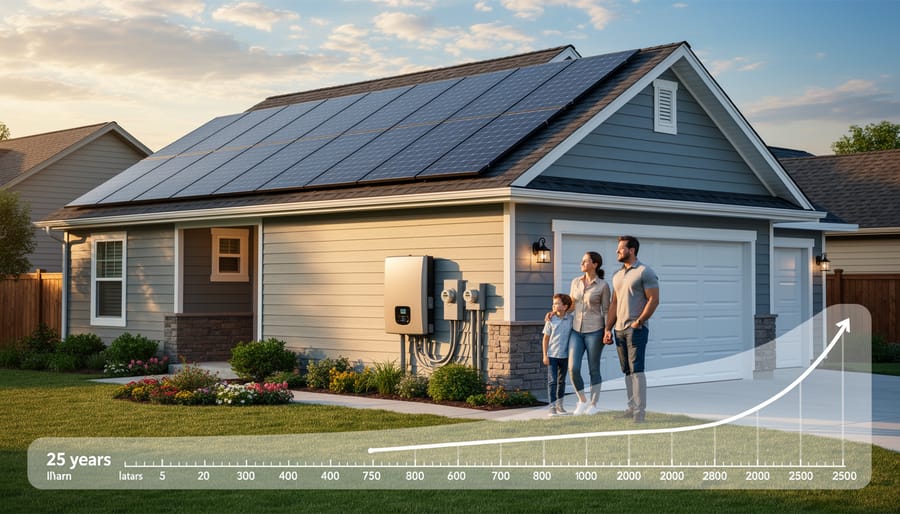
The Complete Picture: What Goes Into Solar Lifecycle Costs
Upfront Investment Costs
Understanding your upfront investment costs is the foundation of any solar life-cycle cost analysis. These initial expenses represent the largest financial commitment you’ll make when transitioning to solar energy.
Equipment costs typically form the bulk of your investment. Solar panels themselves range from $0.50 to $1.00 per watt in Illinois, while inverters add approximately $0.15 to $0.30 per watt. If you’re considering energy storage, battery systems can add $8,000 to $15,000 to your total project cost. For a typical residential 8-kilowatt system in Illinois, equipment alone generally runs between $12,000 and $18,000.
Installation labor comprises the next significant expense, usually accounting for 10-20% of total project costs. In Illinois, expect to pay $4,000 to $8,000 for professional installation on a standard residential system. Complex roof configurations or ground-mounted systems may increase these costs.
Permitting and interconnection fees vary by municipality across Illinois. Most homeowners pay between $500 and $1,500 for permits, inspections, and utility interconnection applications. Some Illinois communities have streamlined these processes to encourage solar adoption, potentially reducing both costs and timeline.
System design and engineering services typically add $500 to $1,500, ensuring your installation meets local building codes and maximizes energy production for Illinois weather patterns. Working with locally owned solar providers often means better familiarity with regional permitting requirements and climate considerations.
Ongoing Operations and Maintenance
One of solar energy’s greatest advantages is its minimal ongoing maintenance requirements compared to conventional power systems. Once your solar panels are installed, they operate silently with no moving parts, significantly reducing wear and tear. Regular maintenance typically involves simple visual inspections to check for debris, shading from new tree growth, or any physical damage to the panels. Most Illinois homeowners can perform basic cleaning themselves a few times per year, simply rinsing panels with water to remove dust, pollen, or bird droppings that may reduce efficiency.
Professional inspections are recommended every few years to verify electrical connections, inverter performance, and overall system health. These checkups are relatively inexpensive, usually costing a few hundred dollars. Your monitoring system, often included with modern installations, tracks energy production in real-time, alerting you to any performance issues immediately. This proactive approach prevents small problems from becoming costly repairs.
When calculating life-cycle costs, budget approximately one to two percent of your initial system cost annually for maintenance and monitoring. This predictable expense is considerably lower than the ongoing fuel costs, tune-ups, and frequent repairs associated with generators or traditional energy infrastructure, making solar an economically sound long-term investment for Illinois property owners.
Component Replacement and Upgrades
Understanding component replacement costs is essential when calculating the true lifecycle expenses of your solar system. While solar panels typically last 25-30 years with minimal degradation, other components require periodic replacement that impacts your long-term budget.
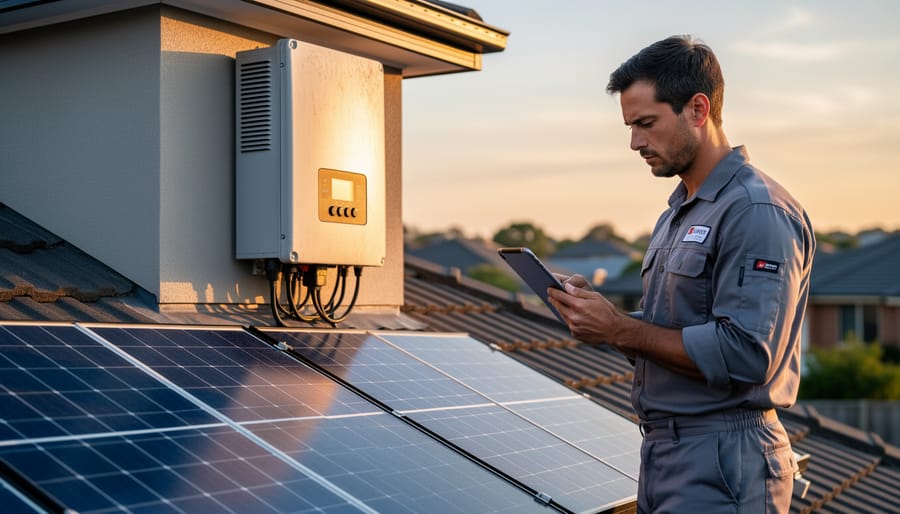
Inverters, which convert DC power from panels to AC electricity for your home or business, generally need replacement every 10-15 years. This represents one of the most significant post-installation expenses, typically ranging from $1,000 to $3,000 for residential systems and more for commercial installations. String inverters require full replacement, while microinverter systems may allow for individual unit replacement as needed.
Solar panels experience gradual efficiency loss, usually around 0.5% annually. Most manufacturers guarantee 80-85% output after 25 years, meaning replacement is rarely necessary within the system’s primary lifespan. However, this degradation should factor into your energy production calculations.
If you include battery storage, expect replacement cycles every 10-15 years depending on usage and battery chemistry. Lithium-ion batteries, the current industry standard, cost between $7,000 and $15,000 for typical residential systems. Protecting your solar investment means planning for these scheduled replacements in your financial projections. Illinois solar providers can help you create realistic replacement schedules based on your specific system configuration.
Energy Savings and Revenue
Understanding how your solar installation will reduce electricity costs is central to evaluating its financial performance. In Illinois, solar energy savings come from two primary sources: offsetting utility costs and generating revenue through net metering programs.
To calculate your offset utility costs, start by reviewing your annual electricity consumption in kilowatt-hours from recent utility bills. Multiply this by your current electricity rate to determine your baseline annual cost. Your solar system’s production, measured in kilowatt-hours, directly replaces purchased electricity. For example, if your system generates 10,000 kWh annually and your electricity rate is $0.13 per kWh, you’ll save $1,300 yearly in utility costs.
Illinois offers net metering, which allows you to earn credits for excess electricity your system sends back to the grid. These credits offset future consumption, effectively acting as a storage mechanism without batteries. Your utility company tracks these credits, providing additional value beyond direct consumption offset. This becomes particularly valuable when maximizing your project’s return throughout its lifespan.
Rising electricity rates significantly impact long-term savings. Illinois electricity rates have historically increased 2-3% annually. When calculating lifecycle savings, apply a conservative escalation rate to future utility costs. A system saving $1,300 today could save $1,560 annually within ten years at 2% annual increases, compounding your financial benefits substantially over the 25-30 year system lifespan.
Illinois-Specific Factors That Impact Your Numbers
When calculating the true lifecycle costs of solar in Illinois, you’ll need to account for several state-specific factors that can significantly impact your bottom line. Understanding these elements will give you a more accurate picture of your solar investment’s financial performance over time.
The Illinois Shines program stands as one of the most substantial financial incentives available to Illinois solar adopters. This state-backed initiative provides Adjustable Block Program incentives that can cover a significant portion of your upfront costs. The program pays you based on the size and type of your system, with different incentive levels for residential, small commercial, and larger installations. These payments are delivered over time as Solar Renewable Energy Credits, which represent the environmental benefits your system produces.
Speaking of SRECs, Illinois operates a robust renewable energy credit market. Your solar system generates one SREC for every 1,000 kilowatt-hours of electricity produced. These credits have tangible monetary value and should be factored into your lifecycle cost calculations as ongoing revenue that offsets your initial investment.
Property tax considerations also play a crucial role in your analysis. Illinois offers a property tax exemption for solar energy systems, meaning the added value solar brings to your property won’t increase your annual property tax bill. This exemption can result in thousands of dollars in savings over your system’s 25-30 year lifespan.
Don’t forget the federal Investment Tax Credit, which allows you to deduct 30 percent of your solar installation costs from your federal taxes. This incentive works alongside Illinois programs to further reduce your effective system cost.
Local utility rates and net metering policies vary across Illinois, affecting how much you save on electricity and what compensation you receive for excess power sent back to the grid. Your specific utility provider’s rates and policies will directly impact your annual savings calculations.
Finally, Illinois weather patterns influence your system’s actual performance. While our state receives adequate sunlight for solar viability, seasonal variations mean production estimates should reflect realistic local conditions rather than idealized scenarios.
How to Calculate Your Solar System’s True Lifecycle Cost
Step 1: Gather Your Total Investment Costs
Before calculating your solar system’s lifecycle costs, you need a clear picture of your total upfront investment. Start by collecting quotes from solar installers that detail equipment costs, installation labor, permitting fees, and any necessary electrical upgrades. In Illinois, these figures typically range from $15,000 to $40,000 for residential systems, depending on size and complexity.
Next, subtract available incentives to find your true out-of-pocket cost. This includes the federal Investment Tax Credit, currently at 30% of total system cost, plus any Illinois-specific incentives like the Adjustable Block Program or Solar Renewable Energy Credits. Some locally owned installers can help you navigate these programs and identify utility rebates or property tax exemptions available in your area.
Don’t forget to account for financing costs if you’re taking a loan. The interest paid over the loan term should be included in your total investment calculation for accurate lifecycle analysis.
Step 2: Project Your Annual Savings
Once you’ve determined your solar system’s capacity, the next step is projecting how much money you’ll save each year. Start by estimating your annual energy offset—this is the amount of electricity your solar panels will generate compared to what you currently purchase from the grid. In Illinois, a well-designed system typically offsets 80-100% of a home’s electricity needs.
To create an accurate projection, you’ll need to account for electricity rate inflation. Illinois electricity rates have historically increased by approximately 2-3% annually. This means your savings grow over time as you avoid these rising utility costs while your solar production remains consistent.
Don’t forget to factor in net metering benefits available through Illinois utilities. Net metering allows you to send excess electricity back to the grid in exchange for credits on your utility bill. During sunny summer months, you might generate more power than you need, banking credits that offset consumption during winter months when production is lower.
Multiply your estimated annual kilowatt-hour production by your current electricity rate, then apply a conservative inflation factor for each future year. This calculation reveals your projected annual savings and demonstrates how solar becomes increasingly valuable as traditional electricity costs rise.

Step 3: Factor in Future Costs
Once you’ve mapped out your solar system’s timeline, the next step is identifying what costs you’ll encounter along the way. While solar panels are remarkably durable, they do require occasional attention to maintain peak performance.
Start by factoring in routine maintenance costs. Most solar systems in Illinois need annual inspections and cleaning, which typically run between $150 and $300 per visit. You’ll also want to budget for inverter replacement, usually necessary around the 10 to 15-year mark, costing $1,000 to $3,000 depending on your system size.
Component warranties provide helpful guidance here. Most solar panels come with 25-year performance warranties, but other parts like inverters may have shorter coverage periods. Plan for potential repairs outside warranty periods, and consider Illinois weather patterns—our freeze-thaw cycles and occasional hail can impact long-term maintenance needs.
Don’t forget monitoring system fees if your installation includes remote tracking. These subscriptions, while modest at $100 to $200 annually, add up over decades. Creating a detailed maintenance schedule with associated costs gives you a realistic picture of your total investment beyond installation day.
Step 4: Calculate Net Present Value
Money you spend or save ten years from now isn’t worth the same as money today. That’s where Net Present Value comes in for your solar investment. This step converts all future costs and savings into today’s dollars so you can make an apples-to-apples comparison.
Think of it this way: if you save $1,000 on electricity bills five years from now, that’s worth less than saving $1,000 today because of inflation and the potential to invest that money elsewhere. To calculate NPV, you apply a discount rate (typically 3-5% for homeowners) to your projected costs and savings for each year of your solar system’s life.
Here’s a practical example: Your solar system saves you $2,000 annually in electricity costs. Using a 4% discount rate, that $2,000 savings in Year 5 is worth about $1,644 in today’s dollars. Year 10’s $2,000 savings? That’s worth roughly $1,352 today.
By discounting all future savings and subtracting your initial investment and ongoing costs, you arrive at your NPV. A positive NPV means your solar investment makes financial sense. Most Illinois solar installations show strong positive NPV when you factor in federal tax credits, state incentives, and our locally competitive installation costs.
Why Lifecycle Analysis Matters More Than Payback Period
When evaluating solar investments, many property owners initially focus on simple payback period—the time it takes for energy savings to equal the upfront installation cost. While this metric offers a quick snapshot, it falls short of revealing the complete financial picture.
Simple payback calculations have significant limitations. They don’t account for maintenance costs, equipment degradation, financing expenses, or changing electricity rates over time. More importantly, they ignore the value your system continues to generate after the payback threshold. A solar installation that “pays for itself” in eight years still has 17-plus years of productive life remaining, creating substantial long-term value that payback calculations simply overlook.
Lifecycle cost analysis addresses these gaps by examining every expense and benefit throughout your system’s entire operational lifespan—typically 25 to 30 years for solar projects. This comprehensive approach includes initial equipment and installation costs, ongoing maintenance, potential repairs, insurance, monitoring services, and even eventual decommissioning or upgrades. On the revenue side, it factors in energy savings at projected future rates, available incentives, potential income from renewable energy credits, and the increased property value your system creates.
For Illinois property owners, this matters especially because our state’s energy landscape is evolving. Electricity rates, incentive programs, and net metering policies all influence your return on investment differently over time. Lifecycle analysis captures these variables, providing realistic projections that simple payback can’t match.
Integrating sustainability planning into your financial evaluation strengthens decision-making further. Understanding the full lifecycle cost helps you choose quality components that deliver reliable performance for decades, compare financing options accurately, and plan for long-term system optimization—ultimately maximizing your solar investment’s true value.
Making Lifecycle Cost Analysis Work for Your Project
Applying lifecycle cost analysis effectively requires a strategic approach that goes beyond simple number-crunching. Start by comparing different system options side-by-side, evaluating not just the upfront investment but the projected energy production, maintenance requirements, and expected lifespan of each configuration. For Illinois properties, this means considering how different panel types and inverter technologies perform in our specific climate conditions, including snowy winters and humid summers.
Quality components are essential to minimizing long-term costs. While premium solar panels and inverters may cost 15-20% more initially, they often deliver better warranties, higher efficiency, and longer operational life. A panel with a 25-year performance warranty versus a 10-year warranty provides significantly greater value when you calculate total energy production over time. The same principle applies to mounting systems, electrical components, and monitoring equipment.
Working with experienced installers who understand long-term value makes a substantial difference in your lifecycle costs. A quality installation from knowledgeable professionals ensures proper system design, optimal panel placement, and code-compliant electrical work that prevents costly repairs down the road. Locally owned solar companies bring expertise specific to Illinois building codes, utility interconnection requirements, and regional weather patterns. Effective timeline management during installation also protects your investment by ensuring work is completed efficiently and correctly.
Planning for future maintenance and component replacements is the final piece. Create a maintenance schedule that includes annual inspections, inverter replacement around year 10-12, and potential panel cleaning. Budget for these predictable expenses from the beginning, and you’ll avoid financial surprises while maximizing your system’s performance throughout its entire lifecycle.

Looking beyond the initial price tag, lifecycle cost analysis provides the complete financial story of solar energy investment. While upfront costs naturally draw attention, the true measure of value emerges over the decades your system generates clean electricity. When you account for energy savings, incentives, minimal maintenance requirements, and avoided utility rate increases, solar systems consistently demonstrate strong economic performance throughout their 25 to 30-year lifespan and often beyond.
For Illinois property owners, the combination of federal tax credits, state incentives, and net metering policies makes the long-term financial case particularly compelling. The key is starting with accurate projections based on your specific situation, including your property’s solar potential, current energy usage, and local utility rates.
Working with knowledgeable local solar partners ensures you receive a personalized lifecycle cost analysis tailored to Illinois conditions. Experienced professionals understand regional weather patterns, state incentive programs, and utility policies that directly impact your return on investment. They can help you model different scenarios, select quality equipment appropriate for our climate, and plan an installation that maximizes performance over decades. This partnership approach transforms lifecycle cost analysis from an abstract concept into a practical roadmap for your solar journey.
