
Quantum Dots Are Revolutionizing Solar Panel Efficiency – Here’s How
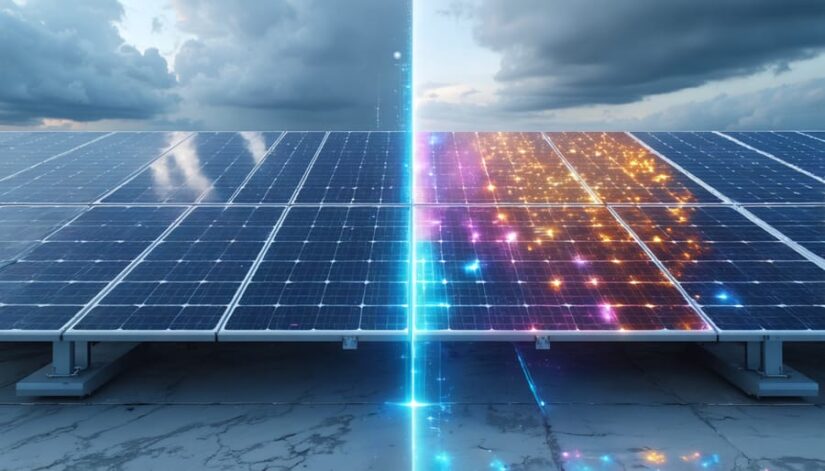
Quantum dot nanotechnology is revolutionizing solar panel technology by harnessing particles just billionths of a meter in size to capture and convert sunlight with unprecedented efficiency. These microscopic semiconductors can be precisely tuned to absorb specific wavelengths of light, enabling solar panels to harvest more energy from the sun’s spectrum than ever before. For Illinois property owners, this breakthrough means higher energy production even during cloudy days and at dawn or dusk, potentially reducing payback periods by 20-30%. While traditional silicon panels typically convert 15-20% of sunlight into electricity, quantum dot-enhanced panels are pushing efficiencies beyond 30%, marking a significant leap forward in renewable energy technology. This advanced nanotechnology represents the next generation of solar power, offering Illinois businesses and homeowners a more powerful and cost-effective path to energy independence.
What Makes Quantum Dots Special in Solar Technology?
The Science Behind Quantum Dots
Quantum dots are tiny semiconductor particles smaller than a human hair’s width – typically just a few nanometers in size. Their unique properties come from their size: when light hits these microscopic particles, they can absorb and emit different colors of light depending on how big they are. Think of them as tiny light transformers that can capture and convert sunlight more efficiently than traditional solar materials.
What makes quantum dots special is their ability to be precisely tuned. By adjusting their size during manufacturing, we can control exactly what kind of light they’ll absorb and emit. Larger quantum dots produce red light, while smaller ones create blue light. This customization allows solar panels to capture a broader spectrum of sunlight that would otherwise be wasted.
In solar applications, quantum dots act like microscopic energy converters, turning sunlight into electricity more efficiently than conventional solar cells. They can even capture light that regular solar panels miss, including some infrared and ultraviolet rays, making them particularly valuable for maximizing solar energy production in Illinois’ varying weather conditions.

Why Size Matters in Quantum Dot Technology
When it comes to quantum dots in solar technology, size truly matters. These tiny semiconductor particles, ranging from 2 to 10 nanometers, have a remarkable ability to capture and convert sunlight into electricity. The fascinating part is that their size directly determines which wavelengths of light they can absorb.
Smaller quantum dots, around 2-3 nanometers, excel at capturing high-energy blue and ultraviolet light, while larger dots of 6-8 nanometers are better suited for absorbing lower-energy red and infrared light. By precisely controlling the size of quantum dots during manufacturing, solar panel makers can create cells that capture a broader spectrum of sunlight.
Here in Illinois, where weather conditions can vary dramatically, this size-dependent absorption is particularly valuable. Quantum dots can be engineered to optimize energy production across different seasons and weather conditions. For example, larger quantum dots help maintain efficiency during cloudy days by capturing more infrared light, while smaller dots maximize energy production during clear, sunny conditions.
This customizable approach to light absorption represents a significant advancement over traditional solar cells, potentially increasing overall panel efficiency by up to 20%.
Real Benefits for Illinois Solar Installations
Enhanced Energy Capture in Midwest Weather
Quantum dot technology is proving to be a game-changer for solar energy in Illinois’s diverse weather conditions. These microscopic semiconductor particles enhance solar panels’ ability to capture and convert sunlight even during cloudy days, which are common in the Midwest. The dots’ unique properties allow them to absorb light across a broader spectrum than traditional solar cells, making them particularly effective during overcast conditions.
In Illinois’s hot summers, conventional solar panels can experience reduced efficiency as temperatures rise. Quantum dots help maintain consistent performance even in high temperatures, ensuring optimal energy production during peak sunlight hours. During spring and fall, when weather patterns are more variable, these nanoparticles continue to capture energy efficiently through rain and partial cloud cover.
Winter performances show particularly promising results. Quantum dot-enhanced panels can still generate significant power even with shorter daylight hours and snow coverage. The technology’s ability to capture indirect light means that even reflected light from snow can be converted into usable energy.
Testing in various Illinois locations has shown that quantum dot solar panels can increase energy capture by up to 20% compared to traditional panels across all seasons. This improvement is particularly valuable for property owners in the Chicago area and central Illinois, where weather conditions can change rapidly throughout the day. The technology’s adaptability to different weather conditions makes it an increasingly popular choice for both residential and commercial solar installations across the state.
Cost-Efficiency and ROI Improvements
Quantum dot nanotechnology represents a significant leap forward in solar energy cost-effectiveness, offering Illinois property owners a smart way to cut your energy bills while maximizing their investment returns. The enhanced efficiency of quantum dot solar panels means property owners can generate more electricity from the same surface area, reducing the total number of panels needed for installation.
Initial installation costs of quantum dot solar systems are currently higher than traditional panels, but the increased energy production capabilities often result in a faster return on investment. Property owners typically see complete cost recovery 1-2 years sooner than with conventional solar installations. In Illinois’s variable climate, this technology’s superior performance in low-light conditions and higher temperature tolerance ensures consistent energy generation throughout the year.
The durability of quantum dot panels also contributes to their cost-effectiveness. With an extended lifespan and minimal degradation rates, these systems maintain their high performance longer than traditional panels, reducing replacement and maintenance costs over time. Additionally, federal and state incentives for advanced solar technologies can significantly offset the initial investment, making quantum dot systems increasingly accessible to Illinois property owners.
For businesses and homeowners looking at long-term energy solutions, quantum dot technology offers compelling financial benefits through reduced utility costs, increased property value, and enhanced energy independence.
Current Applications and Future Potential

Today’s Quantum Dot Solar Solutions
Today’s market offers several innovative quantum dot solar solutions that are revolutionizing solar energy efficiency. Leading manufacturers have successfully integrated quantum dots into traditional solar panels, creating a new generation of high-performance solar cells that can capture a broader spectrum of sunlight.
One of the most promising developments is the quantum dot-enhanced solar film, which can be applied to existing solar panels to boost their efficiency by up to 20%. These films use specially engineered quantum dots that convert otherwise wasted ultraviolet light into usable visible light, maximizing energy harvesting throughout the day.
Commercial quantum dot solar panels are now available with conversion efficiencies reaching 16-18%, compared to traditional silicon panels that typically achieve 15-17% efficiency. What makes these solutions particularly attractive for Illinois property owners is their improved performance in cloudy conditions and during winter months, when conventional panels often struggle to maintain optimal output.
Several manufacturers have also introduced hybrid systems that combine quantum dots with perovskite materials, pushing efficiency rates even higher while maintaining cost-effectiveness. These systems are particularly well-suited for commercial installations where space optimization is crucial.
For Illinois businesses and homeowners, quantum dot solar solutions offer practical advantages beyond just improved efficiency. These include:
– Better performance in low-light conditions
– Enhanced durability with minimal degradation over time
– Reduced installation space requirements due to higher power density
– Potential for integration with existing solar installations
While currently at a higher price point than traditional panels, the increased energy generation and longer lifespan often justify the initial investment, especially in regions with varied weather conditions like Illinois.
What’s Next for Quantum Dot Technology
The future of quantum dot technology in solar energy is incredibly promising, with researchers and manufacturers actively developing innovations that are revolutionizing the energy landscape. One of the most exciting developments is the creation of multi-layer quantum dot solar cells, which could potentially push efficiency ratings beyond 45% – a significant improvement over current technology.
Scientists are working on enhancing quantum dot stability and longevity, addressing one of the key challenges in widespread adoption. New protective coating technologies are being developed that could extend the lifespan of quantum dot solar panels to match or exceed traditional panels, while maintaining their superior light-absorption properties.
For Illinois property owners, these advancements could translate into more efficient solar systems that perform better during cloudy days and winter months. Researchers are also exploring ways to combine quantum dots with existing solar panel technologies, potentially offering cost-effective upgrade options for current solar installations.
Another promising direction is the development of transparent quantum dot solar windows, which could transform ordinary windows into power-generating surfaces. This innovation could be particularly valuable for commercial buildings in urban areas of Illinois, where roof space might be limited.
Manufacturing processes are also evolving, with new techniques being developed to produce quantum dots more sustainably and cost-effectively. This could lead to more affordable solar solutions in the coming years, making this advanced technology accessible to more Illinois homeowners and businesses while maintaining high performance standards.
Quantum dot nanotechnology represents a transformative leap forward for solar energy in Illinois and beyond. As we’ve explored, this innovative technology significantly enhances solar panel efficiency, potentially increasing energy production by up to 20-30% compared to conventional panels. For Illinois property owners, this means more power generation even during our cloudy winter months and better overall return on investment.
The integration of quantum dots in solar technology isn’t just a scientific achievement – it’s a practical solution for addressing our growing energy needs while reducing environmental impact. As manufacturing costs continue to decrease and efficiency improvements become more substantial, quantum dot solar panels are positioned to become increasingly accessible to both homeowners and businesses across Illinois.
Looking ahead, quantum dot technology promises to revolutionize the solar industry by making solar power more efficient, affordable, and adaptable to various applications. From residential rooftops to large-scale commercial installations, this technology will play a crucial role in accelerating our transition to renewable energy and creating a more sustainable future for Illinois communities.
