

How Water Power Transformed Our World: From Ancient Mills to Modern Hydroelectric Marvels
The journey of hydroelectric power stands as one of humanity’s greatest achievements in harnessing natural energy. From ancient water wheels grinding grain in Mesopotamia to massive modern dams powering entire cities, water has been a constant companion in our quest for sustainable energy. The first industrial-scale hydroelectric facility, built at Niagara Falls in 1879, marked a pivotal moment when we transformed flowing water into electricity that could light homes and power factories.
Today’s hydroelectric facilities generate roughly 16% of the world’s electricity, making them the largest source of renewable energy globally. This remarkable evolution represents more than just technological progress – it demonstrates our growing understanding of working with nature to meet our energy needs sustainably. As we face increasing demands for clean energy solutions, the history of hydroelectric power offers valuable lessons about innovation, environmental stewardship, and the importance of investing in renewable resources.
Through examining hydroelectric history, we gain crucial insights into developing future energy solutions that balance human needs with environmental preservation. The same principles that guided early water wheel designers – efficiency, reliability, and sustainable resource use – continue to shape modern renewable energy development, including solar and wind power technologies.
Ancient Origins: First Steps in Harnessing Water Power
Water Wheels in Early Civilizations
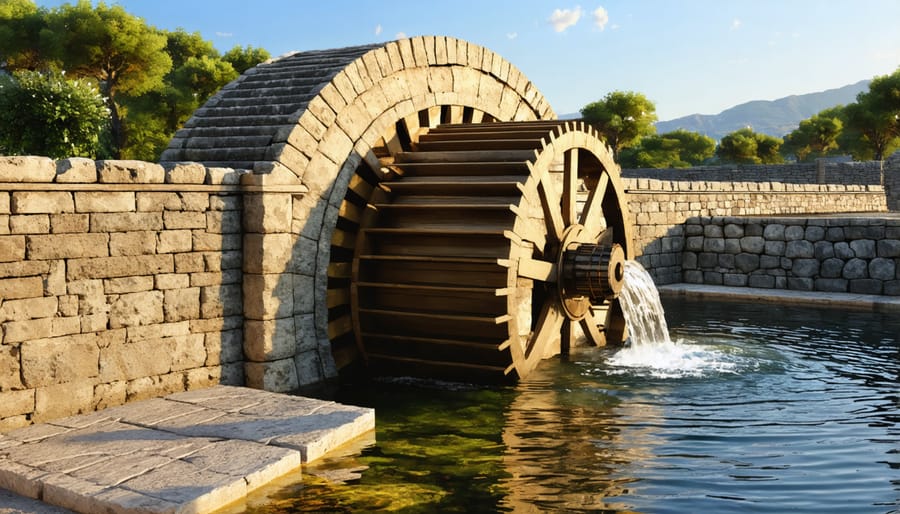
Water wheels stand as one of humanity’s earliest innovations in harnessing the power of moving water. Dating back to around 4000 BCE, these ingenious devices first appeared in ancient Mesopotamia and Egypt, where they revolutionized agricultural practices and grain processing.
The basic design consisted of a large wooden wheel with paddles or buckets attached to its rim. As river water flowed beneath, it turned the wheel, converting the water’s kinetic energy into mechanical power. This simple yet effective technology enabled ancient civilizations to lift water for irrigation systems, dramatically expanding their agricultural capabilities.
In addition to irrigation, water wheels became essential for grinding grain into flour. The wheel’s rotating motion powered large millstones, which could process grain far more efficiently than traditional hand-grinding methods. This advancement helped ancient societies produce food on a larger scale, supporting growing populations and urban development.
The technology spread from the Middle East to other parts of Asia, Europe, and North Africa. Different cultures adapted and improved upon the basic design, creating variations like the noria for water lifting and the horizontal water wheel for more efficient milling operations. These early applications of water power laid the groundwork for future hydroelectric developments.
Roman Engineering Innovations
The Romans revolutionized water wheel technology, transforming simple designs into sophisticated machines that powered their expanding empire. Their engineers developed the vertical water wheel, which proved far more efficient than horizontal designs used by earlier civilizations. This innovation allowed for greater power generation and opened new possibilities for industrial applications.
Roman water wheels were precisely engineered with metal-reinforced wooden paddles and advanced gearing systems. These improvements enabled the wheels to power everything from flour mills to mining operations, serving as the backbone of Roman industrial infrastructure. In regions like Barbegal in southern France, they constructed massive water wheel complexes capable of producing tons of flour daily, demonstrating early examples of large-scale renewable energy use.
The Romans also pioneered the use of aqueducts to deliver consistent water flow to their wheels, ensuring reliable power generation throughout the year. This systematic approach to water management and power generation laid the groundwork for future hydropower developments. Their engineering achievements demonstrated how renewable energy could be harnessed effectively for industrial applications, a principle that remains relevant in modern hydroelectric power generation.
Many of these Roman innovations in water wheel design and water management continued to influence engineering practices well into the medieval period and beyond.
The Industrial Revolution: Water Power’s Golden Age
Mill Towns and Manufacturing
The evolution of water power transformed American manufacturing, particularly during the Industrial Revolution energy transition. Mill towns emerged along rivers, where flowing water powered machinery for textile production, lumber processing, and grain milling. These communities became economic powerhouses, with places like Lowell, Massachusetts, leading the way in industrial innovation.
Water-powered factories revolutionized manufacturing processes by providing consistent, renewable energy that could operate multiple machines simultaneously. This advancement allowed for increased production capacity and efficiency, creating new employment opportunities and fostering technological innovation. The mills’ success demonstrated the potential of renewable energy sources in driving economic growth.
The impact of these early water-powered facilities extended beyond manufacturing. Mill towns developed into thriving communities with schools, housing, and commercial districts. They established a model for sustainable energy use that continues to influence modern hydroelectric development. These historical examples show how renewable energy sources can support both industrial progress and community development, offering valuable lessons for today’s transition to sustainable power solutions.
The legacy of these mill towns remains evident in many riverside communities, where former factory buildings have been repurposed while maintaining their historical significance. Their story demonstrates the longstanding relationship between water power and economic development, providing inspiration for modern renewable energy initiatives.
Technical Innovations
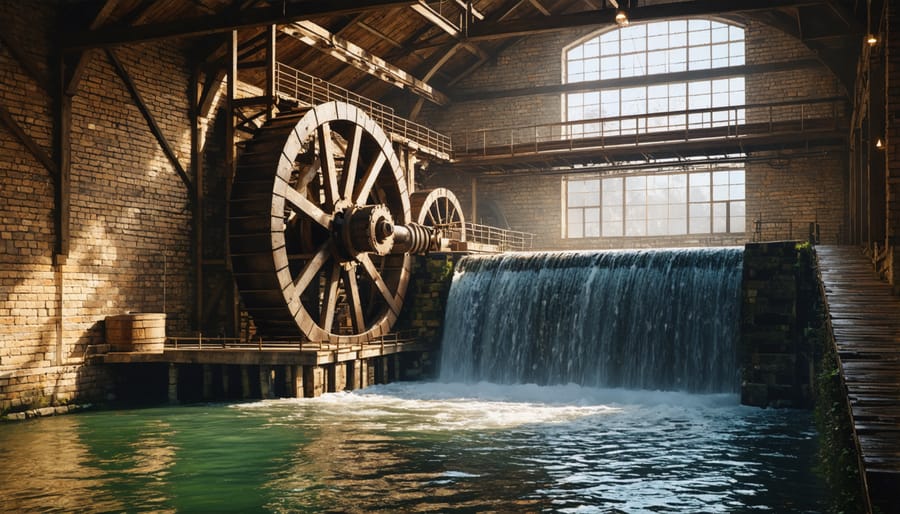
The evolution of hydroelectric technology began with simple wooden water wheels, which were among the most important early American power sources. These early wheels, while basic in design, laid the groundwork for more sophisticated power generation methods. By the early 1800s, engineers had developed more efficient metal water wheels featuring curved blades that could better harness water’s energy.
A significant breakthrough came with the invention of the Francis turbine in 1849 by James B. Francis. This inward-flow reaction turbine dramatically improved efficiency, achieving conversion rates of up to 90% of water’s energy into mechanical power. The Pelton wheel, invented by Lester Allan Pelton in 1880, brought another innovation by using curved buckets to capture the water’s impulse energy, making it ideal for high-head installations.
The Kaplan turbine, developed in 1913 by Viktor Kaplan, introduced adjustable propeller-like blades that could adapt to varying water flow conditions. This versatility made it particularly effective for low-head installations and varying water levels. These technological advances in turbine design, combined with improvements in generator technology, set the stage for modern hydroelectric power plants, demonstrating how early engineering innovations continue to influence today’s renewable energy solutions.
Birth of Modern Hydroelectric Power
First Hydroelectric Plants
The journey from experimental hydropower to functional hydroelectric plants marked a pivotal moment in energy history. In 1878, William Armstrong pioneered the first small-scale hydroelectric installation at Cragside in Northumberland, England, using water from a nearby lake to power a single arc lamp through a water wheel-driven dynamo.
The first commercial hydroelectric plant emerged in 1882 on the Fox River in Appleton, Wisconsin. The Appleton Edison Light Company powered a paper mill and several nearby buildings, producing about 12.5 kilowatts of power. This success sparked widespread interest in hydroelectric development across North America.
Niagara Falls became the site of a major breakthrough in 1895 when the Adams Power Plant began operation. This facility represented the first large-scale hydroelectric plant, initially generating 2,200 kilowatts of power for Buffalo, New York, located 25 miles away. The plant demonstrated the feasibility of transmitting electricity over long distances.
During this period, engineers and inventors refined turbine designs and electrical systems. The Pelton wheel, invented by Lester Allan Pelton in 1879, revolutionized hydroelectric generation by efficiently converting water pressure into mechanical energy. By 1889, more than 200 hydroelectric plants operated in the United States alone.
These early installations laid the groundwork for modern hydroelectric facilities and proved that water power could reliably generate electricity for industrial and residential use. Their success helped establish hydropower as a cornerstone of renewable energy development.
Niagara Falls: A Watershed Moment
The development of the Niagara Falls power station in 1895 marked a revolutionary turning point in the history of electricity generation. This pioneering facility demonstrated that hydroelectric power could be harnessed on a massive scale, transforming not just the surrounding region but the entire landscape of industrial power production.
Visionary engineers Nikola Tesla and George Westinghouse collaborated to design and build this groundbreaking station, which initially generated 5,000 horsepower of electricity. The facility utilized Tesla’s innovative alternating current (AC) system, proving that electricity could be transmitted efficiently over long distances – a capability that would fundamentally reshape modern society.
The success of the Niagara Falls station sparked rapid industrial growth throughout the Buffalo-Niagara region. Manufacturers, drawn by the promise of reliable and affordable electricity, established factories nearby. This industrial boom demonstrated the transformative potential of large-scale hydroelectric power generation.
By 1905, the expanded facility was producing more than 100,000 horsepower, making it the largest hydroelectric power plant in the world at that time. The station’s triumph validated renewable energy as a viable power source for industrial applications and urban development, setting the stage for future hydroelectric projects worldwide.
Today, the Niagara Power Project continues this legacy, generating enough clean electricity to power millions of homes and businesses, while serving as a testament to the enduring potential of renewable energy sources.
Modern Era: Large-Scale Hydroelectric Projects
Revolutionary Dam Projects
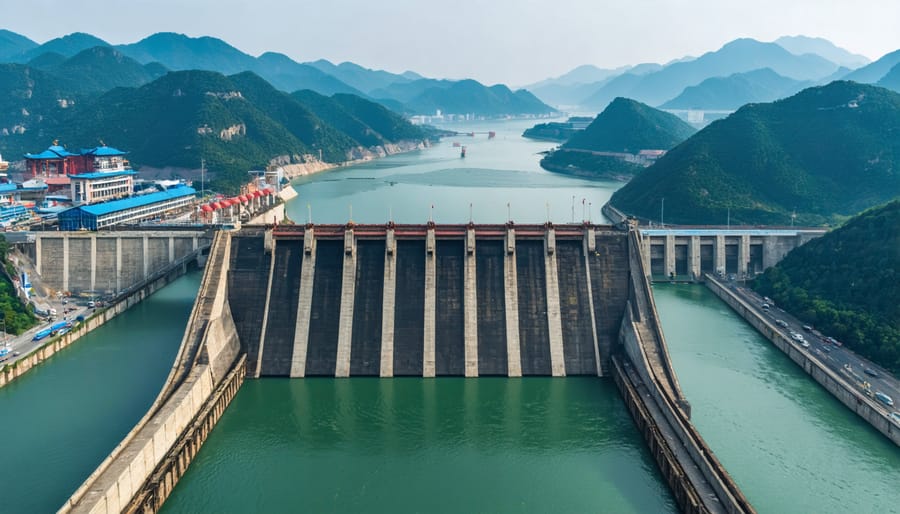
The early 20th century marked a revolutionary period in hydroelectric power development, with ambitious dam projects reshaping our modern energy infrastructure. The Hoover Dam, completed in 1936, stands as a testament to human engineering prowess. This massive structure on the Colorado River not only provided essential power to the growing southwestern United States but also demonstrated the potential of large-scale hydroelectric projects.
The Grand Coulee Dam in Washington state, finished in 1942, became another milestone achievement. As the largest hydroelectric facility in North America, it transformed the Columbia River Basin, providing irrigation for agriculture and power for aluminum production during World War II.
The Tennessee Valley Authority’s network of dams, developed during the Great Depression, revolutionized the southeastern United States. This integrated system of dams not only generated electricity but also controlled flooding and improved navigation, serving as a model for regional development worldwide.
Internationally, the Itaipu Dam between Brazil and Paraguay, completed in 1984, set new standards for hydroelectric generation. This engineering marvel produces enough electricity to power 40% of Brazil’s needs and nearly all of Paraguay’s electrical consumption, demonstrating how sustainable water power can support developing economies while minimizing environmental impact.
Environmental Considerations
While hydroelectric power stands as a significant renewable energy source, its environmental impact has been a subject of ongoing consideration throughout its history. The construction of large dams fundamentally alters river ecosystems, affecting both wildlife habitats and water flow patterns. Fish populations, particularly migratory species like salmon, face challenges navigating these artificial barriers, leading to the development of fish ladders and other passage solutions.
Water quality changes have also been observed in reservoir systems, where slower-moving water can affect temperature, oxygen levels, and sediment distribution. These alterations can impact both aquatic life and downstream communities. Additionally, the flooding of land to create reservoirs has historically displaced communities and submerged valuable agricultural areas and cultural sites.
However, the industry has evolved to address these concerns. Modern hydroelectric facilities incorporate environmental protection measures from the design phase. These include improved fish passage systems, water quality monitoring, and controlled water release schedules that better mimic natural river flows. Some facilities now operate as “run-of-river” systems, which minimize the need for large reservoirs and reduce environmental disruption.
The balance between clean energy generation and ecosystem preservation remains a critical consideration in hydroelectric development, driving innovations in sustainable facility design and operation practices.
As we look to the future, hydroelectric power continues to play a vital role in our renewable energy transition. While newer technologies like solar and wind power gain prominence, hydropower’s reliability and proven track record make it an indispensable part of our clean energy portfolio. Modern hydroelectric facilities are becoming increasingly efficient and environmentally conscious, with innovations focusing on minimizing ecological impact while maximizing power generation.
The lessons learned from hydropower’s rich history inform today’s sustainable energy developments. From the simple water wheels of ancient civilizations to the sophisticated pumped storage systems of the present, hydroelectric power demonstrates how renewable energy can successfully scale to meet industrial and residential demands. This legacy of innovation continues to inspire new approaches to clean energy generation.
For Illinois residents and businesses considering renewable energy options, hydropower’s journey offers valuable insights into the reliability and potential of sustainable energy sources. As we work toward a cleaner energy future, hydroelectric power stands as a testament to humanity’s ability to harness natural resources responsibly and effectively. The principles developed through centuries of hydropower evolution now guide the implementation of other renewable technologies, ensuring a more sustainable and energy-secure tomorrow.
