
How Illinois Shines Turns Your Solar Panels Into a Revenue Stream
Understand that Illinois Shines offers you two revenue streams from your solar investment: immediate electricity savings on your utility bills and additional income through Renewable Energy Credits (RECs). Every 1,000 kilowatt-hours your solar panels generate creates one REC that the state purchases upfront or over time, putting thousands of dollars directly into your pocket beyond what you save on electricity costs.
Calculate your potential REC payment by multiplying your system size by your expected annual production, then by the current REC price, which ranges from $70 to $82 per REC depending on your system size and payment structure. A typical 8-kilowatt residential system in Illinois generates roughly 9,600 kilowatt-hours annually, creating 9.6 RECs worth approximately $700 to $790 per year for 15 years.
Choose between receiving 100% of your REC value upfront as a lump sum or spreading payments over 15 years for a 120% total return. The upfront option reduces your solar payback period to as little as 5-7 years, while the 15-year option maximizes total returns but extends your full ROI timeline.
Verify your system qualifies by ensuring your installer is Illinois Shines-approved and your project meets program requirements before breaking ground. As locally owned solar experts, we navigate the application process for you, ensuring you capture every dollar available while avoiding the costly mistakes that delay or reduce your REC payments.
What Is the Illinois Shines Program?
Illinois Shines is the state’s official solar incentive program designed to make renewable energy more accessible and financially attractive for homeowners, businesses, and community organizations. Launched under the Future Energy Jobs Act in 2017 and significantly expanded through the Climate and Equitable Jobs Act in 2021, the program represents Illinois’ commitment to achieving 40% renewable energy by 2030.
The program is administered by the Illinois Power Agency and Elevate Energy, working in partnership with utility companies like ComEd and Ameren Illinois. Through Illinois Shines, solar system owners receive financial incentives by generating Renewable Energy Credits, which represent the environmental benefits of producing clean solar energy. Each time your solar panels produce 1,000 kilowatt-hours of electricity, you earn one REC that can be monetized through the program.
What makes Illinois Shines distinct from federal incentives is how the benefits work together rather than compete. While the federal Investment Tax Credit provides an upfront tax deduction of 30% on your solar installation costs, Illinois Shines offers ongoing payments for the RECs your system generates over a 15-year period. These are separate, stackable benefits that significantly improve the overall economics of going solar.
The program operates on a block structure with predetermined pricing that adjusts as capacity fills up within each block. This means the sooner you participate, the better your chances of locking in higher REC prices. Illinois Shines also includes specific carve-outs and enhanced incentives for projects that serve low-income communities, public schools, and environmental justice areas, reflecting the state’s commitment to equitable clean energy access.
Understanding how Illinois Shines integrates with federal tax benefits is essential for accurately calculating your solar investment returns and determining realistic payback periods for your system.
Understanding RECs: The Hidden Value in Your Solar System
How RECs Are Generated
The foundation of REC monetization begins with solar energy production itself. For every megawatt-hour (MWh) of electricity your solar system generates—equivalent to 1,000 kilowatt-hours—you earn one Renewable Energy Credit. This simple ratio makes tracking straightforward: if your commercial facility produces 500 MWh annually, you generate 500 RECs.
The tracking process happens automatically through approved meters installed with your solar system. These meters measure your production in real-time and report data to PJM-EIS GATS, the Generation Attribute Tracking System that manages REC certification in Illinois. This independent platform ensures accuracy and prevents double-counting, maintaining the integrity of the renewable energy market.
Once your production data reaches GATS, the system creates certified RECs in your account. Each REC receives a unique serial number and timestamp, establishing a verifiable chain of custody. This certification process typically occurs monthly, allowing you to see your accumulating REC balance as your system produces clean energy throughout the year.
Through the Illinois Shines program, approved vendors handle the technical aspects of REC registration and tracking, simplifying the process for system owners while ensuring compliance with state requirements.
Why Illinois RECs Are Worth More
Illinois stands out as one of the most attractive markets for solar Renewable Energy Credits in the United States, and there’s a clear reason why. Illinois’s renewable energy mandates require utilities to procure a significant percentage of their electricity from renewable sources, with specific carve-outs for solar energy. These requirements create strong, sustained demand for RECs.
Unlike states with voluntary renewable programs or weaker mandates, Illinois has legally binding renewable portfolio standards that utilities must meet. This creates what economists call inelastic demand—utilities need these RECs regardless of price fluctuations, which keeps values higher. The Illinois Shines program further stabilizes this market by offering long-term contracts, typically 15 years, that lock in REC prices.
Additionally, Illinois RECs cannot be substituted with credits from other states. This geographic restriction means your locally generated solar energy has guaranteed value within the state market. For property owners, this translates to predictable, reliable income that significantly improves the return on investment for solar installations compared to states with less robust renewable energy policies.
The Economics of Illinois Shines REC Monetization
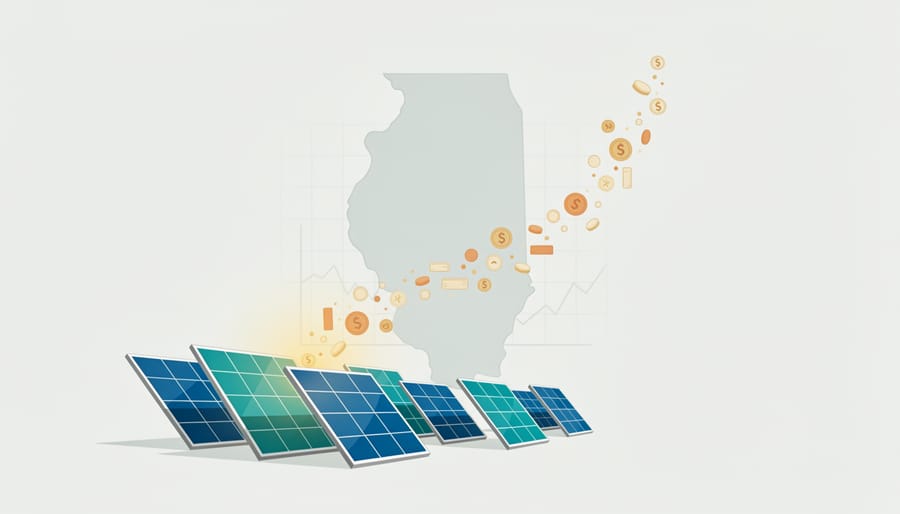
Current REC Pricing and Payment Structures
Illinois Shines offers two primary payment structures for RECs, allowing participants to choose the option that best fits their financial goals. The upfront payment option provides approximately 90 percent of the total REC value in a single lump sum shortly after your solar system becomes operational. This approach delivers immediate returns and can help offset installation costs quickly. Alternatively, the ongoing payment structure distributes payments over 15 years through annual installments, providing steady, predictable income throughout the contract period.
REC pricing is determined through Illinois Shines’ blocks system, which operates on a declining price structure. Each block represents a certain amount of solar capacity, and as blocks fill up, pricing adjusts downward for subsequent blocks. This means earlier participants typically receive higher rates per REC. Current pricing varies based on system size, project type, and which block is currently open. For residential systems, rates generally range from approximately $70 to $90 per REC, though these figures change as the program progresses through blocks.
System size directly impacts your REC revenue. A typical residential system producing 10 to 12 RECs annually could generate between $700 and $1,080 per year under ongoing payments, or receive a substantial upfront payment of several thousand dollars. Commercial and industrial systems, which produce more RECs, see proportionally higher returns. Understanding current block availability and pricing is essential for maximizing your solar investment’s financial benefits, which is where working with local experts familiar with Illinois Shines regulations becomes invaluable.
Calculating Your Potential REC Revenue
Understanding how much revenue your solar system can generate through RECs helps you make an informed investment decision. Let’s walk through realistic examples for both residential and commercial installations.
For a typical residential system, consider a 10-kilowatt (kW) installation in central Illinois. This size system generally produces approximately 12,000 kilowatt-hours (kWh) annually. Under the Illinois Shines Adjustable Block Program, residential systems in the current blocks receive approximately $78 per REC. Since one REC equals 1,000 kWh, your 10 kW system would generate 12 RECs per year.
Over the 15-year Illinois Shines contract period, your revenue calculation looks like this: 12 RECs annually multiplied by $78 per REC equals $936 per year, totaling approximately $14,040 over the full contract term. This represents a significant portion of your system’s initial cost and substantially improves your overall return on investment.
Commercial systems see proportionally larger returns. A 100 kW commercial installation producing roughly 120,000 kWh annually would generate 120 RECs per year. At current commercial block pricing of approximately $72 per REC, this translates to $8,640 annually or nearly $130,000 over the 15-year contract period.
Keep in mind that REC prices adjust slightly as blocks fill, and production varies based on your specific location, roof orientation, and shading conditions. As locally owned solar experts familiar with Illinois conditions, we provide customized production estimates and financial projections tailored to your property’s unique characteristics, ensuring you have accurate expectations for your solar investment’s performance.
How Illinois Shines REC Payments Work
The Application and Approval Process
Enrolling your solar system in Illinois Shines begins with selecting an approved vendor who understands the program requirements and local market conditions. These vendors must meet specific qualifications established by the Illinois Power Agency, including proper licensing, insurance coverage, and demonstrated experience with solar installations. Working with a locally owned solar company that has established relationships with the program can streamline this process significantly.
The application process involves submitting detailed system information, including equipment specifications, site details, and projected energy production. Your installer will typically handle most paperwork on your behalf, ensuring all technical requirements are met. Once submitted, applications undergo review by program administrators who verify system eligibility and calculate your projected REC value based on current Adjustable Block pricing.
Timeline expectations vary depending on application volume and block availability. Initial approval can take several weeks, though experienced vendors often expedite this through their familiarity with requirements. After approval, your system must pass final inspection before REC generation begins. The entire process from application to first REC payment typically spans three to six months. Understanding these timelines helps you set realistic expectations for when monetization of your solar investment will commence, making it easier to plan your project finances accordingly.
REC Generation and Payment Timeline
Understanding when and how you’ll receive payment for your RECs is essential to evaluating the financial benefits of going solar through Illinois Shines. The program offers different payment structures depending on your system size and the specific block you enter.
For residential and small commercial systems under 25 kilowatts, the program typically provides upfront payments for a portion of your REC value. This means you receive a significant lump sum shortly after your system is approved and interconnected, usually within 30 to 90 days. The upfront payment covers multiple years’ worth of REC production, providing immediate offset against your installation costs.
For larger commercial and industrial systems, the payment structure often involves annual disbursements spread across the 15-year contract period. Under this arrangement, you’ll receive annual payments based on your system’s actual energy production from the previous year. The Illinois Power Agency verifies your system’s generation through meter readings and calculates payments accordingly.
The exact payment timeline depends on several factors, including your utility territory, system size, and which program block you qualify for. Community solar projects typically follow a different schedule, with quarterly or annual payments distributed to subscribers.
It’s important to note that processing times can vary based on program volume and administrative capacity. Working with experienced local solar installers who understand Illinois Shines procedures can help ensure smooth navigation of the payment process and timely receipt of your REC revenue.
Residential vs. Commercial REC Monetization
The Illinois Shines program structures REC monetization differently for residential and commercial properties, reflecting the varying scales and economics of each sector. Understanding these distinctions helps property owners make informed decisions about their solar investments.
Residential homeowners typically participate in smaller system categories, with most installations falling under 10 kilowatts. The program compensates residential participants through the Adjustable Block Program, where REC prices vary by block and category. As of recent program years, residential systems have received compensation ranging from approximately $70 to $80 per REC, though these rates fluctuate based on block availability and program demand. Homeowners receive payments upfront as a single lump sum or through performance-based payments over several years, depending on their chosen payment structure.
Commercial and industrial property owners, however, engage with different program categories that reflect their larger system sizes. Commercial installations typically range from 10 kilowatts to several megawatts, qualifying for categories with distinct REC pricing structures. Larger commercial systems generally receive lower per-REC compensation compared to residential installations, but the total revenue potential increases substantially due to greater energy production volumes. For example, while a commercial system might receive $65 per REC compared to a residential system’s $75, the commercial installation could generate ten times more RECs annually.
The program also differentiates between small and large commercial projects. Small commercial systems under 100 kilowatts often receive preferential pricing compared to utility-scale installations. Additionally, commercial participants must navigate more complex application requirements, including additional documentation and potentially longer approval timelines.
Another key difference involves project financing. Commercial entities can leverage various tax incentives alongside REC revenue, creating more sophisticated financial models. They also face different interconnection requirements and utility coordination processes compared to residential customers.
Working with locally owned solar experts familiar with Illinois Shines can help both residential and commercial property owners identify the most advantageous program pathway, optimize system sizing for maximum REC revenue, and navigate the application process efficiently for their specific property type.
Maximizing Your Illinois Shines Benefits
Stacking Incentives: RECs Plus Federal Tax Credits
One of the most compelling aspects of Illinois Shines is that REC payments can be combined with the federal Investment Tax Credit (ITC), currently set at 30% of your total system cost through 2032. This stacking of incentives significantly improves your return on investment.
Here’s how it works: The federal ITC provides an immediate reduction in your tax liability equal to 30% of your installation costs. Meanwhile, Illinois Shines delivers ongoing REC payments over 15 years based on your system’s production. These two benefits operate independently, meaning you receive the full value of both programs.
For example, on a $30,000 residential system, you’d receive a $9,000 federal tax credit in year one, plus approximately $12,000 to $15,000 in REC payments over 15 years. Combined with energy savings, these stacked incentives often result in payback periods of 6 to 8 years for Illinois homeowners.
As a locally owned solar company with deep expertise in Illinois incentives, we help property owners navigate both programs to maximize their financial returns while supporting clean energy development in our state.
Working with an Approved Vendor
Choosing an Illinois Shines-approved vendor ensures you’re working with a company that meets state-mandated standards for quality, reliability, and program compliance. Approved vendors understand the intricate application process, documentation requirements, and timeline expectations specific to the Illinois Shines program. They handle the technical submissions and coordinate with program administrators on your behalf, reducing delays and potential errors that could affect your REC payments.
Locally owned solar experts bring additional advantages to your project. They possess firsthand knowledge of Illinois-specific regulations, regional utility requirements, and local permitting processes. Their proximity means better customer service, faster response times, and ongoing support throughout your system’s lifetime. Local companies also understand which solar financing options work best for Illinois residents and can guide you through combining Illinois Shines incentives with federal tax credits and other available programs to maximize your return on investment.
Real-World ROI: What to Expect from Your Solar Investment
Understanding the real-world return on your solar investment in Illinois requires looking beyond just the upfront costs. When you combine traditional electricity savings with REC revenue from the Illinois Shines program, most residential solar systems achieve payback periods between 6 to 10 years. Commercial and industrial installations often see even faster returns due to higher energy consumption and larger system sizes.
Here’s what typical Illinois property owners can expect: A residential system costing $20,000 after federal tax credits might generate $1,500 annually in electricity savings plus $3,000 in REC payments during the initial contract period. This combined annual benefit of $4,500 translates to a payback period of approximately 4.5 years, though actual results vary based on system size, energy usage, and specific program incentive levels.
The financial benefits extend well beyond the REC contract period. Solar panels typically come with 25-year performance warranties, meaning your system continues generating electricity savings long after REC payments conclude. Over a 25-year period, Illinois homeowners commonly realize total returns of $40,000 to $70,000 when accounting for both REC revenue and avoided electricity costs. Business owners often see six-figure returns over the same timeframe.
Property value appreciation adds another dimension to your investment. Studies consistently show that homes with solar installations sell for premium prices, with buyers willing to pay more for properties with lower operating costs. Additionally, Illinois solar systems hedge against future electricity rate increases, which have historically averaged 2-3% annually.
For a comprehensive ROI analysis specific to your property, working with a locally owned Illinois solar provider ensures you receive accurate projections based on your actual energy consumption, available roof space, and current program incentive rates. Our expertise in solar energy allows us to model realistic financial scenarios that account for all revenue streams and long-term benefits.
The Illinois Shines program fundamentally changes the economics of going solar. By monetizing your Renewable Energy Credits, you’re not just making an environmentally responsible choice—you’re making a smart financial investment that delivers tangible returns for years to come. The combination of REC payments, federal tax incentives, and long-term electricity savings creates a compelling value proposition that puts money back in your pocket while reducing your carbon footprint.
Understanding the financial mechanics of REC monetization is essential to maximizing your solar investment. From the application process through the Illinois Solar for All or Adjustable Block Program to receiving your quarterly payments, the system is designed to reward early adopters and make solar accessible to more Illinois property owners. Whether you’re a homeowner looking to reduce monthly expenses or a business owner seeking predictable energy costs and additional revenue streams, the economics speak for themselves.
The numbers we’ve explored demonstrate that solar energy in Illinois isn’t just about sustainability—it’s about sound financial planning. With payback periods often ranging from seven to twelve years and systems lasting twenty-five years or more, your solar investment continues generating value long after it pays for itself.
Ready to discover your specific REC revenue potential? Connect with a locally owned Illinois solar expert who understands the nuances of the Illinois Shines program and can provide a customized financial analysis based on your property, energy usage, and goals. Your path to solar savings starts with a conversation.
