

How Corporate PPAs Are Changing Illinois’s Energy Landscape (And What It Means for Your Business)
Power Purchase Agreements (PPAs) represent one of the most financially strategic paths for Illinois businesses to transition to renewable energy without upfront capital investment. Under this model, a solar developer installs, owns, and maintains a solar energy system on your property or at an off-site location, while you agree to purchase the electricity generated at a predetermined rate—typically lower than your current utility costs—for a contract term of 15 to 25 years.
This arrangement immediately reduces your energy expenses while transferring all installation costs, maintenance responsibilities, and performance risks to the solar provider. Your organization gains predictable energy pricing that shields you from volatile utility rate increases, which have historically averaged 2-3% annually in Illinois. The solar developer benefits from federal tax incentives and accelerates depreciation benefits that you, as the electricity purchaser, cannot claim directly but still benefit from through reduced per-kilowatt-hour pricing.
Illinois businesses particularly benefit from PPAs due to the state’s Adjustable Block Program and robust Renewable Energy Credit (REC) market, which provide additional revenue streams that solar developers factor into competitive pricing structures. Manufacturing facilities, warehouses, commercial properties, and municipal buildings with stable, long-term operations find PPAs especially advantageous because the extended contract terms align with operational timelines while avoiding the balance sheet impact of asset ownership.
The fundamental question isn’t whether PPAs offer value—the proven economics speak clearly—but rather whether this specific financing structure aligns with your organization’s financial strategy, facility ownership timeline, and energy consumption patterns. Understanding these alignment factors determines whether a PPA, direct purchase, or alternative solar financing model best serves your transition to renewable energy while maximizing both environmental impact and financial returns.
What Is a Corporate PPA and Why Should Illinois Businesses Care?
The Basics: How a PPA Works in Plain English
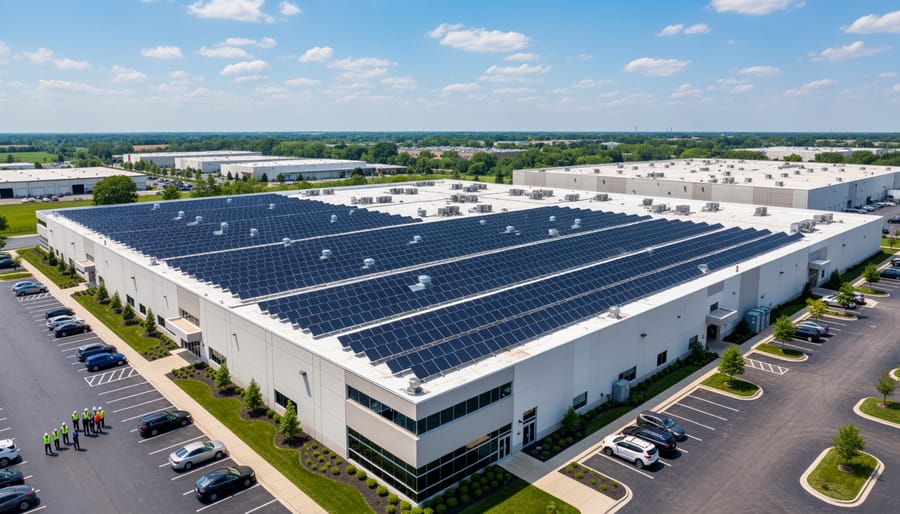
A Power Purchase Agreement (PPA) is one of several renewable energy financing options that allows businesses and organizations to access solar energy without the upfront costs of purchasing and installing a system.
Here’s how it works: A third-party developer finances, installs, owns, and maintains a solar energy system on your property or at a remote location. Your organization then agrees to purchase the electricity generated by that system at a predetermined rate for a set period, typically 15 to 25 years.
Think of it like leasing instead of buying. The energy producer handles all the technical aspects—equipment, installation, maintenance, repairs, and monitoring. You simply pay for the clean energy you consume, usually at a rate lower than what you’d pay your traditional utility company.
The relationship creates benefits for everyone involved. The energy producer secures a long-term customer and steady revenue stream, making the project financially viable. Your organization gains predictable energy costs, potential savings on electricity bills, and the environmental benefits of solar power without capital expenditure or operational responsibilities.
For Illinois businesses, this arrangement is particularly attractive because it eliminates technical barriers to going solar. You don’t need expertise in renewable energy systems or staff to manage them. The producer assumes performance risk, ensuring the system operates efficiently throughout the contract term. Meanwhile, you advance your sustainability goals while potentially reducing operating costs.
Physical vs. Virtual PPAs: Which Makes Sense for Your Business?
When exploring PPA investments, businesses encounter two primary structures: physical PPAs and virtual PPAs. Understanding the distinction helps you choose the right approach for your organization.
Physical PPAs involve a direct connection between a renewable energy facility and your business location. The electricity generated flows directly to your operations through the existing power grid. This option works best for businesses with substantial on-site energy needs and the ability to accommodate the energy delivery logistics. In Illinois, physical PPAs make particular sense for manufacturers, distribution centers, and large commercial facilities with consistent daytime power consumption that aligns with solar generation patterns.
Virtual PPAs, also called financial PPAs, don’t involve physical electricity delivery. Instead, they’re financial contracts where you agree to purchase renewable energy credits and receive payments based on the difference between the market electricity price and the agreed contract price. This structure offers greater flexibility since the renewable facility doesn’t need to be near your location. Virtual PPAs suit multi-location businesses, organizations without suitable on-site space, or companies prioritizing renewable energy goals over direct consumption.
Illinois businesses benefit from both options, though virtual PPAs have gained popularity due to their flexibility and the state’s competitive renewable energy market conditions.

Corporate PPA Investment Strategies: Three Approaches That Work
Single-Source Strategy: Committing to One Large Solar Project
For corporations with substantial energy consumption, a single-source strategy involves partnering with one large solar project through a PPA. This approach streamlines administration and simplifies the renewable energy transition by consolidating all your clean energy needs under one agreement.
This strategy works particularly well for larger businesses, industrial facilities, or multi-location operations throughout Illinois that consume significant electricity annually. By committing to a single, large-scale solar installation, companies often secure more favorable pricing per kilowatt-hour due to economies of scale. The administrative burden remains minimal since you’re managing one relationship, one contract, and one billing process rather than juggling multiple agreements.
Key considerations include ensuring your energy consumption patterns align with the project’s capacity. You’ll want to verify that the solar facility can meet your demand throughout the year, accounting for Illinois seasonal variations. Additionally, assess the project’s location relative to your operations, as proximity can affect transmission costs and energy reliability.
Financial stability matters significantly with this approach. Since you’re making a long-term commitment to a single project, thorough due diligence on the developer’s track record and the installation’s technical specifications becomes essential. Working with experienced, locally owned solar providers who understand Illinois energy markets helps ensure your investment delivers consistent value throughout the contract term.
Portfolio Approach: Spreading Risk Across Multiple Projects
For mid-sized businesses exploring solar PPAs, a portfolio approach offers significant advantages over committing to a single large-scale project. By spreading investments across multiple smaller power purchase agreements, companies can better manage exposure while maintaining flexibility in their renewable energy strategy.
This diversification strategy allows businesses to test different project sizes, locations, and technologies without overcommitting resources upfront. For example, an Illinois manufacturer might enter three 100-kilowatt PPAs across different facilities rather than one 300-kilowatt agreement. This approach provides natural risk mitigation—if one project encounters performance issues or changing business needs at a specific location, the other agreements continue generating value.
The portfolio method also offers practical flexibility for growing businesses. Companies can add new PPAs as they expand, adjust energy procurement as operational needs evolve, and benefit from learning experiences across multiple projects. This is particularly valuable when managing investment risk in renewable energy.
Additionally, smaller individual commitments often mean simpler negotiations and faster project implementation. Mid-sized Illinois businesses can start with modest agreements, gain confidence in the PPA model, and scale their renewable energy portfolio strategically over time while maintaining operational control and financial predictability.
Aggregated PPAs: Joining Forces with Other Businesses
For many smaller businesses and organizations, the idea of entering into an individual Power Purchase Agreement may seem out of reach due to limited energy needs or budget constraints. Aggregated PPAs offer a practical solution by allowing multiple businesses to pool their resources and collectively purchase renewable energy. This collaborative approach makes the financial and environmental benefits of solar energy accessible to companies that might not qualify for standalone agreements.
In an aggregated PPA, several organizations join together to meet the minimum capacity requirements that solar developers typically need to make projects financially viable. Each participating business commits to purchasing a portion of the energy generated, proportional to their needs and budget. This pooling strategy distributes the administrative costs and reduces individual financial risk while still providing the long-term price stability and sustainability benefits that larger corporations enjoy through traditional PPAs.
Illinois businesses particularly benefit from this model because aggregated agreements can leverage state renewable energy incentives and credits across multiple participants. Organizations can maintain their competitive edge by securing predictable energy costs while demonstrating environmental responsibility to customers and stakeholders.
Working with a locally owned solar partner experienced in structuring aggregated agreements is essential for success. The right partner will handle the complex coordination between multiple businesses, ensure equitable energy allocation, and navigate the technical requirements specific to Illinois regulations. This expertise transforms what could be an overwhelming process into a straightforward path toward renewable energy adoption, making sustainability achievable for businesses of all sizes.
The Illinois Advantage: Why PPAs Make Sense in Our State
Illinois Solar Incentives and the Climate and Equitable Jobs Act
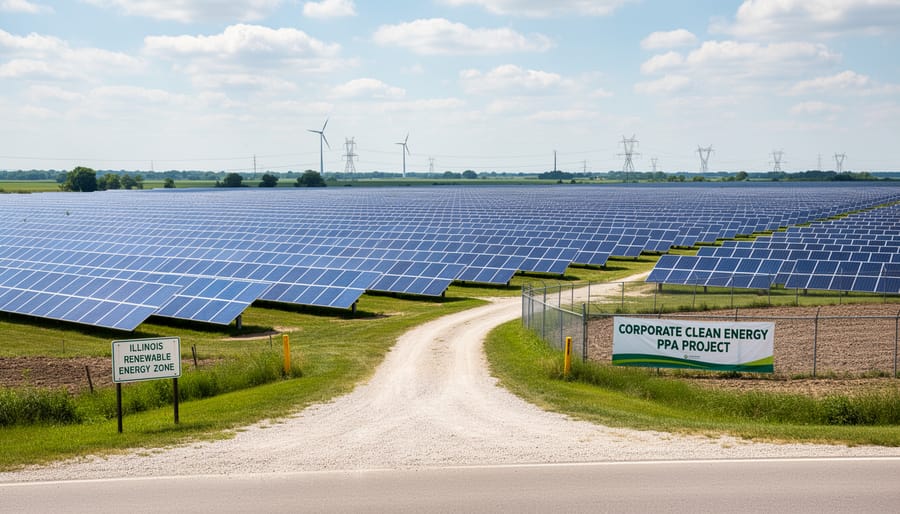
Illinois has emerged as a national leader in renewable energy support, making PPA investments particularly attractive for businesses operating in the state. The Climate and Equitable Jobs Act (CEJA), signed into law in 2021, represents one of the most comprehensive clean energy initiatives in the United States and directly impacts the economics of solar PPAs.
CEJA establishes ambitious renewable energy goals, requiring Illinois to achieve 50% renewable energy by 2040 and 100% carbon-free energy by 2050. To support these targets, the legislation significantly expands the Illinois Shines program, which provides substantial financial incentives for solar installations through Renewable Energy Credits (RECs). These credits generate additional revenue streams that PPA providers can pass along to business customers through lower electricity rates.
The legislation also prioritizes projects that benefit disadvantaged communities and create local jobs, making Illinois-based solar providers particularly valuable partners. For businesses entering into PPAs, these state-level incentives complement federal benefits like the Investment Tax Credit. When combined with Illinois solar tax credits and RECs, the overall financial package significantly improves PPA terms.
CEJA’s workforce development provisions ensure a steady pipeline of qualified solar professionals, which helps maintain competitive pricing and reliable installation timelines. The legislation’s long-term commitment to renewable energy also provides certainty for the 20-25 year duration of typical PPAs, protecting businesses from policy uncertainty that could affect project economics in other states.
Supporting Local: The Economic Impact of Illinois-Based Solar Projects
When your business enters a solar Power Purchase Agreement with an Illinois-based developer, you’re doing more than reducing energy costs and carbon emissions. You’re making a tangible investment in your local community’s economic vitality.
Illinois-developed solar projects create substantial employment opportunities throughout the project lifecycle. From initial site assessment and engineering to construction, installation, and ongoing maintenance, these projects require skilled workers. Local solar companies employ engineers, electricians, project managers, and technicians—many of whom live in the communities where projects are built. This means your PPA investment helps sustain good-paying jobs for Illinois residents.
The economic ripple effect extends beyond direct employment. Solar projects require services from local businesses including legal firms, financial institutions, equipment suppliers, and construction companies. These partnerships strengthen the broader business ecosystem across the state. Additionally, solar installations contribute to local tax revenues, supporting schools, infrastructure, and public services in Illinois communities.
For community-minded businesses, choosing a locally owned solar developer through a PPA demonstrates a commitment to regional economic development. This resonates with customers and employees who value corporate responsibility. You’re not just purchasing clean energy from a distant provider—you’re partnering with Illinois experts who understand local regulations, incentive programs, and the specific needs of businesses operating in the state.
This local approach ensures your clean energy goals align with community prosperity, creating a win-win scenario for your business and Illinois.

Is Your Business Ready for a PPA? Key Considerations Before You Commit
Understanding Your Energy Profile and Consumption Patterns
Before committing to a PPA investment, you need a clear picture of your organization’s energy consumption. Start by reviewing at least 12 months of utility bills to identify your average monthly usage, peak demand periods, and seasonal fluctuations. This baseline data reveals patterns that determine whether a PPA structure aligns with your operational needs.
Illinois businesses with consistent daytime energy demands typically benefit most from solar PPAs, as production naturally aligns with consumption. Manufacturing facilities, office buildings, and retail operations often find this match ideal. Calculate your average cost per kilowatt-hour, including demand charges and delivery fees, to establish your current energy expense benchmark.
Consider your facility’s growth trajectory over the next 15-20 years, as most PPAs span this timeframe. Are you planning expansions that would increase energy needs? Will operational changes affect consumption patterns? Understanding these factors helps ensure the PPA’s capacity matches your long-term requirements.
If your annual energy costs exceed $50,000, a PPA investment often makes strong financial sense. Our team specializes in analyzing Illinois businesses’ unique consumption profiles to determine optimal solar solutions that deliver measurable savings from day one.
Contract Terms Decoded: What to Look for in a PPA Agreement
Before signing a PPA agreement, it’s essential to understand the key terms that will govern your solar investment for years to come. A typical PPA contract length ranges from 15 to 25 years, so carefully consider what time frame aligns with your business’s long-term plans and facility usage. While longer contracts may offer better rates, they also require more commitment.
The pricing structure is perhaps the most critical element. Most PPAs feature a fixed price per kilowatt-hour (kWh) or include an escalator clause where rates increase annually by a predetermined percentage, typically between 1-3%. Compare these rates against your current utility costs and projected increases to ensure genuine savings over time. Some agreements also include production guarantees, specifying minimum energy output the system must deliver.
Pay close attention to termination conditions and what happens if your business relocates or your energy needs change significantly. Understand who maintains ownership of the system, who handles maintenance responsibilities, and what occurs at the contract’s end. Many agreements offer options to purchase the system, extend the contract, or have the equipment removed.
Insurance requirements, performance monitoring rights, and what happens during system underperformance are also important considerations. Working with a locally owned solar provider with expertise in Illinois’s energy landscape can help you negotiate favorable terms that protect your interests while maximizing your renewable energy benefits.
The Financial Analysis: Calculating Your ROI on a PPA Investment
Evaluating your return on investment starts with comparing your PPA rate against current utility rates. Request your PPA provider’s projected rate schedule and place it alongside your current electricity costs per kilowatt-hour. Calculate the difference and multiply by your estimated annual energy consumption to determine year-one savings.
For long-term projections, factor in Illinois utility rate increases, which historically average 2-3% annually, while your PPA rate typically remains fixed or escalates at a predetermined lower rate. This creates a widening savings gap over the contract’s 15-25 year term. Calculate cumulative savings by adding each year’s differential.
Consider additional financial benefits beyond direct savings. Solar PPAs often provide budget predictability, protection against rate volatility, and potential tax advantages depending on your business structure. Compare these benefits against alternative financing mechanisms to ensure you’re selecting the most advantageous approach.
A locally owned Illinois solar provider can help you model various scenarios based on your specific energy usage patterns and local utility rates, ensuring accurate projections for your investment decision.
Working with a Local Partner: What Illinois Renewables Brings to Your PPA Strategy
Navigating the complexities of a Power Purchase Agreement requires more than just understanding the financial model. It demands a partner who knows the local regulatory landscape, understands Illinois-specific incentives, and can manage every aspect of project delivery. This is where working with a locally-owned renewable energy company like Illinois Renewables makes a significant difference in your PPA strategy.
As a locally-owned business based in Illinois, we bring an intimate understanding of state and municipal regulations that can impact your solar project timeline and economics. Our team has established relationships with local utilities, permitting offices, and regulatory bodies throughout the state, which translates to smoother approvals and faster project completion. When you work with a local partner, you’re not just another file in a national company’s portfolio. You’re a neighbor, and your project success directly reflects on our reputation in the community we call home.
Illinois Renewables offers comprehensive service from initial site assessment through final utility interconnection. We handle the entire project development process, including engineering design, permitting, installation, and ongoing system monitoring. This end-to-end approach eliminates the coordination challenges that arise when working with multiple vendors, reducing delays and miscommunication that can derail PPA timelines.
Our expertise in Illinois solar incentives, including understanding how state renewable energy credits and local utility programs interact with PPA structures, ensures your agreement is optimized for maximum value. We stay current on changing regulations and can advise how policy shifts might affect your long-term energy strategy.
Additionally, our local presence means responsive service when you need it. Questions about system performance, billing reconciliation, or maintenance scheduling are answered by people familiar with your facility and invested in your satisfaction. This accessibility and accountability set local partners apart from distant corporations and create a foundation for successful, long-term PPA relationships that deliver consistent value throughout the agreement term.
Corporate power purchase agreements represent a strategic opportunity for Illinois businesses to stabilize energy costs, advance sustainability goals, and demonstrate environmental leadership. As energy markets continue to evolve and stakeholder expectations around climate action intensify, PPAs offer a proven pathway to secure renewable energy at competitive rates while supporting the growth of local clean energy infrastructure.
Whether you’re motivated by cost predictability, corporate responsibility commitments, or both, evaluating a PPA requires careful consideration of your organization’s energy consumption patterns, financial objectives, and long-term business strategy. The unique advantages Illinois offers—including favorable renewable energy policies, diverse solar and wind resources, and growing infrastructure—make this an opportune time to explore how a PPA might align with your goals.
Illinois Renewables brings locally owned expertise in solar energy to help businesses navigate the complexities of renewable energy procurement. Our team understands the specific regulatory landscape and market conditions in Illinois, ensuring you receive tailored guidance throughout the evaluation and implementation process. Ready to explore whether a corporate PPA makes sense for your organization? Contact Illinois Renewables today for a consultation to discuss your energy needs and discover how renewable energy investments can deliver both financial and environmental returns for your business.
