

Why Emerging Markets Are Making Renewable Energy Their Smartest Investment Yet
Examine the global evidence first: renewable energy investments in developing nations are generating returns of 8-15% annually while simultaneously reducing energy costs by up to 40% for businesses and households. Countries like India, Brazil, and Kenya demonstrate that solar and wind installations pay for themselves within 5-7 years, even in less-established markets. These emerging market transformations prove renewable technology works financially in challenging conditions—making the case even stronger for stable, incentive-rich environments like Illinois.
Calculate your specific return potential by requesting a detailed site assessment that factors in your current energy consumption, available tax credits (including the federal 30% Investment Tax Credit), and Illinois-specific incentives like Solar Renewable Energy Credits. Local solar installations typically achieve payback periods of 6-10 years, followed by decades of reduced or eliminated electricity bills. For Illinois business owners, commercial solar projects qualify for accelerated depreciation, reducing taxable income while building long-term energy assets.
Compare financing options strategically: cash purchases maximize lifetime savings, solar loans eliminate upfront costs while maintaining tax benefits, and Power Purchase Agreements let you access clean energy with zero capital investment. Each approach offers distinct financial advantages depending on your cash flow, tax situation, and investment timeline. The renewable energy market has matured significantly, with proven technology, established contractors, and comprehensive warranties that protect your investment for 25 years or more.
The Economic Case for Renewable Energy in Emerging Markets

Decreasing Technology Costs and Increased Accessibility
One of the most compelling reasons renewable energy has become an attractive investment is the dramatic reduction in technology costs. Over the past decade, solar panel prices have dropped by more than 80%, transforming what was once considered a premium technology into an economically viable solution for everyday homeowners and businesses. This price decline, driven by manufacturing improvements and increased global production, has made solar energy accessible to a much broader market.
The cost of battery storage systems has similarly decreased, addressing one of the primary concerns about renewable energy: intermittency. Modern battery technology allows property owners to store excess energy generated during peak sunlight hours for use during evenings or cloudy days, maximizing the return on their solar investment.
In Illinois, these technological advances translate into practical benefits for local investors. The combination of lower equipment costs and favorable state incentives means the payback period for solar installations has shortened considerably. What might have taken 15-20 years to recoup just a decade ago can now be achieved in 7-10 years or less, depending on your specific situation and energy usage.
Installation costs have also become more competitive as the solar industry has matured. Locally owned companies bring expertise in navigating regional requirements and optimizing system design for Illinois weather patterns, ensuring you receive maximum value from your investment. This accessibility means renewable energy is no longer reserved for large corporations or affluent early adopters—it’s a practical investment option for property owners across various budget levels.
Energy Independence and Price Stability
One of renewable energy’s most compelling investment advantages is the energy independence it provides. Emerging markets have demonstrated this principle powerfully. Countries like India and Morocco have invested heavily in solar infrastructure specifically to reduce their reliance on imported coal and natural gas. This strategy protects them from volatile international fuel prices and supply chain disruptions that can destabilize their economies.
The same principle applies right here in Illinois. When businesses and homeowners generate their own electricity through solar panels, they’re no longer entirely subject to utility rate fluctuations. Traditional energy prices can swing dramatically based on natural gas availability, seasonal demand, and infrastructure costs. Solar energy, by contrast, offers predictable costs for decades.
Consider this: once your solar system is installed, the sun doesn’t send you a bill with surprise rate hikes. Your energy production costs remain stable and calculable, making long-term financial planning significantly easier. For Illinois manufacturers and businesses with tight margins, this cost predictability can be the difference between profit and loss during economic uncertainty.
Illinois businesses face particular energy challenges during harsh winters when heating demands spike and energy costs soar. A well-designed solar installation, especially when paired with energy storage solutions, provides a hedge against these seasonal price increases. You’re essentially locking in your energy costs at today’s rates while utility customers face ongoing increases.
This energy security isn’t just about saving money. It’s about gaining control over one of your largest operational expenses and protecting your business from external market forces beyond your control.
Job Creation and Economic Growth
Renewable energy investments deliver significant economic benefits beyond environmental impact. The solar industry creates jobs across manufacturing, installation, maintenance, and project management—positions that cannot be outsourced and directly benefit local communities. Illinois’s growing solar sector demonstrates this economic multiplier effect, with local job creation spanning rural and urban areas alike.
Studies show that renewable energy projects generate more jobs per dollar invested compared to fossil fuel infrastructure. Installation technicians, electricians, engineers, and administrative staff all contribute to this expanding workforce. For Illinois businesses and homeowners, choosing locally owned solar providers strengthens regional economies by keeping revenue within the community. Agricultural operations particularly benefit from this dual advantage—reducing operational costs while contributing to workforce development. As Illinois continues expanding its renewable energy capacity through supportive policies and incentives, the economic ripple effects extend beyond individual projects to create sustained regional prosperity and energy independence.
What Emerging Markets Teach Us About Renewable Investment Success
Leapfrogging Traditional Infrastructure
Developing nations are proving a crucial investment principle: sometimes the best infrastructure strategy is skipping outdated systems entirely. Countries across Africa and Asia are bypassing traditional coal and natural gas plants, installing solar and wind power as their first major grid infrastructure. This approach eliminates the need for expensive fossil fuel plants that would become stranded assets within decades.
The same logic applies to Illinois businesses upgrading their energy systems today. Rather than investing in incremental improvements to conventional power infrastructure, forward-thinking companies are leapfrogging directly to solar installations and battery storage. This strategy avoids locking capital into systems that face regulatory pressure and rising operational costs.
For Illinois homeowners and business owners, this represents a significant investment opportunity. Installing solar now means you skip the transition period entirely, avoiding the costs associated with maintaining aging equipment while competitors gradually shift to renewables. You gain immediate access to lower operating costs, tax incentives, and energy independence. The question isn’t whether to upgrade eventually, but whether you can afford to delay while technology costs continue falling and incentives remain available.
Government Incentives and Policy Support
Emerging markets worldwide demonstrate how effective government support can accelerate renewable energy adoption and create attractive investment opportunities. Countries like India and Brazil have successfully implemented feed-in tariffs, tax credits, and renewable energy certificates that transformed their solar sectors from nascent industries into thriving markets. These programs reduced upfront costs for investors while guaranteeing long-term returns, proving that strategic policy support directly impacts investment viability.
The United States offers similarly robust incentives that make solar investments financially compelling. The federal Investment Tax Credit (ITC) currently provides a 30% tax credit for solar installations on residential and commercial properties, significantly reducing initial capital requirements. This incentive extends through 2032, offering predictable benefits for long-term planning. Additionally, accelerated depreciation through the Modified Accelerated Cost Recovery System (MACRS) allows businesses to recover investments faster, improving cash flow and overall returns.
Illinois enhances these federal benefits with Illinois state incentives through programs like Illinois Shines and the Adjustable Block Program. These initiatives provide Solar Renewable Energy Credits (SRECs) that generate ongoing revenue streams for system owners. Illinois homeowners and businesses can stack state and federal incentives, maximizing return on investment while contributing to the state’s clean energy goals. Property tax exemptions for solar installations further improve financial outcomes by preventing assessed value increases from adding to tax burdens. Together, these multi-layered incentives create one of the nation’s most favorable environments for solar investment.
Community-Scale Projects and Local Ownership
Community-owned renewable energy projects are proving highly successful in emerging markets worldwide, demonstrating that local investment and ownership create stronger, more resilient energy systems. In countries like Kenya and Bangladesh, village-level solar installations managed by community members have achieved remarkable sustainability because residents have direct financial stakes in their success. This model ensures better maintenance, higher usage rates, and economic benefits that stay within the community rather than flowing to distant corporations.
These international examples mirror the locally owned approach that makes renewable investments particularly attractive right here in Illinois. When community members invest in solar projects within their own region, they create jobs for local installers and technicians while keeping energy dollars circulating in the local economy. The financial returns benefit the actual users of the system, whether that’s a homeowner reducing monthly utility bills or a business owner controlling operational costs. This direct connection between investment and benefit creates accountability and long-term commitment that strengthens the entire project’s performance and return on investment.
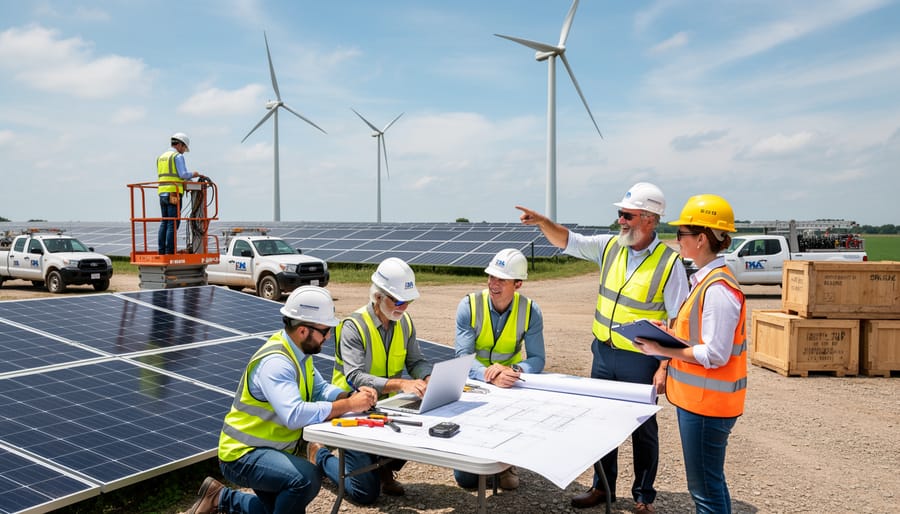
Key Investment Metrics: What Makes Renewable Energy Financially Sound

Return on Investment Timeline
Understanding the timeline for returns helps set realistic expectations for your solar investment. Based on current data from Illinois residential and commercial projects, most solar installations achieve payback within 7 to 12 years, depending on system size, energy consumption, and available incentives. Residential systems typically see returns on the longer end of this spectrum, while commercial installations often recover costs faster due to higher energy usage and larger tax benefits.
This timeline compares favorably with emerging markets, where payback periods range from 5 to 10 years thanks to abundant sunshine and aggressive government subsidies. Illinois benefits from the state’s Solar Renewable Energy Credits program and federal Investment Tax Credit, which can reduce upfront costs by 30% or more. After the payback period, systems continue generating free electricity for 25 to 30 years, creating substantial long-term savings.
For business owners, accelerated depreciation through MACRS further shortens the ROI timeline. Our locally owned team has helped numerous Illinois clients structure their investments to maximize returns, considering factors like utility rates, financing options, and property-specific conditions that directly impact your payback period.
Long-Term Savings vs. Upfront Costs
When evaluating renewable energy as an investment, the timeline matters significantly. While solar systems require substantial upfront costs, typically ranging from $15,000 to $30,000 for residential installations in Illinois, the long-term financial benefits extend across 25-30 years of system operation.
Consider a typical Illinois homeowner paying $150 monthly for electricity, or $1,800 annually. With ComEd’s electricity rates averaging 13-15 cents per kilowatt-hour, a solar installation can eliminate or drastically reduce these costs. Over 25 years, that represents $45,000 in electricity expenses, and this calculation assumes flat rates without accounting for the historical trend of rising energy costs.
The math becomes even more compelling when factoring in federal tax credits, which currently cover 30 percent of installation costs, plus Illinois-specific incentives through programs like Solar Renewable Energy Credits. A $20,000 system effectively costs $14,000 after the federal credit, with payback periods typically ranging from 8-12 years depending on your energy consumption and local utility rates.
Beyond the payback period, solar panels continue generating free electricity for another 15-20 years. Modern panels come with 25-year warranties and maintain 80-85 percent efficiency even after decades of operation. This means your initial investment continues delivering returns long after recovering the upfront costs, transforming what initially appears as an expense into a revenue-generating asset that increases property value while providing energy independence.
Financing Options That Improve Investment Viability
The upfront cost of renewable energy can feel overwhelming, but flexible financing options make these investments accessible without draining your capital reserves. Power Purchase Agreements (PPAs) allow you to benefit from solar energy with zero down payment—a third party owns and maintains the system while you purchase the electricity at a predetermined rate, often lower than your current utility costs. This model has proven particularly effective for businesses looking to reduce operating expenses immediately.
Solar loans function similarly to traditional financing, spreading the system cost over 10-20 years while you retain ownership and capture all available incentives. Many Illinois homeowners find that monthly loan payments are offset by energy savings, creating a cost-neutral transition to clean power. Leasing arrangements offer another path, where you pay a fixed monthly fee to use equipment installed on your property.
These financing structures have enabled countless renewable energy solutions across Illinois without requiring substantial capital investment. For business owners, these options preserve cash flow for core operations while still securing long-term energy cost predictability and environmental benefits.
Risk Factors and How to Mitigate Them
Technology and Performance Risks
Like any technology investment, renewable energy systems carry performance considerations that directly impact your returns. The good news is that modern solar equipment has proven remarkably reliable, with most panels carrying 25-year performance warranties. However, your actual results depend heavily on two critical factors: equipment quality and installation expertise.
Lower-quality components may offer attractive upfront savings but often underperform or require costly repairs within just a few years. Similarly, improper installation can reduce system efficiency by 20-30%, significantly affecting your projected savings and payback period. Weather events, while rare in Illinois, can also impact system performance if installations don’t meet proper engineering standards.
Working with a locally owned solar provider who understands Illinois-specific conditions makes a substantial difference. Experienced installers account for regional weather patterns, roof types common to our area, and local building codes that ensure long-term reliability. They select equipment proven to perform in Midwest conditions and stand behind their work with comprehensive warranties.
When evaluating renewable energy as an investment, choose providers who offer transparent performance guarantees, use tier-one equipment from established manufacturers, and maintain local service teams for ongoing support. This approach minimizes technology risks and protects your investment over its 25-plus year lifespan.
Regulatory and Policy Changes
Regulatory and policy changes represent one of the most significant variables affecting renewable energy investments. Federal incentives like the Investment Tax Credit (ITC) currently offer 30% tax credits for solar installations, but these percentages can shift with new legislation. In Illinois, state-level programs including the Illinois Shines initiative provide additional financial support through Solar Renewable Energy Credits (SRECs), though funding levels and eligibility requirements evolve with each budget cycle.
To minimize exposure to policy shifts, diversify your investment approach. Lock in current incentives by moving forward with installations while favorable programs remain active. Work with locally owned solar providers who maintain expertise in navigating Illinois-specific regulations and can alert you to upcoming changes. Consider financing structures that account for potential policy adjustments, such as power purchase agreements that transfer some regulatory risk to the provider.
Building flexibility into your investment timeline also helps. Projects with shorter payback periods naturally carry less policy risk than those requiring decades to break even. Stay informed about legislative calendars affecting renewable energy programs, and maintain relationships with providers who actively monitor the regulatory landscape on your behalf.
Choosing the Right Installation Partner
Selecting the right installation partner significantly impacts your renewable energy investment’s success and long-term performance. Working with experienced, locally owned firms offers distinct advantages over national chains or inexperienced contractors. Local companies understand Illinois-specific regulations, incentive programs, and weather patterns that affect system design and performance. They’re invested in the community and available for ongoing maintenance, troubleshooting, and warranty support years after installation. An experienced partner will conduct thorough site assessments, provide realistic production estimates, and design systems optimized for your property’s unique characteristics. They should demonstrate a track record of successful installations, proper licensing and insurance, and transparent pricing. Quality installers also guide you through financing options, rebate applications, and interconnection agreements with your utility company. This expertise ensures your renewable energy system delivers the expected returns, protecting your investment from costly mistakes that could undermine financial projections and system performance over its 25-30 year lifespan.
Making the Investment Decision: Is Renewable Energy Right for You?
Assessing Your Property and Energy Needs
Before investing in renewable energy, you’ll want to evaluate whether your property is suitable for solar installation. Start by examining your roof’s condition—most solar panels last 25-30 years, so your roof should be structurally sound and have at least 15 years of life remaining. If repairs are needed, it’s more cost-effective to complete them before installation.
Sun exposure is equally important for maximizing your return on investment. South-facing roofs in Illinois typically generate the most energy, though east and west orientations can also work well. Consider any shading from trees, buildings, or other obstructions that might limit your system’s efficiency throughout the day.
Review your current energy consumption patterns by analyzing 12 months of utility bills. This data helps determine the appropriate system size and potential savings. Homes or businesses with higher energy usage often see faster payback periods, making solar a more attractive investment. Understanding these baseline factors ensures you’re making an informed decision about whether renewable energy fits your specific situation and financial goals.

Calculating Your Personal ROI
Understanding your potential return on investment starts with evaluating your specific situation. In Illinois, several factors determine your solar ROI, making each installation unique to the property and energy needs.
Begin by examining your current electricity costs. Review your utility bills from the past year to calculate your average monthly usage in kilowatt-hours and your cost per kWh. Illinois residents typically pay around 13-15 cents per kWh, though rates vary by provider and can increase over time. Higher current electricity costs generally mean faster payback periods for solar installations.
Next, consider the size of the system you’ll need. A typical Illinois home uses approximately 10,000 kWh annually, requiring a 7-10 kW solar system. Installation costs average $2.50-$3.50 per watt before incentives, meaning a 7 kW system might cost $17,500-$24,500 upfront.
Factor in available incentives that significantly improve your ROI. The federal Investment Tax Credit currently offers 30% back on installation costs. Illinois residents also benefit from Solar Renewable Energy Credits, which can provide additional income over time. Property tax exemptions ensure your home’s increased value won’t raise your taxes.
Calculate your estimated payback period by dividing your net system cost (after incentives) by your annual electricity savings. Most Illinois homeowners see payback periods between 8-12 years, with systems lasting 25-30 years. This means 13-22 years of essentially free electricity, delivering substantial long-term returns while contributing to energy independence.
The evidence is clear: renewable energy represents a sound investment opportunity backed by proven success in emerging markets worldwide. Countries across Asia, Africa, and Latin America have demonstrated that solar and wind power deliver measurable returns while building energy independence. These same principles apply right here in Illinois, where favorable policies, declining equipment costs, and abundant solar potential create compelling opportunities for homeowners and businesses alike.
The key to maximizing your renewable energy investment lies in understanding the specific factors that affect returns in our region. Illinois offers distinct advantages through state incentive programs, net metering policies, and financing options designed to accelerate payback periods. However, navigating these opportunities requires knowledge of local regulations, utility requirements, and installation best practices unique to our climate and infrastructure.
Working with experienced local partners makes all the difference in transforming renewable energy from an abstract concept into a profitable reality. Locally owned solar providers bring invaluable expertise in Illinois-specific factors like permitting processes, seasonal efficiency considerations, and maximizing available incentives. This regional knowledge ensures your system is designed, installed, and maintained for optimal long-term performance.
If you’re ready to explore how solar energy can work for your home or business, we encourage you to reach out for a consultation. Our team will assess your property, explain available incentives, and provide transparent projections tailored to your specific situation. Discover how renewable energy can deliver both environmental benefits and solid financial returns for your Illinois property.
