
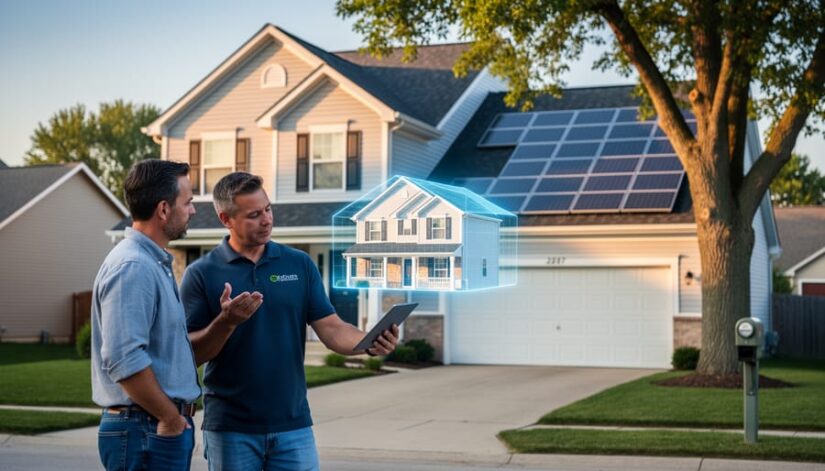
How Digital Twins Can Slash Your Home Energy Bills Before You Install Solar
Imagine walking through your home before it’s even built—testing where sunlight hits hardest at 2 PM in July, identifying which rooms lose heat fastest in January, and calculating exactly how many solar panels you need based on your family’s actual energy usage patterns. Digital twins make this possible by creating virtual replicas of physical properties that simulate real-world conditions with remarkable accuracy.
A digital twin is a dynamic, data-driven model of your property that mirrors its physical characteristics, energy systems, and environmental interactions in real time. Unlike static blueprints or basic 3D renderings, these virtual replicas continuously update using data from sensors, weather stations, and utility meters to predict performance, identify inefficiencies, and test improvements without touching a single wire or panel.
For Illinois homeowners considering solar energy, digital twins transform guesswork into precision. Rather than relying on generic estimates, you can model your specific roof angles, shading patterns from that oak tree in the backyard, and seasonal sunlight variations unique to your ZIP code. This technology allows solar professionals to design systems optimized for your property’s exact conditions—determining ideal panel placement, predicting annual energy production within 2-3% accuracy, and calculating payback periods based on your household’s consumption patterns.
The practical benefits extend far beyond installation day. Digital twins continuously monitor system performance, comparing actual output against predicted benchmarks to catch issues before they become costly problems. They integrate with smart home devices to optimize when you run major appliances, store excess solar energy, or draw from the grid during peak pricing periods. For property managers overseeing multiple buildings, digital twins provide centralized oversight of energy performance across entire portfolios, identifying optimization opportunities that would otherwise remain invisible until utility bills arrive.
What Digital Twins Mean for Your Home Energy System
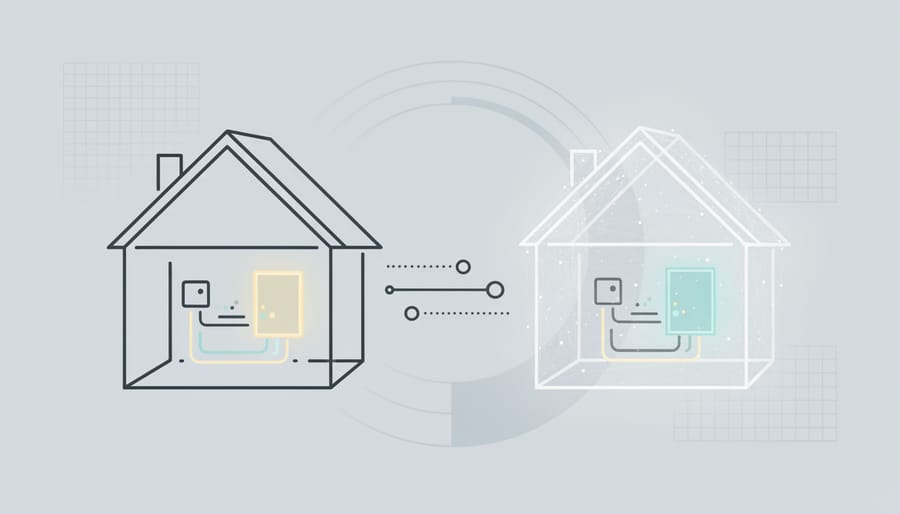
The Virtual Mirror of Your Home
Think of a digital twin as a living, breathing virtual copy of your home that exists in the digital world. Unlike static blueprints or photographs, this technology creates a dynamic replica that continuously updates based on real-world conditions at your property.
Here’s how it works in practical terms: sensors throughout your home collect data on energy consumption patterns, temperatures in different rooms, sunlight exposure throughout the day, and even structural characteristics like insulation quality and window efficiency. This information feeds into sophisticated software that builds and maintains your property’s digital counterpart.
For Illinois homeowners considering solar energy, digital twins offer particularly valuable insights. The technology tracks how much electricity your home uses during peak and off-peak hours, identifies which appliances consume the most energy, and monitors environmental factors like seasonal weather patterns and shading from nearby trees or buildings. This real-time tracking helps solar professionals design systems tailored specifically to your property’s unique characteristics.
The beauty of digital twins lies in their ongoing nature. Rather than relying on estimates or averages, you get actual performance data from your home. This precision proves especially useful when planning solar installations, as the digital model can simulate how different panel configurations would perform on your roof throughout the year. You’re essentially test-driving solar solutions before making any physical changes to your property, ensuring you invest in a system that delivers maximum benefit for your specific situation.
Real-Time Data That Actually Helps You Save
Digital twins transform raw data into money-saving insights by continuously monitoring your home’s energy ecosystem. These virtual models connect to your smart thermostats, solar panels, lighting systems, and appliances through IoT energy management technology, gathering information 24/7 about how your property uses electricity.
The real power comes from what happens with this data. Your digital twin analyzes patterns in your energy consumption alongside external factors like Illinois weather forecasts, seasonal sunlight availability, and local utility rate fluctuations. For example, it might recognize that your air conditioning runs most during afternoon peak-rate hours and recommend shifting some usage to morning periods when your solar panels are already generating power and rates are lower.
Beyond simple monitoring, digital twins identify inefficiencies you’d never spot on your own. They can detect when a device is consuming more energy than expected, suggesting maintenance before problems escalate. They also learn your household routines, automatically adjusting systems to reduce waste without sacrificing comfort.
For Illinois homeowners with solar installations, this means understanding exactly when your panels produce surplus energy and how to best use or store it. The system provides clear, actionable recommendations rather than overwhelming you with spreadsheets and technical readings. You might receive notifications like “Pre-cool your home at 2 PM using solar power to reduce evening grid usage” or “Your system efficiency dropped 8 percent this week due to panel shading.” These specific insights translate directly into lower utility bills and maximized solar investment returns.
Why Illinois Homeowners Need Digital Twins Before Going Solar
Right-Sizing Your Solar System From Day One
One of the most critical decisions in solar adoption is determining the right system size. Too small, and you’ll continue paying high utility bills; too large, and you’ve invested more than necessary. This is where digital twin technology becomes invaluable for Illinois property owners.
A digital twin creates a precise virtual model of your property that factors in your actual energy consumption patterns throughout the year. Rather than relying on rough estimates or industry averages, the technology analyzes your historical utility data, seasonal variations, and unique usage habits. For Illinois homes and businesses, this means accounting for the substantial energy demands of winter heating and summer cooling that characterize our climate.
The digital twin also models your property’s specific solar production potential. It considers your roof’s orientation, pitch, and available space, along with local weather patterns typical to Illinois. The system simulates how shadows from nearby trees, buildings, or structures will affect panel performance during different seasons and times of day. This level of detail ensures your solar array is designed to match both your consumption needs and your property’s production capabilities.
This precision prevents two common and costly mistakes. Oversizing means you’re paying for panels that generate more electricity than you can use or benefit from, particularly given Illinois net metering policies. Undersizing leaves you dependent on grid power and missing out on potential savings. By modeling your actual conditions rather than working from general assumptions, digital twin technology helps our locally owned team design a system that delivers optimal performance and return on investment from day one. You get exactly the capacity you need, nothing more and nothing less.
Predicting Performance Through Illinois Winters
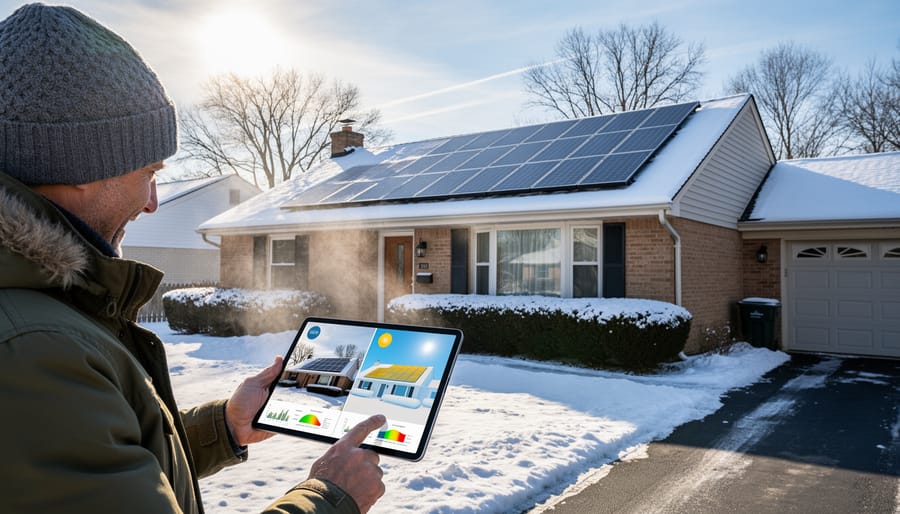
Illinois winters present unique challenges for solar energy production, with shorter days, snow accumulation, and cloud cover significantly impacting system performance. Digital twins address these concerns by creating detailed simulations that account for seasonal variations throughout the year, giving homeowners realistic expectations before installation.
Unlike simplified calculators that might show only peak summer performance, digital twins incorporate historical weather data specific to Illinois regions. They model how solar panels perform during December and January when sun angles are lowest, how snow coverage affects output, and what to expect during typical cloudy periods. This technology simulates years of operation within minutes, showing month-by-month energy production patterns that help homeowners understand the complete performance picture.
For Illinois property owners considering solar, this predictive capability eliminates surprises. The digital twin can demonstrate how a south-facing roof with a particular pitch will capture winter sunlight differently than an east-west configuration. It accounts for surrounding trees that cast longer shadows during winter months and calculates how quickly panels will shed snow based on installation angle and temperature patterns.
This seasonal modeling directly influences system design decisions. If the digital twin reveals significant winter performance drops, installers can recommend additional panel capacity or suggest battery storage solutions to maintain consistent energy supply year-round. Homeowners gain confidence knowing their investment accounts for Illinois’s full climate reality, not just ideal conditions.
The technology also helps set realistic financial projections. By accurately predicting lower winter production alongside robust summer output, digital twins provide honest return-on-investment timelines. This transparency builds trust and ensures homeowners make informed decisions based on actual Illinois weather patterns rather than generalized national averages.
Smart Home Integration: Making All Your Systems Work Together
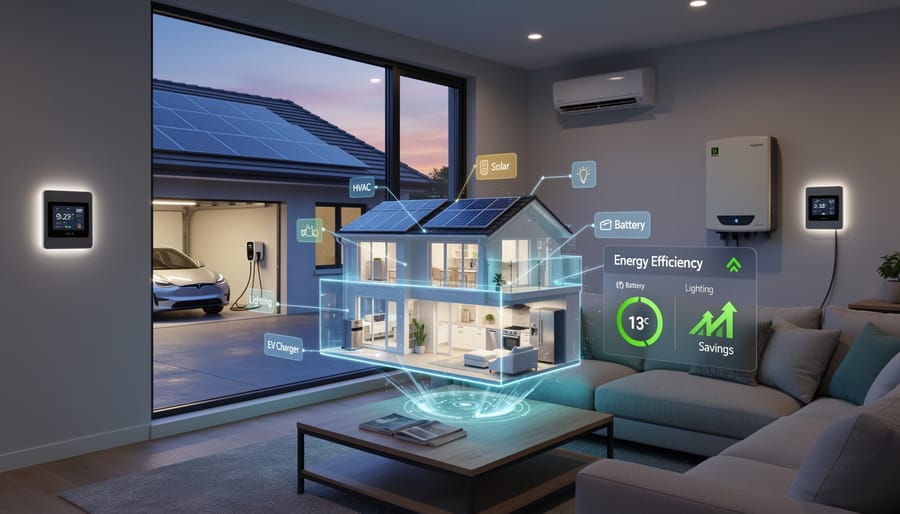
Coordinating Solar with Your Existing Home Systems
One of the most valuable capabilities of a digital twin is its ability to coordinate your home’s energy systems for maximum efficiency. By continuously analyzing your solar production patterns, battery charge levels, electricity usage, and time-of-use utility rates, the digital twin identifies the optimal moments to run major appliances and manage climate control.
For example, your digital twin might detect that your solar panels will produce peak power between 11 AM and 2 PM on a sunny day. It can then signal your dishwasher or washing machine to delay their cycles until that window, allowing you to use free solar energy instead of grid electricity. Similarly, if your system includes battery storage, the digital twin determines the best times to charge those batteries based on surplus solar production and when utility rates are lowest.
Climate control represents another significant opportunity for coordination. Digital twins work seamlessly with smart thermostats to pre-cool or pre-heat your home during periods of abundant solar production, reducing your reliance on expensive grid power during peak demand hours. In Illinois, where time-of-use rates can vary significantly throughout the day, this coordination translates into substantial savings.
The system learns from your preferences and adjusts automatically. You maintain complete comfort while the digital twin handles the complex calculations behind the scenes, ensuring every kilowatt-hour of solar energy works as efficiently as possible for your household.
Battery Storage Decisions Made Simple
Adding battery storage to a solar system represents a significant investment, and digital twin technology removes much of the guesswork from this decision. By creating a virtual model of your Illinois home’s energy patterns, digital twins analyze whether battery storage makes financial sense for your specific situation.
The technology examines your household’s electricity consumption hour by hour, identifying when you use the most power and how that aligns with your solar production. For many Illinois homeowners, peak usage occurs in early morning and evening hours when solar panels aren’t generating electricity. A digital twin calculates exactly how much of that grid-purchased power could be replaced by stored solar energy, translating those kilowatt-hours into dollar savings.
Digital twins also factor in Illinois-specific considerations like seasonal sunlight variations and local utility rate structures. Some areas have time-of-use rates where electricity costs more during peak hours. The model determines whether storing solar energy to use during expensive rate periods creates enough savings to justify the battery investment.
Beyond basic cost analysis, digital twin modeling accounts for your personal priorities. If backup power during outages matters more than immediate financial returns, the simulation shows how different battery sizes would keep essential systems running. This personalized approach means you’re not relying on generic calculations or sales pitches. Instead, you receive data-driven insights based on your actual home, your real usage patterns, and your specific goals, making the battery storage decision straightforward and financially sound.
Real Cost Savings: What Digital Twin Planning Delivers
Avoiding Expensive Design Errors
Solar installations represent a significant investment, and mistakes can be costly to fix after the fact. Digital twin technology helps homeowners and businesses in Illinois avoid common design errors before any physical work begins.
One frequent issue is incorrect panel placement. Without precise modeling, installers might position panels where shading from trees, chimneys, or neighboring buildings reduces efficiency. A digital twin analyzes sun paths throughout the year, identifying optimal placement that maximizes energy capture during Illinois’s varying seasonal conditions.
Inadequate system capacity is another problem that digital twins prevent. Undersized systems leave you purchasing grid electricity unnecessarily, while oversized installations waste money on unused capacity. By simulating your actual energy consumption patterns against production forecasts, digital twins help right-size your system for your specific needs.
Equipment incompatibility can also derail projects. Pairing the wrong inverter with your panel array, or selecting components that don’t communicate effectively with your monitoring system, creates performance issues. Digital twins test equipment configurations virtually, ensuring all components work together seamlessly before purchase.
These preventive capabilities save Illinois property owners from expensive corrections, system underperformance, and the frustration of dealing with avoidable technical problems. As a locally owned company with expertise in solar energy, we’ve seen how proper planning through digital modeling protects your investment from day one.
Faster Return on Your Solar Investment
Digital twin technology transforms your solar investment from a best-guess scenario into a precision-engineered financial decision. By creating a virtual replica of your Illinois property, we can test countless system configurations before a single panel is installed. This means identifying the optimal panel placement, inverter sizing, and battery storage capacity that delivers maximum energy production for your specific building orientation, roof characteristics, and local weather patterns.
The result is a faster payback period. Traditional solar installations often rely on standardized estimates that may oversize or undersize your system. Digital twins eliminate this guesswork, ensuring every component works together efficiently from day one. For Illinois homeowners and businesses, this precision typically accelerates return on investment by 12 to 18 months compared to conventional planning methods.
Beyond initial installation, digital twin modeling integrates with AI energy optimization systems that continuously monitor performance. The virtual model updates in real-time, alerting you to maintenance needs before they reduce output and identifying opportunities to enhance savings as your energy usage patterns evolve. This ongoing optimization means your system maintains peak efficiency throughout its 25-plus year lifespan, maximizing every dollar of your investment while supporting Illinois’s clean energy future.
How the Digital Twin Process Works with Your Solar Installation
From Initial Assessment to Virtual Model
Creating an accurate digital twin of your Illinois property begins with comprehensive data collection. The process starts with a detailed energy audit that evaluates your current electricity usage patterns, heating and cooling systems, and existing infrastructure. Professional assessors document structural characteristics like roof angles, orientation, shading from trees or neighboring buildings, and available mounting surfaces for solar panels.
Site analysis goes beyond basic measurements. Advanced tools capture weather patterns specific to your location, seasonal sun exposure, and potential obstacles that might affect system performance. This data feeds into specialized software that constructs a virtual replica of your property. The digital model incorporates everything from your home’s thermal envelope to appliance energy consumption.
Once established, this virtual twin serves as the foundation for solar system design tailored to your specific needs. It can simulate how different panel configurations would perform throughout the year, helping determine optimal placement and capacity. The model also integrates with predictive maintenance sensors to continuously refine its accuracy, ensuring your solar investment delivers maximum value based on real-world conditions rather than generic estimates.
Testing Before Installing
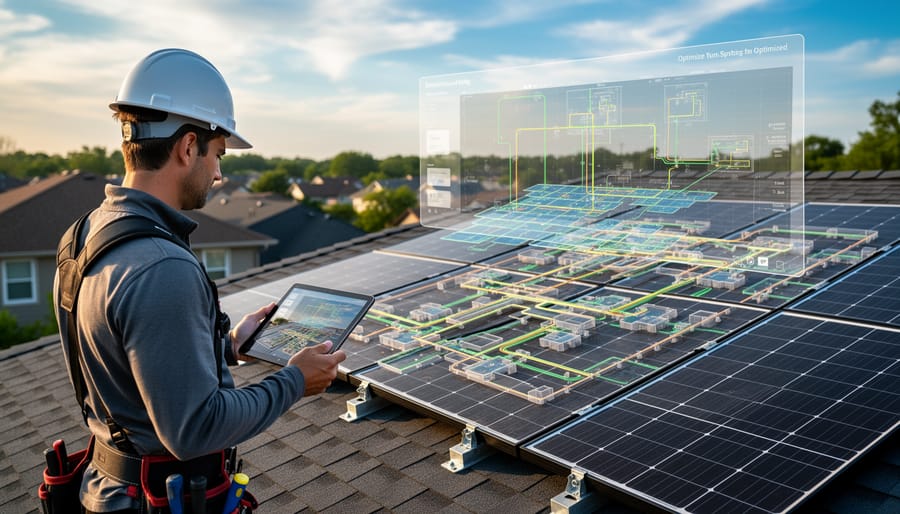
One of the most valuable applications of digital twin technology is the ability to test different solar panel configurations virtually before installing anything on your property. Instead of making costly adjustments after installation, you can explore multiple design options in a risk-free digital environment.
Using your property’s digital twin, solar energy experts can simulate how various panel placements, angles, and system sizes will perform throughout the year. This includes testing different roof sections, ground-mounted options, and even future expansion scenarios. The simulation accounts for Illinois-specific factors like seasonal sun angles, typical cloud cover patterns, and local weather conditions.
For example, you might discover that placing panels on your south-facing roof generates 15% more energy than an east-west split, or that adding three additional panels now costs less than expanding your system later. The digital twin can also identify potential shading issues from trees or neighboring structures at different times of day and year.
This virtual testing phase saves homeowners and business owners both time and money by ensuring the final design is optimized for maximum energy production before any physical work begins. You’ll have confidence knowing your solar investment is configured specifically for your property’s unique characteristics.
Beyond Installation: Ongoing Energy Optimization
Catching Problems Before They Cost You
One of the most valuable features of digital twins in real estate is their ability to catch problems early, before they drain your wallet. These virtual models continuously monitor your home’s energy systems in real-time, tracking performance metrics like solar panel output, battery charge levels, and overall energy consumption patterns. When something starts operating outside normal parameters, you receive an alert immediately.
For example, if your solar panels begin producing less energy than expected, your digital twin can identify whether it’s due to accumulated dirt, a malfunctioning inverter, or shading from new tree growth. Instead of discovering the problem months later through unexpectedly high utility bills, you can address it right away. The same applies to HVAC systems running inefficiently or insulation gaps letting conditioned air escape.
This predictive maintenance approach saves Illinois homeowners significant money over time. A small drop in solar efficiency might cost you an extra twenty dollars monthly, but left unchecked for a year, that becomes nearly two hundred and fifty dollars plus potential equipment damage. Digital twins help you stay ahead of these issues, maximizing your solar investment and keeping your home’s energy systems running at peak performance throughout every Illinois season.
Adapting to Your Changing Energy Needs
Life rarely stays the same, and neither do your home’s energy requirements. Digital twins excel at helping you adapt to these changes without costly trial-and-error. Planning to add an electric vehicle? Your digital twin can simulate the increased electrical load and recommend whether your current solar array can handle the demand or if you need additional panels. Considering a home addition or renovating your kitchen with new energy-efficient appliances? The system recalculates your energy profile in real-time.
For Illinois homeowners, this adaptability is particularly valuable as seasonal variations dramatically affect energy consumption. When you install a new central air conditioning system or heat pump, your digital twin immediately adjusts its models to optimize performance. It can even help you plan major purchases by showing you exactly how that new pool heater or home office setup will impact your energy bills and solar production.
This forward-looking capability means your solar investment grows with you. Instead of guessing whether your system can accommodate lifestyle changes, you’ll have data-driven insights that protect your investment and maintain optimal efficiency through every phase of homeownership.
Digital twin technology is transforming solar energy planning from educated guesswork into precision engineering. For Illinois homeowners considering solar, this means moving beyond rough estimates and generic system designs to solutions tailored specifically to your property’s unique characteristics. By creating a virtual replica of your home that accounts for roof angles, shading patterns, local weather data, and energy consumption habits, digital twins remove the uncertainty that has traditionally made solar investment decisions feel risky.
The result is straightforward: better system performance, more accurate cost projections, and greater confidence in your solar investment. You’ll know exactly how much energy your system will generate throughout Illinois’s changing seasons, how quickly you’ll see returns, and what adjustments might optimize your savings over time. This technology essentially provides a test drive of your solar system before installation begins.
As you explore solar options for your property, don’t settle for one-size-fits-all approaches. Ask potential solar providers whether they utilize digital twin capabilities in their planning process. Inquire how they’ll model your specific property conditions and what data they’ll incorporate into their projections. The providers who embrace this technology demonstrate a commitment to precision and transparency that serves Illinois homeowners well.
Making the switch to solar is a significant decision. Digital twins ensure it’s an informed one, backed by data and engineered for your success.
