
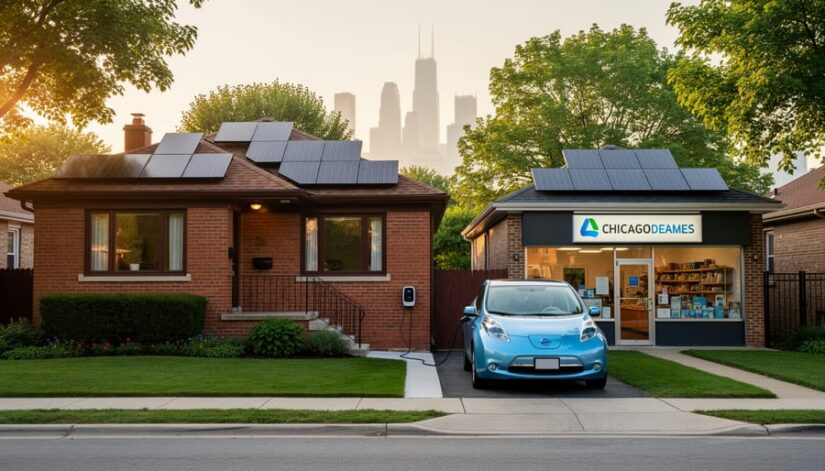
How Green Finance Is Making Solar Energy Affordable for Illinois Property Owners
The shift to renewable energy hinges on one critical factor often overlooked: access to capital. Green finance transforms energy transition pathways from theoretical possibilities into practical realities by connecting property owners with funding mechanisms that make solar installations financially viable today, not years from now.
Illinois homeowners and businesses face a unique opportunity. State-backed incentives, federal tax credits, and innovative financing models have converged to eliminate the primary barrier to solar adoption: upfront costs. Understanding which financial tools align with your specific situation determines whether your solar project launches this year or remains on a wish list indefinitely.
Green finance encompasses more than traditional loans. Power purchase agreements allow you to install solar panels with zero down payment. Property-assessed clean energy programs attach financing to your property tax bill rather than personal credit. Solar renewable energy credits generate ongoing revenue streams that offset installation expenses. Each mechanism serves different ownership structures, cash flow situations, and long-term energy goals.
This guide breaks down how Illinois-specific green finance programs work in practice, which financing models match different property types, and how to evaluate total cost of ownership rather than just installation price. Whether you manage a commercial facility or own a single-family home, the right financial pathway exists to accelerate your transition to clean energy while protecting your bottom line.
What Green Finance Actually Means for Your Solar Investment
Green finance might sound like corporate jargon, but it’s actually a straightforward concept that can significantly impact your solar investment. At its core, green finance refers to financial products and services specifically designed to support environmentally beneficial projects—like your solar energy system.
When you’re considering solar panels for your Illinois home or business, green finance opens doors to funding options you might not find through traditional channels. These specialized mechanisms recognize that renewable energy projects deliver both financial returns and environmental benefits, which changes how lenders and investors evaluate risk and structure their offerings.
For solar investments, green finance typically appears in several forms. Green loans function similarly to conventional loans but often feature lower interest rates because lenders view renewable energy projects favorably. Some financial institutions in Illinois offer these products with terms specifically tailored to solar installations, matching repayment schedules to your expected energy savings.
Grants represent another green finance tool, providing funds that don’t require repayment. While competitive, these opportunities exist at federal, state, and sometimes local levels for qualifying solar projects. Illinois homeowners and businesses should research current grant programs, as availability changes based on policy priorities and funding cycles.
Property Assessed Clean Energy (PACE) financing deserves special attention. This mechanism allows property owners to finance solar installations through their property tax bills, with repayment periods extending up to 20 years. The financing stays with the property if you sell, making it an attractive option for both residential and commercial projects.
Power Purchase Agreements (PPAs) and solar leases represent indirect green finance mechanisms. These arrangements allow third-party companies to install solar panels on your property using their capital, while you purchase the electricity generated at predetermined rates, typically lower than utility prices.
Understanding these green finance options helps you identify which funding approach aligns best with your financial situation, whether you’re a homeowner looking to reduce energy costs or a business owner planning a larger commercial installation.
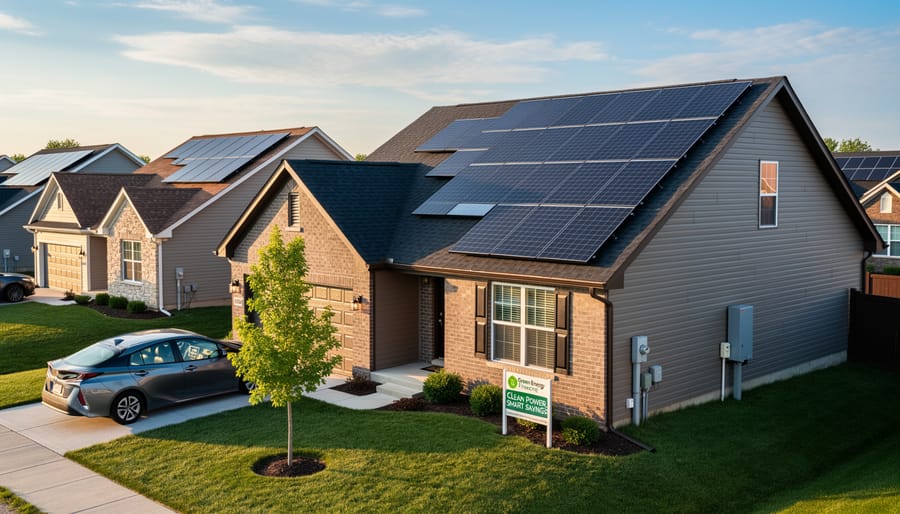
Illinois-Specific Green Finance Programs Breaking Down Cost Barriers
Federal Tax Credits and Incentives
The federal Investment Tax Credit (ITC) remains one of the most powerful incentives for homeowners and businesses considering solar energy. This program allows you to deduct 30% of your total solar installation costs directly from your federal taxes, significantly reducing your upfront investment.
Here’s how the savings work in practice: If your complete solar system costs $20,000, you’ll receive a $6,000 tax credit, bringing your net cost down to $14,000. For a larger commercial installation at $100,000, the ITC provides $30,000 in savings, reducing your actual investment to $70,000. These aren’t deductions that simply lower your taxable income—they’re dollar-for-dollar reductions in what you owe the IRS.
The ITC applies to both residential and commercial solar projects in Illinois, covering equipment costs, installation labor, and even energy storage systems added to your solar array. The 30% rate is currently locked in through 2032, after which it will step down to 26% in 2033 and 22% in 2034.
To claim this credit, you’ll need to own your solar system rather than lease it. The credit applies in the tax year when your system becomes operational, and if your tax liability is lower than the credit amount, you can roll the remaining credit forward to future tax years.
Illinois Solar Renewable Energy Credits (SRECs)
Illinois homeowners and businesses can generate ongoing revenue from their solar installations through Solar Renewable Energy Credits, or SRECs. These financial instruments represent the environmental benefits of solar energy production, creating an additional income stream beyond electricity savings.
Through the Illinois Shines program, which operates under Illinois energy policies, solar system owners earn one SREC for every megawatt-hour of clean electricity their system produces. The program purchases these credits at predetermined rates, providing predictable revenue for 15 years. This long-term income helps offset installation costs and accelerates your return on investment.
The Illinois Shines program operates on a block structure, where incentive rates gradually decrease as more solar capacity is added statewide. This means earlier participants typically receive higher rates, making now an advantageous time to invest in solar energy.
For businesses, SREC revenue can significantly improve project economics and cash flow. Residential systems also benefit, with SREC payments often covering a substantial portion of monthly system financing. The program’s streamlined application process makes participation straightforward—your locally owned solar installer typically handles the enrollment and ongoing reporting requirements.
Understanding how SRECs fit into your overall financial picture is essential for maximizing the value of your solar investment and supporting Illinois’s transition to renewable energy.
Low-Interest Green Loans and PACE Financing
For Illinois homeowners and businesses looking to transition to solar without significant upfront costs, low-interest green loans and Property Assessed Clean Energy (PACE) financing offer accessible pathways forward. These programs recognize that the initial investment in solar energy can be substantial, even with available incentives.
PACE financing is particularly attractive because it allows property owners to fund solar installations through a special assessment on their property tax bill. The loan attaches to the property rather than the individual, and payments are spread over 15-20 years, making monthly costs manageable. In Illinois, commercial PACE programs have gained traction, helping businesses upgrade to renewable energy systems without depleting operating capital. The extended repayment period often means that energy savings can meet or exceed the assessment payment.
Green loans, offered by various Illinois financial institutions and credit unions, provide competitive interest rates specifically for renewable energy projects. These loans typically feature terms more favorable than conventional financing, with some lenders offering rates as low as 2-4% for qualified borrowers. Many locally owned community banks have developed specialized green loan programs that understand the unique financial profile of solar investments.
Both financing options transform solar energy from a large capital expense into a predictable monthly payment, making the green energy transition financially feasible for more Illinois residents and businesses.
How Solar Financing Models Work in Practice
Direct Purchase with Green Loans
Purchasing your solar energy system outright through a green loan offers the most long-term financial benefits. With this approach, you own the system from day one, which means you’re immediately eligible for all available incentives, including the federal Investment Tax Credit and Illinois-specific programs. This ownership translates to increased property value and maximum lifetime savings.
Green loans, specifically designed for energy efficiency improvements, make this upfront investment remarkably manageable. These specialized financing products typically offer competitive interest rates and terms ranging from 5 to 20 years. What makes them particularly attractive for Illinois homeowners and business owners is that monthly loan payments are often comparable to or even lower than your current utility bills. The difference is significant: while utility payments never end, your loan has a defined endpoint, after which you enjoy free electricity for the remaining decades of your system’s 25-30 year lifespan.
Many local Illinois financial institutions and credit unions offer green loan programs with favorable terms. As locally owned solar experts, we help our clients navigate these financing options to find solutions that align with their budget and energy goals, ensuring the transition to clean energy remains accessible and financially sound.
Solar Leases and Power Purchase Agreements
Solar leases and Power Purchase Agreements (PPAs) offer Illinois property owners a zero-down pathway to clean energy without the upfront investment of purchasing a system. With these arrangements, a third-party company owns and maintains the solar panels installed on your property, while you benefit from the electricity they generate.
Under a solar lease, you pay a fixed monthly amount to use the system, typically lower than your previous utility bill. A PPA works similarly, but instead of a fixed lease payment, you purchase the actual power generated at a predetermined rate per kilowatt-hour, which is generally below standard utility rates.
These financing models are particularly attractive for homeowners and businesses who want predictable energy costs without maintenance responsibilities. The third-party owner handles all system upkeep, repairs, and monitoring throughout the contract period, which typically spans 20 to 25 years.
For Illinois property owners, this means immediate savings on electricity bills without capital expenditure. The third-party owner claims the federal tax credits and any applicable state incentives, but passes savings along to you through reduced energy rates. This approach has helped many local businesses and homeowners transition to renewable energy while preserving cash flow for other operational needs or investments.
Which Option Makes Sense for Your Property
Selecting the right financing model depends on your specific circumstances and long-term objectives. For homeowners with strong credit and stable income, traditional loans or home equity financing often provide the most straightforward path to ownership and maximum long-term savings. If you prefer minimal upfront investment, Power Purchase Agreements allow you to benefit from solar energy without ownership responsibilities, though returns accumulate more slowly.
Business owners should evaluate their tax liability when considering financing options. Companies with significant tax obligations can maximize federal Investment Tax Credits and accelerated depreciation through direct ownership or loans. Those with limited tax capacity might find third-party ownership models more beneficial. Property type matters too—commercial buildings with high daytime energy consumption achieve faster payback periods, making aggressive financing more viable.
Consider pairing your solar investment with energy storage solutions to enhance energy independence and reliability. Industrial facilities with substantial power demands often benefit from customized financing packages that our locally owned team can structure specifically for your operational needs. Assess your energy consumption patterns, available capital, timeline for returns, and comfort level with ownership responsibilities to determine which pathway aligns best with your property’s unique situation.
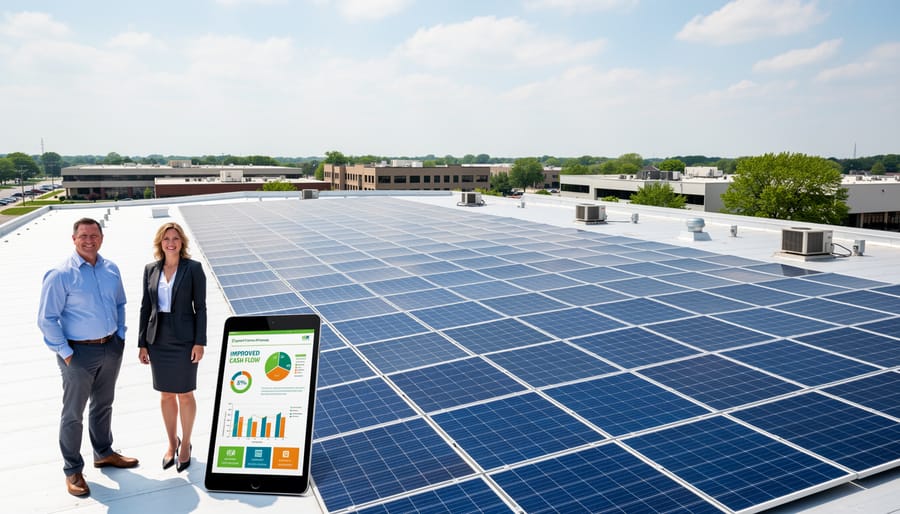
The Business Case: Why Green Finance Accelerates Commercial Solar Adoption
For Illinois businesses and industrial facilities, green finance represents more than just another funding option—it’s a strategic tool that accelerates solar adoption while strengthening the bottom line. The financial advantages extend far beyond traditional capital investments, creating opportunities that align sustainability goals with commercial success.
Cash flow improvements stand out as the most immediate benefit. Green financing programs, including power purchase agreements and equipment leases, allow businesses to go solar with minimal upfront costs. This means companies can redirect capital reserves toward core operations while still accessing clean energy savings. Monthly loan or lease payments typically run lower than conventional electricity costs, generating positive cash flow from day one. For manufacturing facilities and retail operations facing tight margins, this immediate financial relief proves transformative.
The expanding Illinois clean energy sector creates additional incentives through state-backed financing programs specifically designed for commercial properties. These initiatives offer favorable terms that conventional lenders cannot match, including extended repayment periods and reduced interest rates. Property Assessed Clean Energy (PACE) financing, available in participating Illinois counties, ties loan repayments to property tax bills rather than business credit, making solar accessible to companies that might not qualify for traditional loans.
Integration with modern energy networks amplifies these financial benefits. Businesses can participate in demand response programs and sell excess solar generation back to the grid, creating additional revenue streams. Combined with accelerated depreciation benefits under federal tax codes, commercial solar installations often achieve payback periods of 5-7 years.
Sustainability reporting requirements increasingly influence corporate decision-making. Green finance enables businesses to meet environmental, social, and governance benchmarks while documenting measurable carbon reduction. This proves particularly valuable for companies seeking B-Corp certification or responding to supply chain partners demanding verified sustainability commitments.
For industrial facilities with high energy consumption, green financing transforms solar from an operational expense into a strategic asset. Locally owned businesses particularly benefit from community-focused lending programs that understand regional market conditions and long-term growth potential. The combination of immediate savings, tax advantages, and enhanced corporate reputation makes green finance the catalyst that turns solar consideration into commercial reality.
Overcoming Common Financial Concerns About Solar Transition
Making the switch to solar energy often raises legitimate financial questions. Understanding how green finance mechanisms address these concerns can help you move forward with confidence in your investment decision.
The most common worry Illinois property owners express is the upfront cost. While solar installations represent a significant initial expense, green financing options have evolved specifically to overcome this barrier. Power Purchase Agreements (PPAs) and solar leases eliminate upfront costs entirely, allowing you to start saving on energy bills immediately while a third party owns and maintains the system. For example, a Chicago manufacturing facility recently adopted a PPA structure, reducing their energy costs by 18% from day one without any capital expenditure.
Another frequent concern involves uncertainty about long-term savings. Green financing typically includes performance guarantees and production insurance, protecting your investment if the system underperforms. Additionally, Illinois-specific incentives like the Adjustable Block Program provide predictable income through Solar Renewable Energy Credits (SRECs), creating a reliable revenue stream that improves your return on investment calculations.
Property owners also worry about equipment failure or maintenance costs. Most green financing packages bundle comprehensive warranties and maintenance agreements into the loan structure. This means your monthly payment covers not just the equipment but also its upkeep, eliminating surprise expenses. A Springfield business owner shared that their financed solar system included a 25-year performance warranty, giving them peace of mind about the long-term viability of their investment.
Credit concerns shouldn’t discourage you either. Many green finance programs offer flexible qualification criteria, and some Property Assessed Clean Energy (PACE) financing options attach the loan to your property rather than your personal credit, making approval more accessible.
These mechanisms transform solar from an intimidating capital expense into a manageable, low-risk investment that begins generating returns quickly while supporting Illinois’s transition to clean energy.
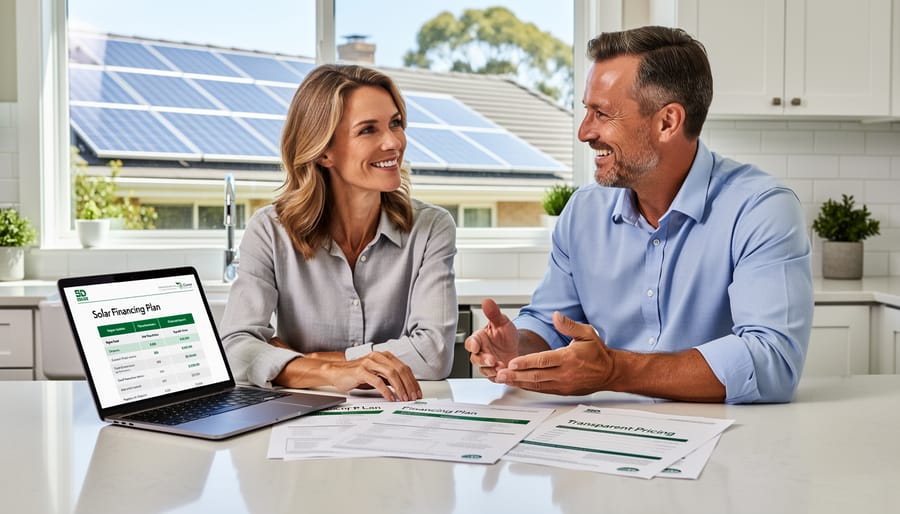
What Makes a Solar Financing Partner Trustworthy
Choosing the right solar financing partner significantly impacts your renewable energy experience. When evaluating potential companies in Illinois, several key factors indicate trustworthiness and reliability.
Transparency should be your first checkpoint. A reputable solar company provides clear, detailed breakdowns of all costs, including equipment, installation, permits, and financing terms. They explain interest rates, payback periods, and projected savings without hiding fees in fine print. Ask for written estimates and compare multiple offers to ensure you’re getting competitive rates.
Local expertise matters tremendously in solar installations. Companies with deep roots in Illinois understand state-specific regulations, utility interconnection requirements, and regional weather patterns that affect system performance. They’re familiar with local permitting processes and have established relationships with Illinois utility companies, which streamlines installation and grid connection.
Look for partners offering comprehensive service from initial consultation through post-installation support. This includes professional site assessments, custom system design based on your property’s unique characteristics, quality equipment selection, expert installation, and ongoing maintenance options. A trustworthy company stands behind their work with solid warranties on both equipment and workmanship.
Certifications and credentials provide additional assurance. Verify that installers hold proper licenses and certifications from recognized industry organizations. Check online reviews, request references from previous clients, and confirm they carry adequate insurance coverage.
Finally, assess their communication style. Trustworthy partners take time to educate you about solar technology, answer questions thoroughly, and never pressure you into quick decisions. They recognize that transitioning to solar represents a significant investment and respect your need to make informed choices at your own pace. Their goal should be building long-term relationships, not just closing sales.
Cost has long been the most significant obstacle preventing Illinois property owners from making the switch to solar energy. Green finance directly addresses this challenge by transforming solar installation from a large upfront expense into an achievable investment through accessible payment structures. Whether through solar loans with competitive interest rates, performance-based incentives from Illinois programs like Adjustable Block Program rebates, or Power Purchase Agreements that eliminate upfront costs entirely, financial mechanisms now exist to match virtually every budget and business model.
The energy transition isn’t just environmentally responsible—it’s increasingly economically advantageous. With Illinois Shines incentives, federal tax credits, and net metering policies working in your favor, the financial case for solar continues to strengthen. The key is identifying which financing approach aligns with your property type, energy consumption patterns, and long-term goals.
We encourage you to take the next step by requesting a customized solar assessment. Our locally owned team brings extensive expertise in solar energy and in-depth knowledge of Illinois-specific financing programs. We’ll help you understand exactly which green finance options maximize your return on investment while accelerating your path to energy independence. The transition to clean energy is more accessible than ever—let us show you how.
