
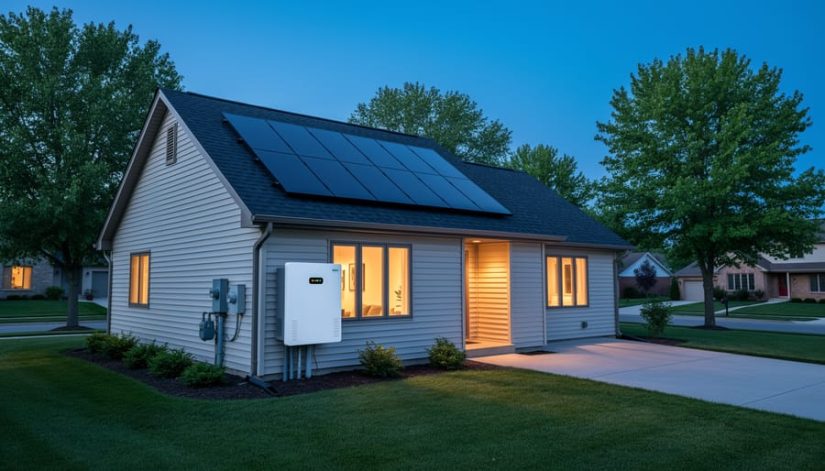
How Battery Storage Turns Your Illinois Solar System Into 24/7 Power
Renewable energy storage solutions capture excess solar or wind power during peak production hours and release it when generation drops or demand increases. This technology transforms intermittent renewable sources into reliable, round-the-clock power systems that reduce grid dependence and lower electricity costs for Illinois properties.
Battery storage systems work by converting DC electricity from solar panels into stored chemical energy, then inverting it back to AC power when needed. Modern lithium-ion batteries can store anywhere from 10 to 20 kilowatt-hours for residential applications, enough to power essential appliances during evening hours or grid outages. For Illinois homeowners, this means maintaining power during severe weather events that increasingly threaten grid stability across the Midwest.
The investment in storage solutions depends on your specific energy consumption patterns and backup power needs. A typical residential system ranges from $10,000 to $15,000 after federal tax credits, with payback periods of 8 to 12 years when factoring in utility bill savings and avoided demand charges. Business owners often see faster returns due to commercial rate structures and higher consumption volumes.
Choosing the right storage capacity requires analyzing your property’s energy usage data, identifying critical loads during outages, and understanding seasonal variations in Illinois’s climate. Systems sized correctly provide energy security without overinvesting in unnecessary capacity, balancing upfront costs with long-term resilience and financial benefits.
Why Solar Without Storage Leaves Money on the Table
If you’re producing solar energy without storage, you’re likely giving away your most valuable power for pennies on the dollar. Here’s why: solar panels generate the most electricity during midday when the sun is strongest, but that’s typically when your home or business uses the least amount of power. This excess energy flows back to the grid, and while that sounds beneficial, the economics tell a different story.
In Illinois, most utility companies offer net metering programs that credit you for the solar power you send back to the grid. However, these credits are often worth significantly less than what you pay for electricity during peak evening hours when your family is home or your business is still operating. For example, you might receive a credit of 3 to 7 cents per kilowatt-hour for your surplus solar energy, but then pay 12 to 18 cents per kilowatt-hour when you draw power from the grid after sunset.
This rate structure creates a substantial financial gap. Without battery storage, you’re essentially selling low and buying high every single day. Over a year, this can translate to hundreds or even thousands of dollars in lost savings opportunities, depending on your system size and energy consumption patterns.
Illinois utility companies have also begun implementing time-of-use rate structures in some areas, where electricity costs more during peak demand periods, typically late afternoon and evening. This pricing model further widens the gap between what you earn from your solar production and what you pay for grid electricity when you actually need it most.
Energy storage allows you to capture and hold onto your valuable midday solar production, then use it during those expensive evening hours. Instead of participating in an unfavorable exchange with your utility company, you become more self-sufficient and maximize the return on your solar investment. For Illinois property owners looking to optimize their energy costs, storage transforms solar from a good investment into a great one.
The Three Storage Technologies That Actually Work for Illinois Homes and Businesses
Lithium-Ion Battery Systems: The Proven Workhorse
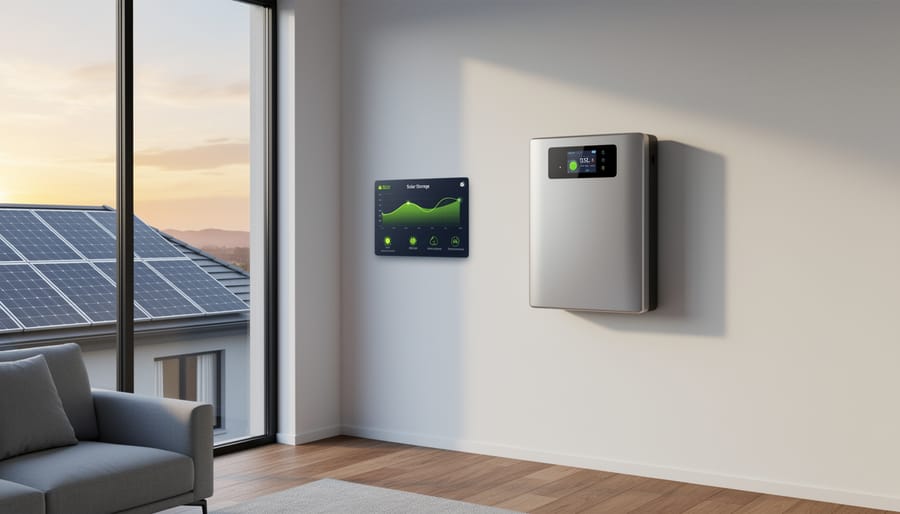
Lithium-ion batteries have become the go-to choice for solar energy storage, and understanding how they work helps explain their popularity. These batteries store energy through a chemical process where lithium ions move between two electrodes—flowing one direction when charging and the opposite direction when discharging. Think of it like water moving back and forth in a reservoir, capturing energy when your solar panels produce excess electricity and releasing it when you need power after sunset or during cloudy periods.
For Illinois homeowners and businesses, lithium-ion systems typically range from 10 to 20 kilowatt-hours (kWh) for residential applications, with commercial installations scaling up to hundreds of kWh depending on energy needs. A standard 13.5 kWh home battery can power essential appliances for 8-12 hours during an outage, while larger systems provide whole-home backup or help businesses avoid costly demand charges.
These batteries generally come with 10-year warranties, though many systems continue performing well beyond that timeframe. You can expect approximately 70-80% capacity retention after a decade of regular use, making them a reliable long-term investment for energy independence.
Illinois weather conditions actually suit lithium-ion technology quite well. Modern systems include thermal management features that maintain optimal operating temperatures, protecting the batteries during our cold winters and humid summers. The batteries typically perform best between 50-85 degrees Fahrenheit, and most quality systems include heating and cooling mechanisms to maintain this range year-round.
The combination of proven reliability, decreasing costs, and excellent performance across our state’s seasonal temperature swings explains why lithium-ion batteries dominate the residential and commercial storage market. Their modular design also allows for future capacity expansion as your energy needs grow.
Flow Batteries: Built for the Long Haul
Flow batteries work differently than the lithium-ion systems most people are familiar with. Instead of storing energy in solid materials, flow batteries store energy in liquid electrolyte solutions held in external tanks. When you need power, these liquids flow through a cell stack where a chemical reaction generates electricity. Think of it like a rechargeable fuel cell that can discharge and recharge thousands of times.
The biggest advantage of flow batteries is their exceptional lifespan. While lithium-ion batteries typically last 10-15 years, flow batteries can operate for 20 years or more without significant capacity loss. They can also handle deeper discharge cycles without degradation, meaning you can use more of the stored energy without shortening the battery’s life.
For commercial and industrial applications in Illinois, flow batteries shine when you need longer discharge times. If your business requires backup power for 4-8 hours rather than the typical 2-4 hours lithium-ion provides, flow batteries become increasingly competitive. Manufacturing facilities, data centers, and agricultural operations with extended power needs often find flow batteries more cost-effective over the system’s lifetime.
The trade-off comes in upfront costs and space requirements. Flow batteries currently cost more per kilowatt-hour than lithium-ion systems and require larger footprints due to their external tanks. However, when you calculate total cost of ownership over 20 years, including replacement costs for shorter-lived alternatives, flow batteries often deliver better value for applications requiring sustained discharge periods.
For most residential applications, the space and cost factors make lithium-ion the practical choice. But for businesses with significant energy demands and available space, flow batteries deserve consideration as a long-term investment in reliable renewable storage.
Hybrid Systems: Getting the Best of Both Worlds
No single storage technology fits every situation, which is why many Illinois businesses are turning to hybrid systems that combine multiple approaches for maximum reliability. By integrating different storage technologies or pairing renewable storage with conventional backup generators, you create a power system that adapts to various scenarios while maintaining critical operations.
A common hybrid configuration pairs lithium-ion batteries for daily cycling with natural gas generators for extended outages. The batteries handle routine tasks like peak shaving and short-duration backup power, while generators provide long-term resilience during multi-day events. This approach is particularly valuable for facilities with critical power needs like medical centers, food processing plants, and data centers.
Another effective strategy combines battery storage with flow batteries or other long-duration technologies. The lithium-ion system responds instantly to power demands, while flow batteries provide sustained energy delivery over longer periods. This configuration optimizes both response time and storage capacity without oversizing expensive components.
Hybrid systems also integrate seamlessly with existing infrastructure. If your facility already has backup generators, adding battery storage reduces generator runtime, lowers fuel costs, and extends equipment life. The batteries handle frequent short-duration events, reserving the generator for genuine emergencies.
For Illinois commercial energy solutions, hybrid systems offer the flexibility to balance upfront costs with operational needs. You can start with battery storage and add complementary technologies as your requirements evolve or as incentive programs make expansion more affordable.
What Storage Capacity Actually Means for Your Property
Understanding storage capacity doesn’t require an engineering degree. At its core, storage capacity is measured in kilowatt-hours (kWh), which tells you how much energy your battery can hold and deliver to your property.
To put this in perspective, a typical Illinois home uses about 30 kWh per day. A standard refrigerator runs on approximately 1-2 kWh daily, while your central air conditioning system might consume 3-5 kWh per hour during peak summer months. A 10 kWh battery system could power essential appliances like your refrigerator, a few lights, your Wi-Fi router, and a laptop for roughly 12-24 hours, depending on your usage patterns.
For residential properties, most Illinois homeowners find that a 10-15 kWh battery system provides adequate backup power for essential loads during grid outages. If you want whole-home backup capability, you’ll likely need 20-30 kWh of storage, or multiple battery units working together. The key is identifying which circuits you absolutely need during an outage versus which ones are nice to have.
Commercial and industrial properties face different calculations. A small business might consume 50-100 kWh daily, while manufacturing facilities or agricultural applications could require several hundred kWh per day. For these properties, storage systems typically range from 50 kWh to several megawatt-hours, depending on operational needs and peak demand management goals.
To estimate your actual storage needs, start by reviewing your utility bills to understand your average daily consumption. Then consider your priorities. Are you mainly concerned about backup power during outages? Focus on essential loads only. Interested in maximizing solar self-consumption and reducing demand charges? You’ll need capacity that matches your usage patterns throughout the day and evening.
Illinois property owners should also factor in seasonal variations. Winter heating and summer cooling significantly impact energy consumption, so your storage capacity should account for these fluctuations. Working with a locally owned solar provider who understands Illinois weather patterns and consumption habits ensures you’ll get sizing recommendations based on real-world conditions rather than generic calculations.
The Real Costs and Payback Timeline in Illinois
Understanding the financial commitment of battery storage helps you make informed decisions about your energy future. In Illinois, residential battery systems typically range from $8,000 to $15,000 for a standard 10-13 kWh unit, while larger 20 kWh systems cost between $15,000 and $25,000. Commercial installations vary significantly based on size and requirements, often starting around $30,000 and scaling upward.
The good news is that Illinois offers substantial support for storage investments. The federal Investment Tax Credit (ITC) covers 30% of your battery storage costs when paired with solar, immediately reducing your upfront expense. Illinois residents can also explore Illinois grants and incentives through programs like the Illinois Shines Adjustable Block Program, which provides additional financial support for renewable energy systems. Many financing options make these systems more accessible, including zero-down loans and lease arrangements.
Payback timelines in Illinois depend on several factors. With average electricity rates around 13 cents per kWh and considering peak demand charges for businesses, most residential systems achieve payback within 10-15 years. This timeline shortens considerably for businesses facing demand charges or properties experiencing frequent outages. When you factor in avoided utility rate increases, which historically average 2-3% annually, the long-term savings become even more compelling.
Beyond energy savings, battery storage adds measurable property value. Studies show that homes with solar and storage systems sell for 3-4% more than comparable properties. For commercial properties, the reliability and sustainability features enhance marketability and tenant appeal.
As a locally owned solar company, we help Illinois residents navigate these financial considerations with transparent, customized proposals that reflect your actual usage patterns and local utility rates, ensuring you understand both the investment and the returns before making any commitment.
Installation Realities: What Happens on Your Property
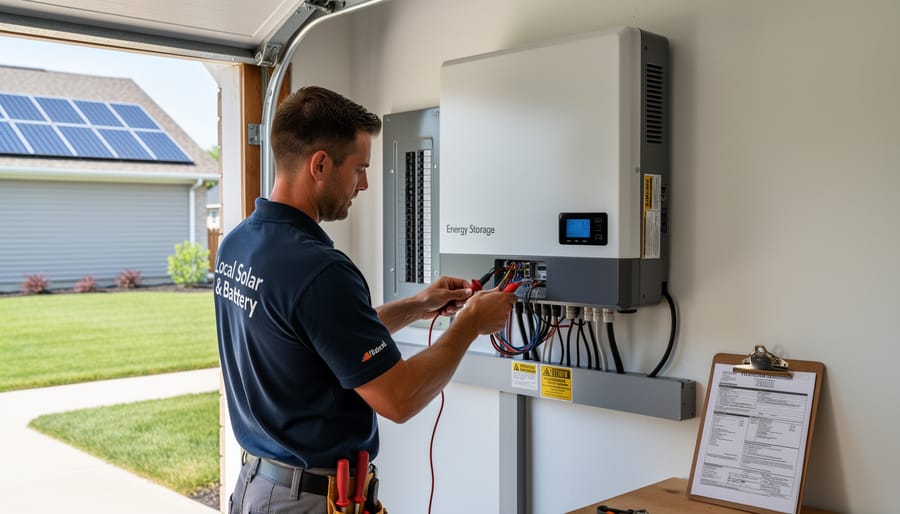
Installing a renewable energy storage system on your property involves several key steps, and understanding the process helps set realistic expectations. The journey typically begins with a comprehensive site assessment where installers evaluate your electrical panel, available space, and existing solar array if you have one. For Illinois properties, this assessment also considers local building codes and utility interconnection requirements, which vary by region.
Space requirements depend on your chosen system. Most residential battery units need approximately 3-4 feet of wall space in a garage, basement, or exterior location. The installation area must maintain temperatures between 32-110°F and remain dry. Business installations requiring larger capacity systems may need dedicated equipment rooms or outdoor pad-mounted enclosures.
Electrical upgrades often represent an overlooked aspect of installation costs. Many older homes require panel upgrades to accommodate the battery system’s electrical demands. Your installer will assess whether your current 100-amp or 200-amp service can handle the additional load or if an upgrade is necessary. These electrical modifications must comply with the National Electrical Code and Illinois-specific requirements.
The actual installation timeline ranges from one to three days for residential systems, depending on complexity and any required electrical work. Commercial installations take longer, sometimes one to two weeks. After physical installation, your system needs inspection and approval from local authorities before activation.
Maintenance requirements remain minimal. Most modern battery systems feature built-in monitoring through smartphone apps, allowing you to track performance and energy usage in real-time. System lifespans typically extend 10-15 years with warranties covering 10 years on average.
Working with experienced local installers familiar with Illinois regulations ensures smooth permitting, proper utility interconnection, and long-term system performance. They understand regional incentive programs and can navigate ComEd or Ameren Illinois requirements efficiently.
Energy storage transforms solar power from a supplemental energy source into a comprehensive solution for Illinois property owners seeking true energy independence. By capturing excess solar generation during peak production hours, battery systems ensure your investment continues delivering value around the clock, through cloudy periods, and during grid outages. This capability is particularly valuable given Illinois’s variable weather patterns and the increasing frequency of power disruptions.
The financial benefits are substantial and measurable. Illinois homeowners and businesses can leverage federal tax credits, state incentives, and net metering programs to offset initial costs while reducing monthly utility bills. With battery systems typically lasting 10-15 years and utility rates continuing to rise, the long-term savings often exceed the upfront investment. Commercial property owners benefit even more through demand charge reduction and uninterrupted operations during outages.
For Illinois properties, the practical advantages extend beyond economics. Manufacturing facilities avoid costly production interruptions, agricultural operations maintain critical systems regardless of weather conditions, and homeowners gain peace of mind knowing their essential appliances remain powered during emergencies.
The next step is straightforward: evaluate your property’s specific energy needs, review available incentive programs, and connect with qualified local solar professionals who understand Illinois’s unique requirements. An experienced provider can assess your consumption patterns, design an integrated solar-plus-storage system tailored to your goals, and guide you through financing options. By partnering with locally owned solar experts who know Illinois regulations and climate considerations, you’ll ensure your system delivers maximum value and reliable performance for decades to come.
