

Illinois Solar Grid Resilience Grants: Powering Through Disasters With Local Support
Illinois homeowners and businesses can now access unprecedented funding opportunities through grid resilience grants, designed to strengthen solar power’s resilience advantage during extreme weather events and power outages. These strategic investments, backed by federal and state initiatives, provide up to 80% coverage for qualifying solar-plus-storage systems, enabling property owners to maintain critical operations during grid disruptions. The Illinois Clean Energy Community Foundation’s latest $25 million allocation specifically targets infrastructure improvements that enhance grid stability across urban and rural communities. Whether you’re a homeowner seeking backup power security or a business aiming to protect operations from outages, these grants offer a practical pathway to energy independence while contributing to Illinois’ broader grid modernization goals.
Understanding Grid Resilience Grants in Illinois
Available Grant Programs
Illinois residents and businesses can access several solar grant opportunities designed to enhance grid resilience. The Illinois Clean Energy Community Foundation offers matching grants of up to $1 million for commercial and industrial facilities implementing solar-plus-storage systems. Small businesses can apply for the Smart Grid Small Business Program, which provides up to $50,000 for grid-enhancing technologies.
Homeowners may qualify for the Residential Resilience Initiative, offering grants between $5,000 and $25,000 for installing battery storage systems paired with existing or new solar installations. The Smart Grid for Schools program supports educational institutions with grants up to $100,000 for implementing advanced energy management systems.
Additionally, the Illinois Department of Commerce and Economic Opportunity administers the Grid Modernization Grant Program, providing funding for large-scale projects that strengthen regional grid infrastructure. Municipalities and public institutions can access special funding through the Public Facility Resilience Grant, covering up to 75% of project costs for critical infrastructure improvements.
Eligibility Requirements
To qualify for grid resilience grants in Illinois, applicants must meet specific criteria established by state and federal programs. Primary eligibility extends to Illinois-based businesses, homeowners with existing solar installations, and organizations operating critical infrastructure facilities. Property owners must demonstrate that their solar energy systems were installed by certified contractors and comply with current state regulations.
Applicants need to show how their proposed resilience improvements will benefit the local grid and community during emergencies. Priority is given to projects in areas with historically unreliable power supply or those serving essential facilities such as hospitals, emergency services, and community centers.
Additional requirements include:
– Current compliance with utility interconnection standards
– Proof of property ownership or long-term lease agreement
– Detailed emergency response and maintenance plans
– Financial documentation showing ability to provide matching funds (typically 25-50% of project costs)
– Clear demonstration of how the project will enhance grid stability
Special consideration is given to projects in environmental justice communities and those incorporating energy storage solutions to maximize grid reliability during outages.
Solar Energy’s Role in Disaster Resilience
Battery Storage Integration
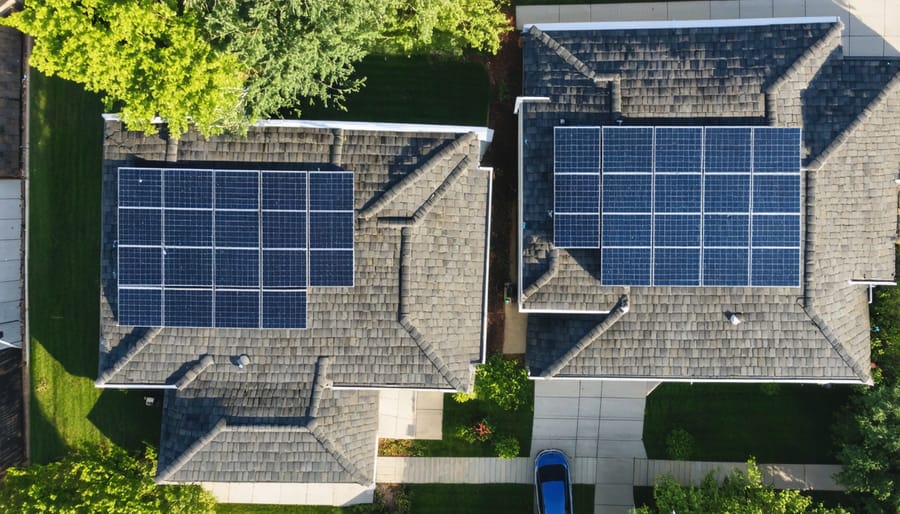
Battery storage systems work as a crucial complement to solar installations, providing a reliable power source when the sun isn’t shining or during grid outages. These systems capture excess energy generated by your solar panels during peak production hours and store it in advanced lithium-ion batteries for later use.
When integrated with your solar installation, battery storage operates automatically through a smart inverter system. During normal operation, your solar panels power your property and charge the batteries simultaneously. If grid power fails, the battery system seamlessly switches on, providing backup power to keep essential systems running.
Modern battery storage solutions can power your property for several hours or even days, depending on the system size and your energy consumption. You can prioritize which circuits receive backup power, ensuring critical equipment like refrigerators, medical devices, or security systems remain operational during outages.
For Illinois property owners, battery storage integration offers additional benefits beyond emergency backup. These systems can help reduce energy costs by drawing from stored power during peak rate periods and contribute to grid stability during high-demand events. When combined with grid resilience grants, the initial investment becomes more manageable while strengthening your property’s energy independence and security.
Regular maintenance and monitoring ensure your battery storage system remains ready to respond when needed, providing peace of mind and reliable backup power for your property.
Microgrid Capabilities
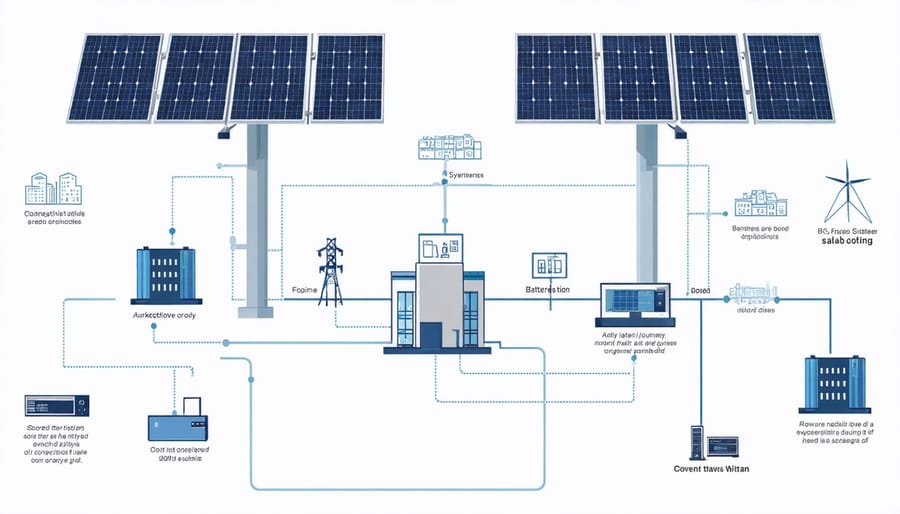
Microgrids represent a groundbreaking approach to power management, offering communities and businesses the ability to operate independently during grid outages. These systems can seamlessly disconnect from the main power grid during emergencies while maintaining electricity supply through local generation sources, primarily solar panels and battery storage systems.
In Illinois, the push for local energy transformation has made microgrids increasingly important for ensuring continuous power supply during extreme weather events or grid failures. When properly configured, a microgrid can power essential services like hospitals, emergency response centers, and critical infrastructure, ensuring community resilience when it matters most.
Key capabilities of microgrids include:
– Autonomous operation during main grid outages
– Integration of renewable energy sources
– Real-time load management and optimization
– Reduced energy costs through peak shaving
– Enhanced power quality and reliability
For property owners, implementing microgrid technology through grid resilience grants can provide both emergency backup power and daily energy cost savings. The system’s ability to prioritize critical loads ensures that essential operations continue uninterrupted, while less critical systems can be managed based on available power resources.
Application Process and Support
Required Documentation
To apply for grid resilience grants in Illinois, you’ll need to prepare the following documentation:
• A completed grant application form from the Illinois Department of Commerce and Economic Opportunity (DCEO)
• Proof of property ownership or written authorization from the property owner
• Recent utility bills showing your current energy consumption patterns
• Detailed project proposal including system specifications and expected outcomes
• Cost estimates from certified solar installers or contractors
• Engineering assessments and feasibility studies for the proposed upgrades
• Documentation of existing solar infrastructure (if applicable)
• Financial statements or proof of matching funds capability
• Environmental impact assessment reports
• Local permit applications and approvals
• Insurance certificates and liability coverage documentation
• Business registration documents (for commercial applications)
• Tax returns from the previous two years
• Photos of the installation site and existing electrical infrastructure
• Grid interconnection studies from your utility provider
We recommend organizing these documents digitally before starting your application. Some requirements may vary based on project size and scope, so it’s advisable to contact your local DCEO office for specific guidance. All technical documentation should be prepared by certified professionals to ensure compliance with state regulations.
Timeline and Deadlines
The Illinois grid resilience grant program operates on a structured timeline throughout the year. Applications for 2024 funding opened on January 15th and will remain available through March 31st. The initial review period spans approximately 45 days, during which the Illinois Power Agency evaluates submissions for completeness and eligibility.
Successful applicants can expect notification by mid-May, with funding disbursement beginning in June. Project implementation must commence within 90 days of grant approval, and recipients have 18 months to complete their resilience improvements.
Key milestone reports are required at 6-month intervals, with the first progress review due within 180 days of project initiation. Final documentation and completion reports must be submitted no later than 60 days after project completion.
For emergency response grants following natural disasters, an expedited process is available with a 14-day review period. These special circumstance applications are accepted year-round, subject to funding availability.
Property owners should note that pre-application workshops are held monthly, offering guidance on requirements and documentation. Attendance at one of these sessions is highly recommended before submitting an application.
Real Success Stories
The impact of grid resilience grants in Illinois is best illustrated through real-world examples. Take the Anderson Manufacturing facility in Rockford, which received a $175,000 grant to install a solar-plus-storage system. During the severe storms of 2022, their facility maintained operations while neighboring businesses experienced extended downtime, saving an estimated $250,000 in potential losses.
In Springfield, the Oak Ridge Community Center transformed its emergency response capabilities with a $120,000 grant. Their new microgrid system, complete with solar panels and battery storage, served as a vital community hub during recent power outages, providing shelter and charging stations for over 300 residents.
The success story of Prairie Farms Dairy in Champaign demonstrates the industrial-scale potential of these grants. Their $300,000 grant funded a comprehensive grid resilience project that reduced power interruptions by 85% and decreased energy costs by 40% annually. The system paid for itself within three years through savings and increased production reliability.
Small businesses have also reaped the benefits. The Family Foods grocery store in Peoria used a $50,000 grant to install backup power systems, preventing inventory losses during grid failures. Owner Maria Rodriguez reports saving over $30,000 in prevented food spoilage during the first year alone.
These examples showcase how grid resilience grants are helping Illinois properties maintain critical operations while achieving significant cost savings and community benefits.
Grid resilience grants represent a vital investment in Illinois’s sustainable energy future. By strengthening our power infrastructure against natural disasters and system failures, these grants help create a more reliable and efficient energy network for everyone. Property owners who take advantage of these opportunities not only protect their own investments but also contribute to building a more resilient community. The time to act is now – with available funding and support from local experts, you can enhance your property’s energy security while participating in Illinois’s clean energy transformation. Don’t wait for the next major outage to consider these improvements. Contact your local solar energy provider today to learn how you can benefit from grid resilience grants and create a more sustainable, secure future for your property.
