

Future-Proof Your Business: Top Renewable Energy Sources That Cut Costs
Renewable energy has transformed from an environmental ideal into a powerful business imperative, with forward-thinking companies saving millions through corporate renewable energy adoption. As Illinois leads the Midwest’s clean energy revolution, businesses and homeowners are discovering five proven renewable resources that offer both environmental benefits and substantial cost savings. From solar arrays dotting warehouse rooftops to wind farms powering industrial operations, these sustainable energy solutions are reshaping our state’s energy landscape. This practical guide explores the most viable renewable options available in Illinois today, complete with implementation strategies, cost considerations, and potential return on investment. Whether you’re a small business owner looking to reduce operating costs or a corporate leader pursuing ambitious sustainability goals, understanding these renewable resources is crucial for making informed energy decisions in today’s competitive market.

Solar Power: The Corporate Energy Game-Changer
Commercial Solar Installation Benefits
Commercial solar installations offer significant financial and operational benefits for businesses in Illinois. By converting unused roof space or land into power-generating assets, companies can substantially reduce their electricity costs while creating a new revenue stream. The federal Investment Tax Credit (ITC) allows businesses to deduct 30% of their solar system costs from their taxes, while Illinois-specific incentives provide additional savings opportunities.
Beyond immediate cost benefits, solar installations enhance property values and demonstrate environmental leadership, which increasingly matters to customers and stakeholders. Companies can expect to see a return on investment within 5-7 years, after which they enjoy virtually free electricity for the system’s remaining lifetime, typically 25-30 years.
Solar power also provides businesses with predictable energy costs, protecting against utility rate increases and market volatility. During peak demand periods, when electricity rates are highest, solar systems generate maximum output, resulting in optimal cost savings. Additionally, businesses can earn renewable energy credits (RECs) and participate in net metering programs, further maximizing their investment’s value while contributing to a more sustainable Illinois.
Illinois Solar Incentives for Businesses
Illinois businesses can significantly reduce their operating costs through various Illinois solar incentives and tax benefits. The Federal Investment Tax Credit (ITC) allows businesses to deduct 30% of their solar installation costs from their federal taxes. Additionally, the Illinois Adjustable Block Program provides performance-based incentives through Solar Renewable Energy Credits (SRECs), offering payments for every megawatt-hour of electricity your system produces.
Local property tax assessments for commercial solar installations are reduced thanks to the Special Assessment for Solar Energy Systems, ensuring your property taxes won’t increase significantly after installation. Businesses can also take advantage of accelerated depreciation through the Modified Accelerated Cost Recovery System (MACRS), allowing for faster return on investment.
The Smart Inverter Rebate Program offers additional savings for qualifying equipment, while various utility companies provide custom incentives for business customers. Many local municipalities offer additional tax abatements and grants, making solar adoption increasingly attractive for Illinois businesses of all sizes.
Wind Energy Solutions for Corporations
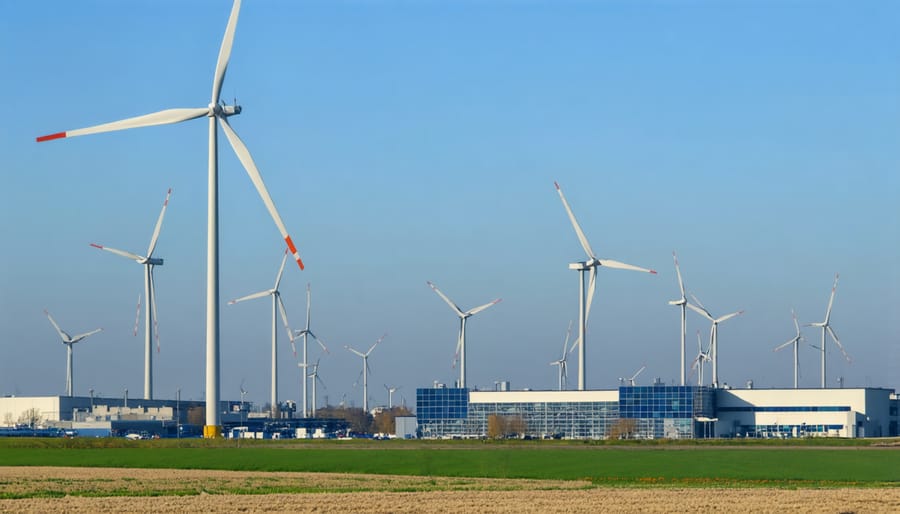
Wind energy solutions offer corporations powerful opportunities to reduce their carbon footprint while potentially lowering energy costs. For businesses in Illinois, both on-site and off-site wind power options present viable paths to renewable energy adoption.
On-site wind solutions involve installing wind turbines directly on company property. This approach works particularly well for facilities with significant land assets, such as manufacturing plants, distribution centers, or corporate campuses in areas with strong wind resources. Companies can choose from various turbine sizes, from smaller models suitable for medium-sized operations to utility-scale turbines that can power large industrial facilities.
Off-site solutions provide flexibility for businesses without suitable land for turbine installation. Power Purchase Agreements (PPAs) allow companies to buy electricity directly from wind farms, often at competitive rates locked in for 15-25 years. Virtual PPAs offer another option, enabling businesses to support wind energy development while maintaining their existing utility relationships.
Corporate wind energy adoption in Illinois benefits from the state’s robust wind resources and supportive regulatory environment. The Prairie State’s flat terrain and consistent wind patterns make it an ideal location for wind energy projects. Many corporations are finding success with hybrid approaches, combining on-site turbines with off-site agreements to meet their renewable energy goals.
Implementation typically begins with a comprehensive site assessment and energy needs analysis. Companies should consider factors such as local zoning regulations, grid interconnection requirements, and available incentives. Working with experienced wind energy consultants can help navigate these considerations and develop a strategy that aligns with corporate sustainability objectives while maximizing financial returns.
Geothermal Energy: Sustainable Climate Control
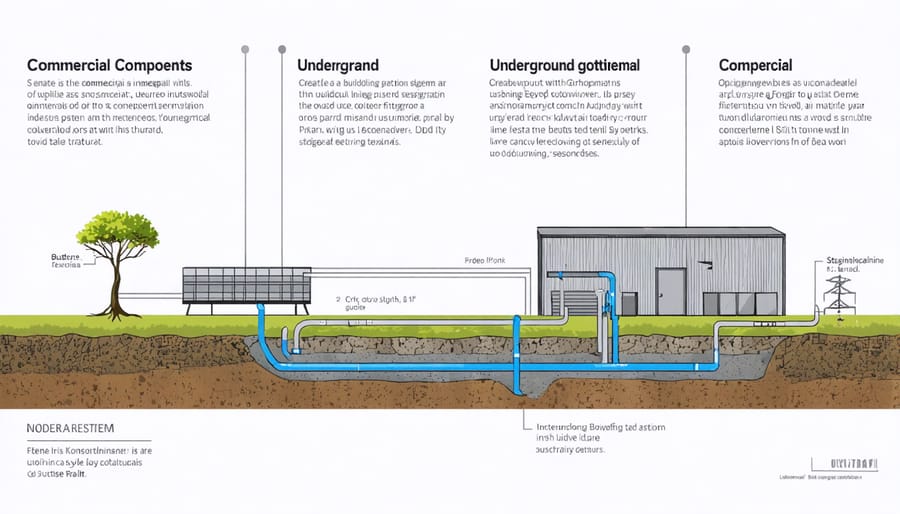
Geothermal energy systems harness the Earth’s constant underground temperature to provide efficient heating and cooling for commercial buildings throughout Illinois. These systems work by circulating fluid through underground pipes, taking advantage of the stable 50-55°F temperature found just a few feet below the surface.
For commercial buildings, geothermal systems offer significant advantages in climate control. The technology uses underground loops filled with water or refrigerant to transfer heat between the building and the Earth. During winter, the system extracts heat from the ground to warm the building, while in summer, it removes heat from the building and deposits it underground.
The initial installation costs for commercial geothermal systems are typically higher than conventional HVAC systems, but the long-term savings are substantial. Businesses can expect to reduce their heating and cooling costs by 40-70% annually. These systems also require minimal maintenance and have a lifespan of 20-25 years for indoor components and 50+ years for ground loops.
Beyond cost savings, geothermal systems provide consistent comfort levels throughout commercial spaces. They operate quietly, eliminate outdoor equipment, and reduce carbon emissions significantly. Many Illinois businesses qualify for federal tax incentives and state rebates when installing geothermal systems, making the transition to this sustainable technology more financially attractive.
For optimal performance in our Illinois climate, proper system sizing and professional installation are essential. Regular maintenance ensures continued efficiency and longevity of the system.
Biomass Energy in Industrial Applications
Biomass energy offers a sustainable solution for industrial processes, particularly in manufacturing facilities across Illinois. By converting organic waste materials into usable energy, businesses can reduce their carbon footprint while managing waste efficiently. Common biomass sources in industrial settings include wood waste, agricultural residues, and food processing byproducts.
Manufacturing facilities can implement biomass systems through direct combustion boilers or gasification processes to generate heat and steam for various industrial applications. These systems can power manufacturing equipment, provide space heating, and support process heating requirements. Many Illinois manufacturers have successfully integrated biomass solutions, particularly in food processing and wood products industries.
The cost-effectiveness of industrial biomass systems depends on factors like fuel availability, transportation costs, and existing infrastructure. Companies can often offset initial investments through reduced waste disposal costs and lower energy bills. Additionally, businesses may qualify for state and federal incentives when implementing biomass energy solutions.
For optimal results, industries should conduct thorough feasibility studies to evaluate local biomass resources and ensure a steady supply chain before implementation. Modern biomass systems feature advanced emission controls and automated feeding systems, making them increasingly practical for industrial applications.
Hydroelectric Power: Corporate Partnerships
Businesses can actively participate in hydroelectric power initiatives through various partnership models with utility companies and power producers. In Illinois, companies can engage in power purchase agreements (PPAs) with hydroelectric facilities along the Mississippi and Illinois Rivers, securing reliable renewable energy while supporting local infrastructure.
Corporate partnerships often take the form of direct investment in hydroelectric projects, where businesses contribute capital for facility upgrades or new development in exchange for guaranteed power rates and environmental credits. Some companies opt for virtual power purchase agreements, allowing them to support hydroelectric generation without physical power delivery.
Many Illinois businesses participate in utility-sponsored programs that allocate a portion of their energy consumption to hydroelectric sources. These programs typically offer flexible terms and can be tailored to match a company’s sustainability goals and budget constraints.
For larger corporations, opportunities exist to develop private hydroelectric facilities on suitable waterways, though this requires significant investment and regulatory compliance. Smaller businesses can join collective purchasing groups to access hydroelectric power at competitive rates while sharing administrative costs.
The transition to renewable energy sources represents a crucial step toward a sustainable future for businesses and communities across Illinois. By embracing these five renewable energy resources, organizations can significantly reduce their carbon footprint while enjoying substantial long-term cost savings. The growing success of corporate renewable energy initiatives demonstrates that sustainable practices and business prosperity can go hand in hand.
For businesses ready to explore renewable energy options, the first step is conducting an energy audit to understand current consumption patterns. This assessment will help determine which renewable resources best suit your needs and infrastructure. Working with local energy consultants can provide valuable insights into available incentives, tax benefits, and implementation strategies specific to Illinois.
Remember that the shift to renewable energy doesn’t have to happen all at once. Start with pilot projects, such as installing solar panels on a portion of your facility or participating in a community wind energy program. As technology continues to advance and costs decrease, the opportunities for renewable energy adoption will only expand, making now the perfect time to begin your organization’s sustainable energy journey.
