
What Is an Energy Community? (And How It Works in Illinois)
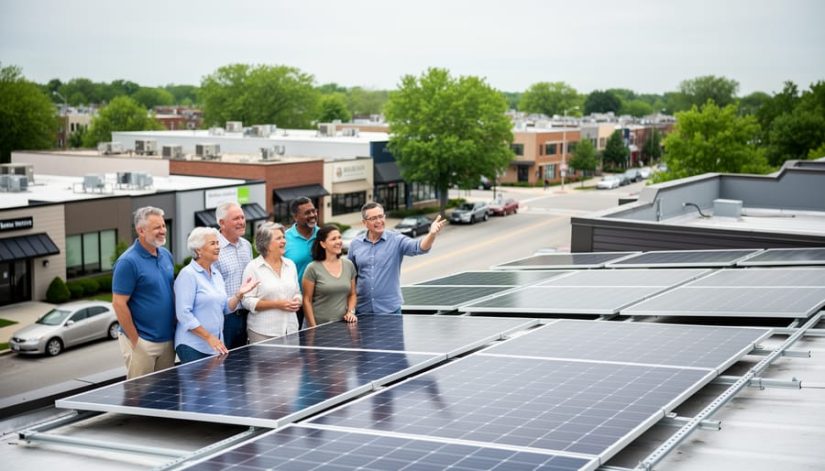
An energy community is a collaborative arrangement in which multiple participants generate, share, or purchase renewable energy together, rather than each installing individual systems. In Illinois, energy communities allow residents, businesses, and organizations to pool resources, reduce costs, and access clean energy benefits even if their properties aren’t suitable for solar panels.
The concept has gained significant traction as electricity costs continue rising and climate concerns push communities toward practical renewable solutions. For homeowners unable to install rooftop solar due to shading, roof condition, or rental status, energy communities offer a real path to renewable energy participation. Business owners find them appealing because shared infrastructure reduces upfront investment while still delivering long-term savings on energy bills.
Illinois has positioned itself at the forefront of this movement through supportive state policies and incentive programs designed to make energy communities accessible across different income levels and geographic areas. The model shifts energy production from a purely individual decision to a collective strategy, spreading both the financial commitment and the environmental impact across multiple stakeholders.
This article breaks down exactly what energy communities are, how they operate in practice, the different models you can choose from, and where they make the most sense for Illinois residents and businesses. Whether you’re exploring alternatives to individual solar installations or trying to understand how your community might benefit from shared renewable infrastructure, you’ll find the framework and practical details needed to evaluate this increasingly popular option.
Energy Community Definition
An energy community is a collaborative arrangement where multiple households, businesses, or organizations pool their resources to invest in and benefit from a shared renewable energy system, typically solar. Rather than each participant installing their own panels, members subscribe to or own a portion of a larger, collectively-managed solar array located elsewhere in their utility service area.
This model operates on three core principles. First, shared renewable energy generation means the community develops a single solar installation that serves multiple participants, achieving economies of scale that individual projects cannot match. Second, collective participation allows members to join based on their energy needs and financial capacity, making solar accessible to renters, condo owners, and those with unsuitable roofs. Third, community ownership models vary from member-owned cooperatives to third-party-developed subscription programs, but all distribute the financial benefits among participants through utility bill credits or direct savings.
- Collective Self-Consumption
- A model where community members directly share the electricity generated by their joint renewable energy system, consuming power produced within their local network.
- Virtual Net Metering
- The billing mechanism that allocates solar credits from a shared array to individual participants’ utility accounts based on their subscription share, without physical delivery of electrons to each property.
- Community Solar
- A subscription-based program allowing residents and businesses to receive solar benefits from an off-site array without installing equipment on their own property.
- Shared Savings
- The financial benefits distributed among energy community members, typically through reduced utility bills or direct payments based on their ownership or subscription percentage.
- Local Energy Resilience
- Enhanced community-wide energy security achieved through distributed generation, reducing dependence on centralized grid infrastructure and improving recovery from outages.
The fundamental difference from individual solar installations lies in access and scale. Where rooftop solar requires suitable property conditions and upfront capital, energy communities open solar participation to anyone within the utility territory, regardless of their roof orientation, shading issues, or homeownership status.
How Energy Communities Work
The Formation Process
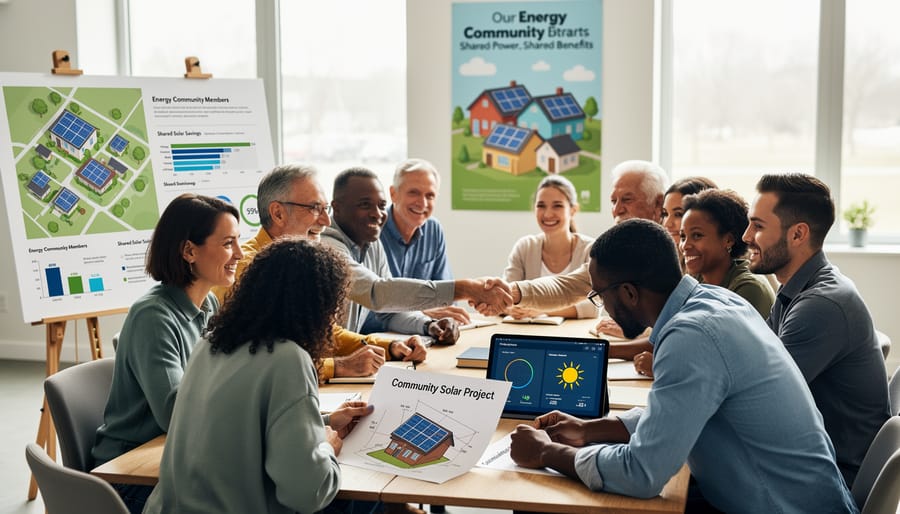
Forming an energy community starts with bringing together interested neighbors, businesses, or property owners who share the goal of accessing affordable renewable energy. Initial conversations often happen through local sustainability groups, homeowner associations, or organized community-driven energy workshops that introduce the concept and gauge interest.
Once a core group forms, members establish governance structures that define decision-making authority, membership criteria, and operational responsibilities. These community governance frameworks typically outline voting rights, leadership roles, and how major decisions about site selection, equipment choices, and financial arrangements will be made. Some groups adopt cooperative bylaws with democratic member control, while others create subscription agreements managed by a third-party developer.
Participation terms must clearly spell out financial commitments, how energy credits or savings will be allocated, minimum subscription periods, and exit procedures. Community-driven energy workshops play a valuable role here, helping potential members understand their obligations, compare different models, and ask questions before committing. These educational sessions ensure participants enter with realistic expectations about costs, timeline, and their ongoing responsibilities to the collective effort.
Energy Generation and Distribution
Once a community solar array is in place, it generates electricity just like any rooftop system, photovoltaic panels convert sunlight into DC power, which an inverter transforms into usable AC electricity. The key difference lies in what happens next.
In Illinois, the generated energy typically flows directly into the local utility grid. Community members don’t receive physical electricity from “their” panels. Instead, participants earn credits on their monthly utility bills proportional to their subscription size or ownership stake. If you subscribe to 2 kilowatts of a 100-kilowatt array, you’d receive roughly 2% of the system’s total production credits each month.
ComEd and Ameren Illinois calculate these credits based on the actual kilowatt-hours the shared array produces. During sunny summer months, your credits might exceed your home’s consumption, rolling over to offset winter bills. The utility handles all metering and credit allocation automatically, you simply see the reduction on your statement.
This virtual net metering approach means renters, condo owners, and anyone without a suitable roof can access solar savings without installing hardware on their property.
Financial and Administrative Management
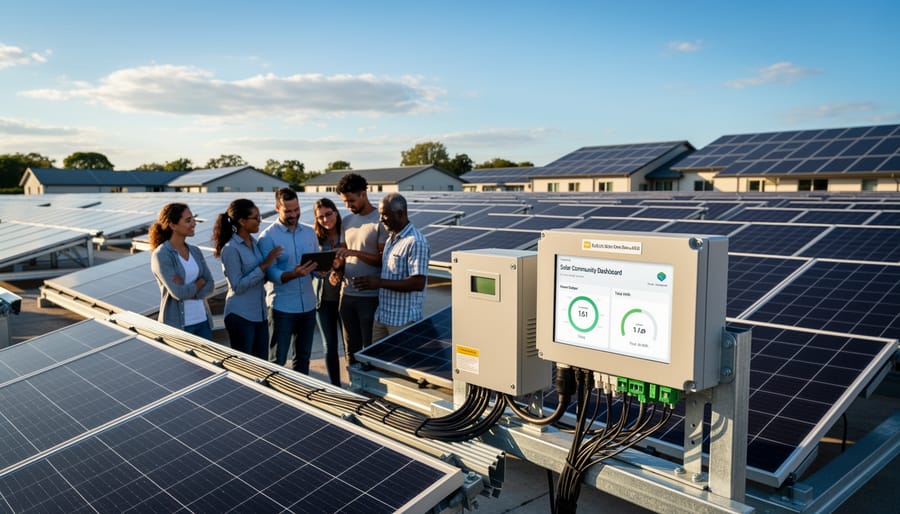
The financial mechanics of energy communities operate through a centralized administrative structure that tracks each member’s share of energy production and translates it into bill credits or direct savings. Most Illinois community solar programs partner with utility companies to apply credits automatically to participants’ monthly electric bills, eliminating the need for members to manage payments or calculations themselves.
A community manager or third-party administrator handles ongoing tasks: collecting subscription fees or ownership contributions, coordinating maintenance schedules for solar equipment, purchasing insurance coverage, and distributing financial reports to members. This collective approach spreads administrative costs across all participants, making professional management affordable while ensuring the system operates efficiently without requiring technical expertise from individual members.
Types of Energy Communities
Community Solar Programs
Community solar programs offer the most accessible entry point for Illinois residents and businesses interested in solar energy without the commitment of installing their own panels. Through a subscription model, participants essentially “rent” a portion of a larger solar array, typically located on a nearby commercial building, vacant land, or open field, and receive monthly credits on their electricity bill proportionate to their share of the system’s production.
In Illinois, the Adjustable Block Program and Illinois Shines initiative have significantly expanded community solar availability, making these programs particularly attractive for renters, homeowners with shaded roofs, and anyone who wants predictable energy savings without upfront installation costs. Subscribers pay a monthly fee that’s typically lower than the credits they receive, resulting in net savings of 10-20% on their electricity bills.
The subscription process is straightforward: you sign up for a share size based on your typical energy usage, the solar array generates power that feeds into the grid, and your utility applies credits to your bill based on your subscription’s production. You can usually cancel or adjust your subscription with 30-90 days’ notice, making this a flexible option for those unsure about long-term commitments or planning to move within a few years.
Cooperative Energy Communities
Cooperative energy communities operate as member-owned organizations where participants hold equity stakes in shared renewable energy systems. Unlike subscription models, co-op members actually own a portion of the solar array or other generation assets, similar to how credit unions function in the financial sector.
Members typically purchase shares to join, with voting rights structured democratically, often one vote per member regardless of investment size. This governance model means participants collectively make decisions about system expansion, maintenance priorities, and how surplus revenue gets distributed. In Illinois, energy co-ops can take advantage of state incentives while maintaining local control over operations.
The ownership structure offers distinct financial benefits. Members receive returns through energy bill savings and may earn dividends when the co-op generates surplus revenue. However, this model requires more active participation than simple subscription programs. Members often serve on boards, attend meetings, and contribute to decision-making processes.
Co-ops work particularly well for groups who want long-term control and community building alongside energy savings. The structure fosters collaboration among neighbors, local businesses, or agricultural communities sharing similar energy goals and values around renewable development.
Neighborhood or District Energy Systems
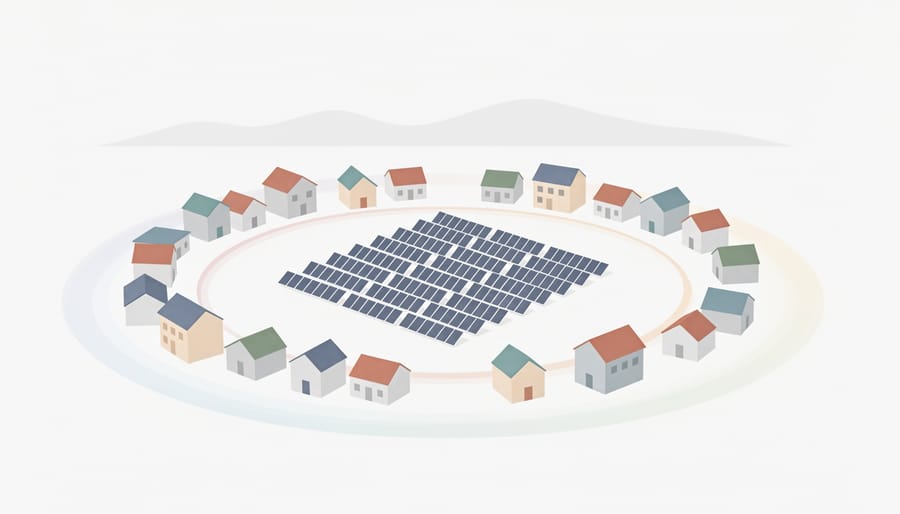
Neighborhood or district energy systems connect multiple adjacent properties to shared solar arrays and battery storage through a local microgrid. Rather than subscribing remotely, participants benefit from energy generated within their immediate area, sometimes just blocks away. These hyperlocal setups keep power flowing during grid outages because the microgrid can “island” itself and operate independently, making them especially valuable for hospitals, fire stations, and community centers that need uninterrupted electricity.
In Illinois, district energy systems often pair rooftop solar on municipal buildings with ground-mounted arrays and centralized battery banks that serve an entire block or subdivision. Participants typically own or lease a share of the generation capacity, and the system’s proximity to the point of use reduces transmission losses and strengthens grid reliability. Because these networks require coordination among property owners, developers, and utilities, community-driven energy workshops help residents understand governance structures, cost allocation, and the broader local impact of keeping energy production and investment within the neighborhood. While district systems demand more upfront planning than remote community solar, they deliver measurable resilience and foster stronger ties among neighbors invested in shared infrastructure.
Uses and Benefits of Energy Communities
For Homeowners and Renters
Energy communities open the door to solar savings for homeowners who can’t install rooftop panels. If your roof faces the wrong direction, sits under heavy tree shade, or needs structural repairs before it can support an array, you can still participate in a shared solar project. Renters gain access too, since you don’t need to own your property or get landlord approval to subscribe to a community solar program.
The financial barrier also drops significantly. Instead of paying $15,000 to $30,000 upfront for a home system, you join with a low or zero enrollment fee and receive monthly utility bill credits based on your share of the community array’s production. Many Illinois programs offer month-to-month subscriptions, so you’re not locked into long-term contracts if your housing situation changes.
For those new to solar concepts, solar training learning resources help you understand how community solar works before committing. You’ll learn how credits appear on your ComEd or Ameren bill and what percentage of your electricity costs the shared array typically offsets.
For Businesses and Commercial Properties
Commercial properties and businesses often face significant energy expenses that directly impact their bottom line. Energy communities offer these entities a practical way to reduce operating costs through shared solar generation, often with 10-20% savings on electricity bills without the full capital outlay required for a dedicated rooftop system.
Beyond cost reduction, participation strengthens a company’s sustainability profile. Energy community membership provides verifiable renewable energy use that can be included in environmental reports, appeals to eco-conscious customers, and helps meet corporate sustainability targets. This becomes particularly valuable for businesses in leased spaces where installing proprietary solar systems isn’t feasible.
The shared infrastructure model also distributes financial risk. Rather than investing hundreds of thousands in a single facility’s solar array, businesses contribute to a community system, gaining renewable energy access with lower upfront costs and shared maintenance responsibilities. For multi-location operations, this approach provides a scalable path to clean energy across several properties.
For Communities and Municipalities
Energy communities deliver measurable benefits beyond individual participants, strengthening entire municipalities and regions. Local job creation stands among the most immediate impacts, from installation and maintenance positions to administrative roles managing community programs. These jobs typically stay within the community rather than flowing to distant corporate headquarters.
Energy resilience improves when communities diversify their power sources. Distributed solar arrays reduce strain on centralized grid infrastructure and provide backup capacity during peak demand or emergencies. Some Illinois municipalities have integrated energy communities with microgrid systems, maintaining essential services during outages.
Environmental gains accumulate at scale. A 2-megawatt community solar project can offset roughly 3,000 metric tons of carbon dioxide annually, equivalent to removing 650 cars from roads. This supports municipal climate action goals and improves local air quality.
Economic development follows as well. Energy communities keep energy dollars circulating locally, reduce municipal energy expenses, and can attract businesses prioritizing sustainability. Property values often increase in areas with established renewable infrastructure, expanding the tax base while demonstrating community-wide commitment to clean energy leadership.
Getting Started with Energy Communities in Illinois
Taking the first step into an energy community doesn’t require technical expertise or a large upfront investment. Illinois residents and businesses have several entry points depending on their goals and circumstances.
Start by attending community-driven energy workshops in your area. These sessions provide foundational knowledge about how energy communities operate, what participation entails, and which models might fit your situation. You’ll connect with neighbors exploring similar options and learn directly from organizers who’ve helped establish local projects. Many workshops also introduce you to existing community solar programs accepting new members.
If you’re interested in joining an established community solar program, review current offerings through the Illinois Shines program database or contact local solar cooperatives. Compare subscription terms, projected savings, contract length, and cancellation policies. Most programs require minimal commitment, just a simple enrollment form and agreement to receive energy credits on your utility bill.
For those considering forming a new energy community, gather a core group of interested participants first. Five to ten committed members provide enough momentum to explore feasibility, secure initial quotes from solar developers, and establish basic governance. Community workshops can guide you through site selection, financing options, and the regulatory requirements specific to Illinois.
Reach out to organizations that have built thriving communities around shared solar projects. Many offer mentorship or consulting to new groups navigating formation processes. The Illinois Solar Energy Association also maintains resources on cooperative development and community solar best practices.
Whether joining or forming, the key is taking that initial step, attending a workshop, making contact with an existing program, or convening your neighbors to discuss shared energy goals.
Frequently Asked Questions
Energy communities remain relatively new to many Illinois residents, and prospective participants often have similar questions about how these systems work in practice. Understanding the financial, logistical, and contractual aspects helps homeowners and businesses make informed decisions about whether joining an energy community aligns with their goals.
How do costs compare to installing individual solar panels?
Energy community participation typically requires no upfront installation costs or equipment purchases. Instead, members pay a subscription fee or agree to purchase energy credits at rates usually 5-15% below their current utility rates, making it accessible for those who cannot afford the $15,000-$30,000 investment for rooftop solar.
What happens if I move to a different address?
Most energy community contracts allow you to transfer your subscription to someone else, cancel with notice (typically 30-90 days), or in some cases, transfer your participation to your new address if it’s within the same utility territory. Review contract terms before joining to understand your specific exit options.
How are my savings calculated and distributed?
Your utility company applies credits to your monthly bill based on your share of the community solar array’s production. The credit amount reflects the kilowatt-hours generated by your portion of the system, and you pay the energy community’s rate for those credits, which is set below your utility’s standard rate.
What role does my local utility play in an energy community?
Your utility company remains your electricity provider and handles billing, infrastructure maintenance, and grid connection. They apply the energy credits from your community solar participation to your bill but are not typically involved in managing the energy community itself.
Eligibility requirements vary by program but are generally inclusive. Most community solar programs in Illinois accept homeowners, renters, and businesses within specific utility service territories. Credit checks may apply for some subscription models, though many programs offer options for participants with lower credit scores. Property ownership is not required, making these programs particularly valuable for renters and those in multi-unit buildings who lack control over their roof space.
The flexibility built into most energy community contracts addresses common concerns about long-term commitment. While initial contract terms often run 15-25 years for cooperative ownership models, subscription-based community solar programs typically offer shorter commitments of one to three years with straightforward cancellation processes.
Types or components
Energy communities in Illinois typically comprise several essential components that work together to deliver shared renewable energy benefits to participants.
Solar Array Infrastructure forms the foundation, consisting of photovoltaic panels, inverters, racking systems, and electrical equipment installed at a dedicated site. These arrays are sized to serve multiple households or businesses rather than a single property.
Metering and Monitoring Systems track energy production and allocate credits or savings to participants. Virtual net metering technology allows the utility to distribute generation credits across multiple accounts without physical connection to each property.
Governance Structure establishes how decisions are made, whether through cooperative boards, subscription agreements, or municipal oversight. This component defines member rights, voting procedures, and conflict resolution processes.
Financial Mechanisms handle billing, credit allocation, and revenue distribution. This includes subscription fees, shared maintenance costs, and the formulas used to divide savings among participants based on their ownership stake or subscription level.
Legal Framework encompasses the contracts, easements, and regulatory compliance documents that formalize the community’s operation and protect participant interests under Illinois energy law.
Energy communities represent a practical pathway to solar energy for Illinois homeowners and businesses who want the benefits of renewable power without the constraints of individual rooftop installations. Whether you’re renting, dealing with shading issues, or simply prefer a collaborative approach, these shared solar models open doors that traditional systems can’t.
The transition from understanding energy communities to active participation starts with education. Community-driven energy workshops provide the foundation, helping you grasp how these systems work, what participation entails, and which model aligns with your goals. From there, you can evaluate local programs, connect with existing communities, or explore forming new ones with neighbors who share your vision.
As a locally owned company serving Illinois, we’ve seen firsthand how energy communities strengthen both individual energy independence and collective resilience. They reduce costs, increase access to clean energy, and build stronger connections within neighborhoods and business districts. The collaborative nature means shared expertise, distributed risk, and solutions that adapt to your specific circumstances rather than forcing you into a one-size-fits-all approach.
Ready to explore how energy communities might work for your home or business? Start with education, ask questions, and discover whether individual solar or community participation makes the most sense for your situation.
