

How Solar Energy Creates Real Economic Value in Illinois Communities
When you flip on a light switch or power up your business equipment, you’re participating in something far more complex than a simple transaction with your utility company. Every energy decision ripples through your local economy, affecting jobs, tax revenues, property values, and community resilience. An integrated economy approach reveals these interconnected effects, showing how renewable energy investments create cascading benefits that traditional cost-benefit analyses often miss.
Think of Illinois’s economy as a web rather than a collection of isolated transactions. When a manufacturing facility in Rockford installs solar panels, the immediate cost savings represent just the beginning. Local electricians gain specialized skills, property tax revenues shift, insurance costs adjust, and the facility’s competitive position strengthens. These changes trigger additional effects as employees spend their wages differently, the company reinvests savings, and neighboring businesses reconsider their own energy strategies.
Integrated energy communities demonstrate this principle in action across Illinois. Rather than viewing solar adoption as individual property decisions, this framework examines how coordinated renewable energy deployment transforms entire neighborhoods and business districts. The economic impacts extend beyond energy bills to encompass workforce development, supply chain evolution, infrastructure modernization, and community wealth building.
Understanding integrated economic effects empowers better decision-making for homeowners, business owners, and industries. It reveals opportunities invisible in traditional financial models and helps you recognize how your energy choices strengthen the broader Illinois economy while improving your bottom line.
What Is an Integrated Energy Community Economy?
The Three Pillars of Energy Economic Integration
Understanding how renewable energy investments create lasting economic value requires examining three interconnected pillars that form the foundation of energy economic integration. These elements work together to transform solar communities from simple energy producers into economic engines for local development.
The first pillar, direct financial benefits, encompasses the immediate monetary advantages flowing to community members. This includes reduced energy costs for homeowners and businesses, property tax revenues generated by solar installations, and lease payments to landowners hosting solar arrays. In Illinois, these direct benefits often begin within months of project completion, providing quick returns that stabilize household and business budgets while funding essential municipal services.
Local job creation and retention forms the second pillar, addressing both immediate construction employment and long-term maintenance positions. Solar projects require skilled electricians, engineers, project managers, and technicians throughout their 25-plus year operational life. When these positions are filled by locally owned companies with expertise in solar energy, wages circulate within the community rather than flowing elsewhere, multiplying the economic impact through subsequent local spending.
The third pillar, community infrastructure development, represents the broader systemic improvements enabled by renewable energy adoption. This includes upgraded electrical grid components, enhanced emergency backup power capabilities, and workforce development programs that prepare residents for emerging green economy careers. These infrastructure improvements attract additional businesses and investment, creating a positive feedback loop that strengthens the entire local economy beyond the original energy project scope.
Together, these three pillars demonstrate why integrated economic analysis provides a more complete picture than traditional return-on-investment calculations alone.
Direct Economic Impact: Where Your Solar Investment Goes
Local Labor and Installation Jobs
When you choose a locally owned solar company for your installation, you’re directly investing in your community’s workforce and economic vitality. Unlike national chains that may send profits out of state, companies rooted in Illinois keep installation dollars circulating locally through strategic hiring practices and contractor relationships.
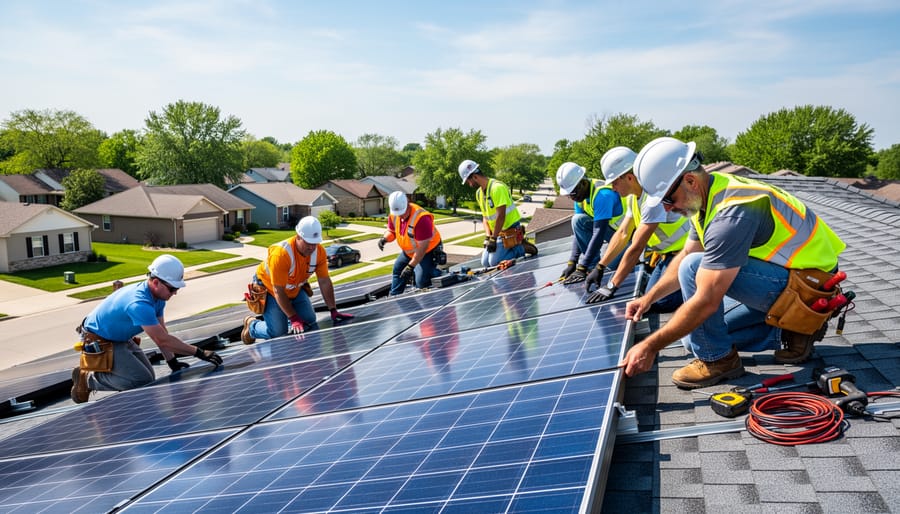
Local solar installers create direct employment opportunities for Illinois residents across multiple skill levels. From certified electricians and roofers to project managers and engineers, these positions offer competitive wages that support local families. The installation process itself requires a diverse team, meaning one solar project can provide income for numerous households in your area.
Beyond direct employees, locally owned solar companies build partnerships with regional contractors and suppliers. This creates a network effect where each installation generates revenue for multiple Illinois businesses. Local electricians handle grid connections, regional roofing companies ensure proper mounting systems, and Illinois-based suppliers provide materials and equipment. These contractor relationships mean that your solar investment multiplies throughout the community, supporting established businesses while enabling them to hire additional workers.
The training and skill development that comes with solar installation work also benefits the community long-term. As workers gain expertise in renewable energy systems, they bring valuable knowledge that positions Illinois communities at the forefront of the clean energy transition. This expertise stays local, creating a foundation for sustained economic growth and energy independence that extends well beyond the initial installation.
Construction and Supporting Services
Solar energy projects generate substantial economic activity through construction and supporting services that extend far beyond equipment installation. When Illinois businesses and homeowners invest in solar systems, they create demand for numerous local service providers who contribute meaningfully to the regional economy.
Professional roof installation and reinforcement services often represent the first phase of solar preparation. Many properties require structural assessments and modifications before solar arrays can be safely mounted. Licensed roofers evaluate load-bearing capacity, make necessary repairs, and ensure installations meet building codes. This work keeps construction professionals employed and circulating income within local communities.
Electrical contractors play an equally vital role in solar project completion. These skilled tradespeople handle complex wiring connections, inverter installations, and grid integration work that requires specialized knowledge. Illinois employs thousands of licensed electricians who benefit from the growing solar sector, with each project requiring multiple service calls and ongoing maintenance relationships.
Permit acquisition and inspection services represent another important economic component. Local building departments, engineering firms, and certified inspectors all participate in ensuring solar installations meet safety standards and regulatory requirements. These administrative and technical services support government operations and professional service businesses throughout the state.
Locally owned solar companies understand these interconnected economic relationships best. By partnering with established Illinois contractors and service providers, solar projects amplify their economic impact across multiple sectors. Each installation becomes a catalyst for job creation, skills development, and business growth that strengthens the broader service economy while advancing clean energy goals.
The Multiplier Effect: How Solar Spending Circulates
Real Examples from Illinois Communities
Across Illinois, solar projects are creating measurable economic ripple effects that extend far beyond the installation phase. When a manufacturing facility in Rockford invested in a commercial solar array, the project employed local electricians and construction crews for six months. Those workers spent their paychecks at nearby restaurants, hardware stores, and service businesses, creating what economists call secondary economic benefits.
In Bloomington, a 50-acre solar farm generated lasting tertiary impacts when the developer contracted with a locally owned landscaping company for ongoing maintenance. This consistent revenue stream allowed the landscaping business to purchase new equipment and hire two additional full-time employees, who in turn supported other local businesses through their household spending.
Champaign County provides another compelling example. A group of agricultural properties leasing land for solar installations generated stable income that farmers reinvested into their operations, purchasing equipment from local dealers and hiring seasonal workers from the community. The tax revenue from these projects funded school improvements and road maintenance, benefiting residents who had no direct connection to the solar facilities.
These examples demonstrate how initial solar investments create interconnected economic pathways throughout Illinois communities. Every dollar spent on solar development circulates through the local economy multiple times, supporting jobs in unexpected sectors from accounting firms to equipment suppliers. This integrated approach to economic analysis reveals the true community value of renewable energy adoption.
Long-Term Community Benefits Beyond Installation
Property Values and Tax Base Stability
Solar installations create measurable impacts on property values and municipal tax bases throughout Illinois communities. Research consistently shows that homes with solar panel systems typically sell for more than comparable properties without solar, with premium values ranging from 3% to 4% in many markets. This increase reflects buyer recognition of long-term energy savings and environmental benefits that solar provides.
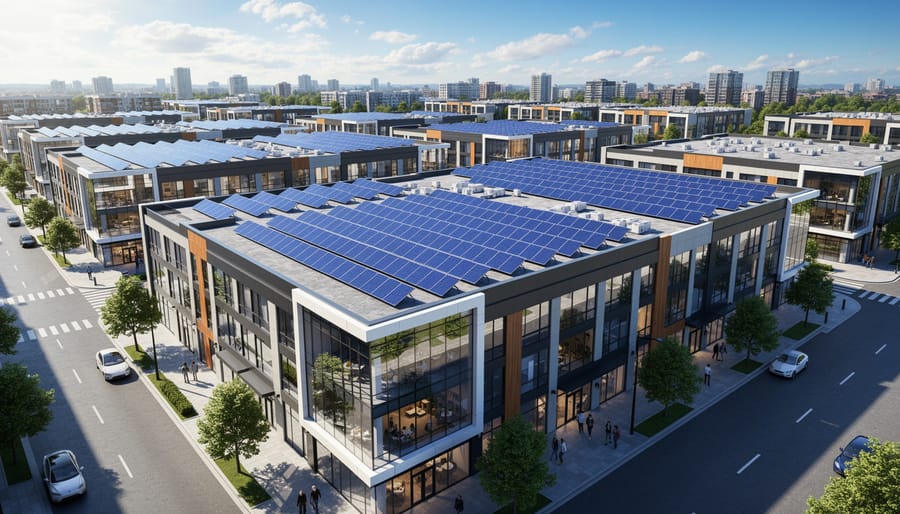
For Illinois municipalities, solar installations contribute to tax base stability in several important ways. Commercial and industrial solar projects add substantial value to the tax rolls, generating property tax revenue that supports local schools, infrastructure, and public services. Unlike some economic development that may require expensive utility extensions or road improvements, solar projects often utilize existing infrastructure, minimizing municipal costs while maximizing tax benefits.
Residential solar adoption also strengthens neighborhood property values over time. As more homeowners invest in solar energy systems, communities demonstrate commitment to sustainable practices that attract environmentally conscious residents and businesses. This creates a positive cycle where property values remain stable or increase, even during economic uncertainty.
Illinois assessment practices recognize solar installations as property improvements, though the state offers exemptions to encourage adoption. The Solar Energy System Property Tax Assessment law provides certain protections for residential solar owners, ensuring installations don’t create prohibitive tax increases while still contributing to municipal revenue streams.
Locally owned solar providers understand these dynamics and help property owners navigate the financial implications of solar investments. By explaining both immediate value additions and long-term tax considerations, they ensure Illinois residents and businesses make informed decisions that benefit their properties and strengthen community tax bases for essential services.
Energy Cost Savings Reinvested Locally
When Illinois households and businesses switch to solar energy, the financial benefits extend far beyond their own balance sheets. reduced energy costs create a ripple effect throughout local economies by freeing up capital that would otherwise flow to distant utility companies or fossil fuel suppliers.
Consider a typical Illinois family that saves $1,200 annually on electricity bills after installing solar panels. That money doesn’t simply disappear into savings accounts. Instead, it becomes available for spending at local restaurants, retail shops, service providers, and entertainment venues. When multiplied across dozens or hundreds of households in a community, these savings inject substantial purchasing power into the local economy.
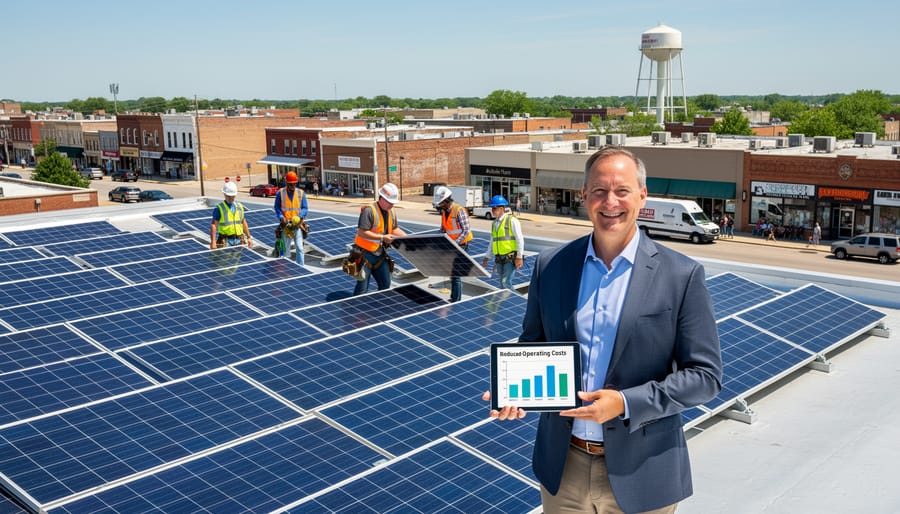
The same principle applies to businesses on a much larger scale. A manufacturing facility that reduces its annual energy costs by $50,000 can reinvest those funds in equipment upgrades, employee wages, or expanded operations. Small businesses with tighter margins find that lower utility bills provide the flexibility to hire additional staff or improve customer offerings.
This locally circulated capital creates what economists call a multiplier effect. Each dollar saved on energy bills changes hands multiple times within the community, generating additional economic activity with each transaction. Local business owners who receive this spending can then pay their employees more, purchase inventory from other local suppliers, or invest in business improvements, keeping the economic benefits cycling through the community rather than leaving it entirely.
Measuring Success: Key Economic Indicators for Integrated Energy Communities
Understanding whether your renewable energy investments are truly strengthening your local economy requires tracking the right indicators. For Illinois communities and businesses investing in solar energy, these practical metrics provide clear insights into economic integration and community-wide benefits.
Start with direct job creation numbers. Count both temporary construction positions and permanent operations roles created by your energy projects. Track whether these positions are filled by local residents, as this indicates how effectively investment dollars are circulating within your community rather than leaving it.
Monitor local spending patterns through vendor contracts. Calculate what percentage of your renewable energy project spending goes to Illinois-based suppliers, contractors, and service providers. Communities with strong integrated economies typically see 60-70 percent of project dollars remaining local.
Property tax revenue provides another concrete measure. Solar installations add to the tax base while requiring minimal public services. Compare your community’s increased tax revenues from energy projects against infrastructure costs to understand net fiscal impact.
Business retention and attraction rates matter significantly. Survey local companies about how access to renewable energy influences their location decisions. Growing businesses often cite energy cost predictability and sustainability commitments as key factors in choosing where to operate.
Track energy cost savings across different sectors. Homeowners, small businesses, and industries should all see measurable reductions in electricity expenses. These savings represent money available for other local spending, creating multiplier effects throughout your economy.
Finally, measure community resilience through energy independence ratios. Calculate what percentage of local energy needs your community generates versus imports. Higher local generation means more money staying in Illinois rather than paying out-of-state utilities, strengthening your economic foundation while building energy security.
When you choose solar energy for your Illinois home or business, you’re making more than an environmental decision—you’re making an economic one that ripples throughout your community. The integrated economy framework demonstrates how every dollar spent on solar installation doesn’t simply disappear into a corporate balance sheet. Instead, it circulates through local businesses, supports neighborhood jobs, and strengthens the financial foundation of your region.
Selecting locally owned solar providers amplifies these benefits exponentially. Local companies hire Illinois workers, source materials from regional suppliers when possible, and reinvest profits back into the communities they serve. This creates a multiplier effect where your initial investment generates additional economic activity at every stage. When installation crews shop at local stores, when providers sponsor community events, and when employees pay property taxes, your solar decision contributes to building stronger communities.
The broader economic impact of your energy choices extends beyond immediate transactions. By supporting local solar expertise, you help establish Illinois as a renewable energy hub, attracting further investment and innovation to the state. You contribute to a more resilient regional economy less dependent on energy imports and price volatility.
As you evaluate solar options, consider asking providers about their local workforce, community involvement, and regional partnerships. These factors directly correlate with how much of your investment stays within Illinois borders. Your energy decision carries economic weight—make it count for your community’s prosperity while advancing your own energy independence and sustainability goals.
