

Floating Wind Turbines Are Revolutionizing Clean Energy Production
Floating wind turbines are revolutionizing offshore renewable energy, pushing the boundaries of what’s possible in clean power generation. Unlike traditional fixed-bottom turbines, these innovative renewable energy technologies can be deployed in deeper waters where wind resources are stronger and more consistent. By combining advanced naval engineering with proven wind power technology, floating turbines open up vast new areas of ocean for sustainable energy production, potentially generating enough electricity to power millions of homes worldwide.
This breakthrough technology addresses one of wind energy’s biggest challenges: the limited availability of suitable shallow-water sites for traditional offshore installations. With nearly 80% of the world’s best wind resources located in waters too deep for conventional turbines, floating platforms represent a game-changing solution that could dramatically accelerate our transition to clean energy while reducing costs and environmental impact.
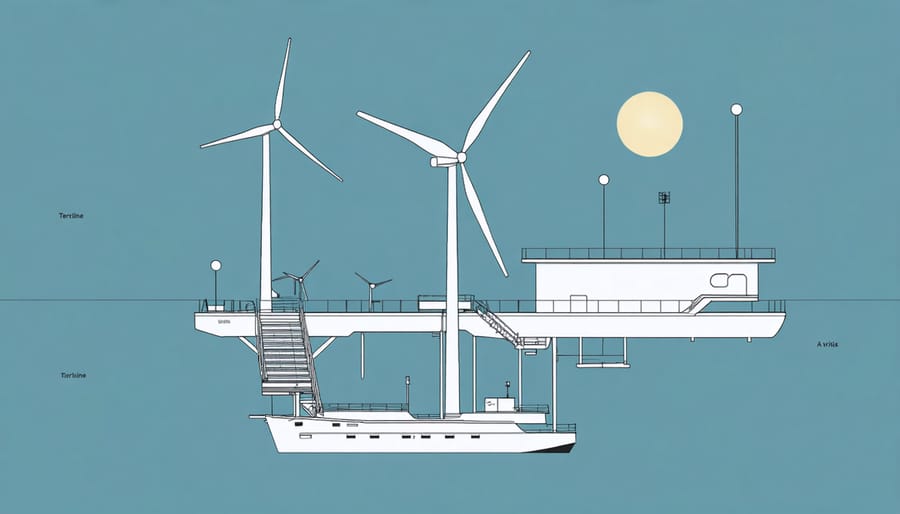
How Floating Wind Turbines Work
Platform Design and Stability
Floating wind turbines rely on several innovative platform designs to maintain stability in challenging ocean conditions. The three main types are spar-buoy, semi-submersible, and tension-leg platforms, each offering unique advantages for different marine environments.
Spar-buoy platforms use a long, cylindrical buoy that extends deep underwater, creating a low center of gravity that naturally resists tilting. This design works particularly well in deep waters but requires significant depth for installation.
Semi-submersible platforms feature multiple large floating columns connected by tubes or trusses. This design distributes the turbine’s weight across a wider area, providing excellent stability even in rough seas. The shallow draft of these platforms makes them versatile and easier to install in various water depths.
Tension-leg platforms use anchored cables to maintain position and stability. These taut lines keep the platform steady while allowing slight movements to accommodate waves and wind. This design is particularly effective in reducing motion and maintaining optimal turbine performance.
Each platform type incorporates ballast systems and advanced motion-compensation technology to ensure the turbine remains as level as possible during operation, maximizing energy production efficiency.
Mooring Systems
Mooring systems are crucial components that keep floating wind turbines stable and in position despite challenging ocean conditions. These systems typically consist of multiple anchor points connected to the floating platform through heavy-duty chains, cables, or synthetic ropes. The most common setup uses three to six mooring lines arranged in a spread pattern to distribute forces evenly.
Engineers carefully select mooring materials and configurations based on water depth, seabed conditions, and expected weather patterns. Common anchor types include drag embedment anchors, which dig into the seabed, and suction anchors that create a vacuum seal with the ocean floor. Some installations use gravity-based anchors, essentially massive concrete blocks that rely on their weight to maintain position.
The mooring system must be flexible enough to allow the turbine to move slightly with waves and wind while preventing excessive motion that could damage components or reduce power generation efficiency. Regular monitoring and maintenance of these systems ensure the long-term stability and safety of floating wind installations, making them a reliable source of renewable energy even in deep ocean environments.
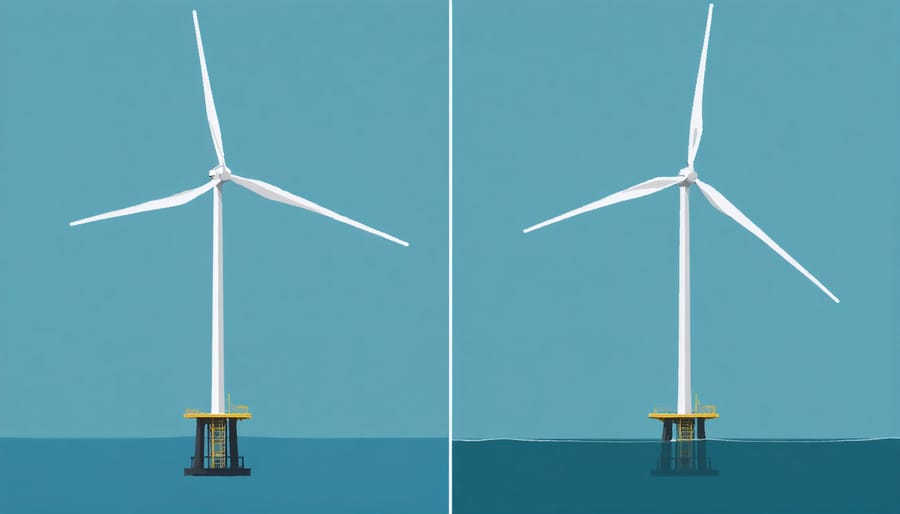
Advantages Over Traditional Offshore Turbines
Access to Deeper Waters
Floating wind turbines unlock access to deeper ocean waters, where wind resources are significantly more abundant and consistent. Unlike fixed-bottom turbines limited to depths of about 60 meters, floating turbines can operate in waters as deep as 800 meters or more. These deeper waters typically experience stronger, more stable wind patterns, resulting in higher energy production efficiency.
The ability to install turbines farther offshore also means less visual impact on coastal communities and reduced conflicts with shipping lanes, fishing activities, and marine ecosystems near the shore. Wind speeds in deeper waters can be up to 30% higher than those closer to shore, and they tend to be more consistent throughout the day. This increased wind reliability translates to more stable power generation and better grid integration.
Additionally, the flexible nature of floating platforms allows developers to choose optimal installation sites based on wind conditions rather than being constrained by water depth. This freedom to access the best wind resources leads to improved capacity factors and more cost-effective renewable energy production over the long term.
Environmental Impact
Floating wind turbines offer significant environmental advantages compared to traditional fixed-bottom installations. Their primary benefit is minimal seabed disruption, as they require only anchor points rather than extensive foundation construction. This reduced impact helps preserve marine habitats and protects sensitive ecosystems on the ocean floor.
The floating design allows these turbines to be positioned farther offshore, reducing their visual impact on coastal communities while providing safer passages for migratory birds. The greater distance from shore also means less interference with marine traffic and fishing activities, helping maintain the balance of local maritime economies.
Studies have shown that floating wind farms can create artificial reef effects, providing new habitats for marine life. The mooring lines and floating structures often become home to various species of fish and invertebrates, contributing to marine biodiversity. Additionally, the wider spacing between turbines in floating arrays allows for better water circulation and less disruption to ocean currents compared to dense fixed-bottom installations.
These environmental benefits make floating wind turbines an increasingly attractive option for sustainable energy production while protecting marine ecosystems.
Current Projects and Future Outlook
Global Implementation
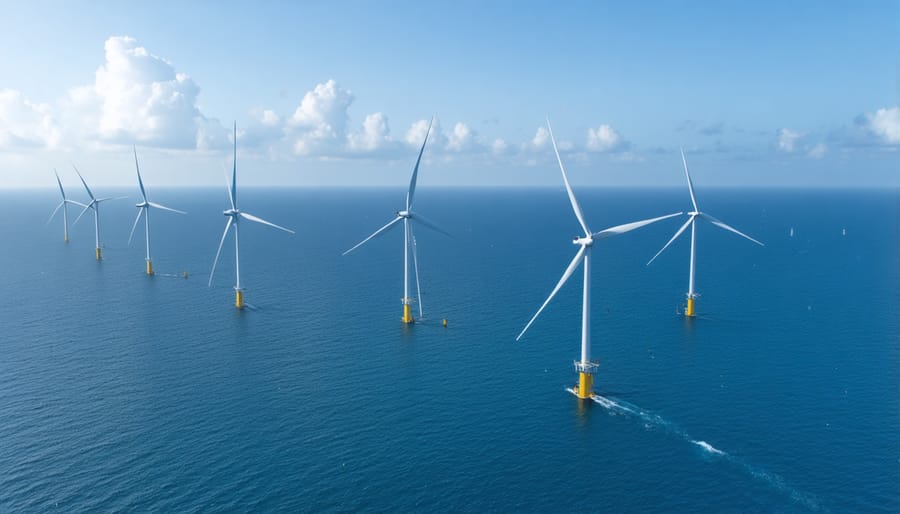
Several successful floating wind projects are now operational worldwide, demonstrating the technology’s growing maturity. The Hywind Scotland project, launched in 2017, became the world’s first commercial floating wind farm, generating enough power for approximately 20,000 homes. Japan has also embraced this technology with the Fukushima FORWARD project, showcasing different floating foundation designs.
Portugal’s WindFloat Atlantic project, completed in 2020, features three 8.4 MW turbines and supplies clean energy to 60,000 households annually. Norway’s TetraSpar Demonstrator, installed in 2021, represents another innovative floating design. France is developing multiple floating wind projects, including the Groix & Belle-Île pilot farm.
The success of these installations has prompted other countries to announce ambitious floating wind goals. The United States is developing projects off the coasts of California and Maine, while South Korea and the United Kingdom are planning large-scale deployments in their waters.
Future Developments
The future of floating wind turbines looks promising, with several technological advancements on the horizon. Researchers are developing more efficient mooring systems and lighter materials to reduce installation costs significantly. Industry experts predict that by 2030, floating wind turbine costs could decrease by up to 70%, making them increasingly competitive with traditional energy sources.
Innovations in blade design and advanced energy storage solutions are expected to improve overall system efficiency. Manufacturers are also exploring automated maintenance systems using artificial intelligence and robotics to reduce operational costs and enhance reliability.
Additionally, the development of larger turbines specifically designed for floating platforms could boost power generation capacity, while improved grid connection technologies will make it easier to transmit electricity from offshore locations to coastal communities. These advancements, combined with growing investment in the sector, suggest that floating wind turbines will play an increasingly important role in our renewable energy future.
Floating wind turbines represent a groundbreaking advancement in renewable energy technology, offering unprecedented potential for clean power generation in previously inaccessible ocean areas. As coastal regions and deep-water locations become viable sites for wind energy production, this innovation could dramatically increase our renewable energy capacity. When combined with other clean energy alternatives, floating wind turbines can help create a more resilient and sustainable power grid. Their ability to harness stronger and more consistent winds offshore, coupled with reduced visual impact and environmental considerations, positions them as a crucial component in the global transition to renewable energy. As technology continues to advance and costs decrease, floating wind turbines are poised to play a pivotal role in shaping our sustainable energy future.
