

Coal’s Legacy: How Modern Energy Transformed Illinois Industry
William L. Shirer’s “The Rise and Fall of the Third Reich” stands as one of the most comprehensive accounts of Nazi Germany, yet its historical accuracy continues to spark intense scholarly debate. Published in 1960, this monumental work draws from captured Nazi documents, the Nuremberg trials, and Shirer’s firsthand observations as a foreign correspondent in Berlin during Hitler’s ascent to power. While praised for its vivid narrative and extensive documentation, historians have questioned certain aspects of Shirer’s interpretation, particularly his emphasis on the German national character and his journalistic rather than academic approach to historical analysis.
The book’s strength lies in its unprecedented access to primary sources and eyewitness accounts, offering readers an immersive view of the Third Reich’s inner workings. However, modern scholarship has revealed nuances and complexities that Shirer’s work sometimes oversimplifies. Contemporary historians have expanded upon his narrative with additional sources and perspectives that weren’t available in 1960, particularly regarding the role of ordinary Germans, the Holocaust, and the broader European context of World War II.
Understanding the book’s accuracy requires examining it both as a groundbreaking historical document of its time and as a work that reflects the limitations and biases of its era. This critical analysis helps readers appreciate its enduring value while recognizing where modern research has deepened our understanding of this crucial period.
The Rise of Coal Power in Illinois
Early Industrial Growth
Illinois’s industrial growth was heavily influenced by its abundant coal reserves, which served as one of the primary early industrial energy sources during the state’s development. The accessibility and affordability of coal powered the rapid expansion of manufacturing facilities, railroads, and urban centers throughout the 19th and early 20th centuries.
The Illinois Coal Basin, stretching across much of the state, provided the foundation for economic development and job creation. Mining operations employed thousands of workers and supported the growth of numerous communities. This period of coal-driven industrialization transformed Illinois from a primarily agricultural state into a major industrial power.
However, it’s important to recognize that historical accounts often oversimplify this transition. While coal undoubtedly played a crucial role, other factors such as transportation infrastructure, immigrant labor, and technological innovations were equally significant in shaping Illinois’s industrial landscape.
Today, as we witness another energy transition toward renewable sources like solar power, understanding this history becomes increasingly relevant. The shift from coal to cleaner energy sources mirrors the earlier transition from wood to coal, demonstrating how energy systems continuously evolve to meet changing societal needs and environmental considerations.
Peak Coal Era
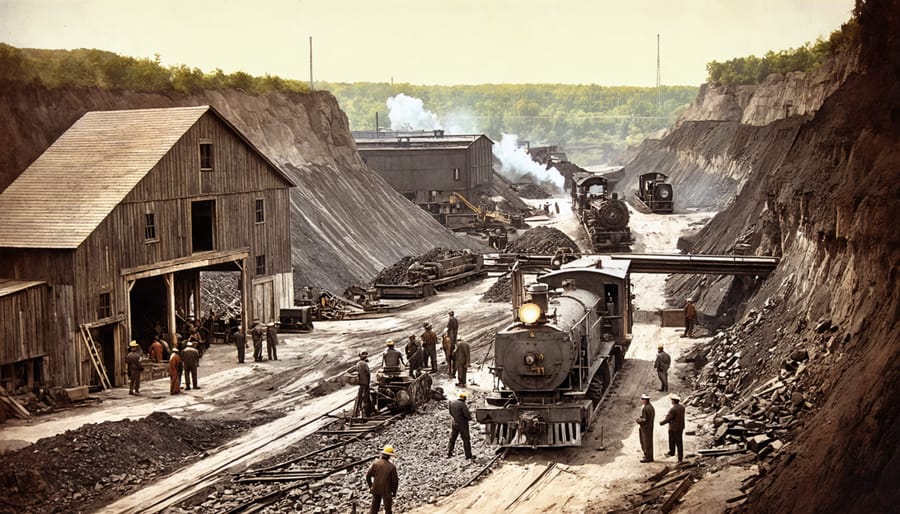
Illinois’s coal industry reached its pinnacle during the mid-20th century, with production peaking in the 1920s when the state produced over 70 million tons annually. This era marked a transformative period in Illinois’s energy landscape, with coal powering everything from residential heating to industrial manufacturing.
During this golden age, Illinois ranked as one of the nation’s top coal producers, with over 100,000 miners employed across the state. The industry’s success was built on the state’s vast coal reserves, particularly in southern Illinois, where thick seams of bituminous coal were relatively easy to access.
Coal companies established numerous mining communities, creating a robust economic ecosystem that supported thousands of families. Cities like Springfield, Belleville, and West Frankfort flourished as coal mining hubs, with the industry shaping local culture and community development.
However, this peak era also brought significant environmental and health challenges. The intensive mining operations left lasting impacts on local landscapes and water systems, while workers faced dangerous conditions and health risks. These challenges, combined with growing environmental awareness and changing energy markets, eventually led to the industry’s gradual decline.
Today, as Illinois transitions toward cleaner energy sources, understanding this historical context helps inform current discussions about sustainable energy development and economic transformation in former coal communities.
Challenging Historical Narratives
Environmental Impact Assessment
While historical accounts can be debated, the environmental context of the Third Reich period provides important insights into the regime’s impact on Central Europe’s ecosystems. Records from 1933-1945 show significant environmental degradation due to rapid industrialization and military production. The regime’s “Four Year Plan” led to increased coal mining, deforestation, and industrial pollution across occupied territories.
German forests, traditionally well-managed, saw extensive clearing for military installations and industrial expansion. Agricultural practices intensified to support the war effort, leading to soil degradation and reduced biodiversity. The Reich’s emphasis on synthetic fuel production, particularly through coal hydrogenation, created lasting contamination at industrial sites.
Studies of soil samples from former military-industrial complexes reveal high levels of heavy metals and chemical pollutants dating to this period. Air quality in major industrial centers deteriorated significantly, with some areas showing evidence of pollution in sediment layers corresponding to the war years.
However, the accuracy of comprehensive environmental data from this period is limited by wartime record destruction and the chaos of the regime’s collapse. Modern environmental historians rely on a combination of surviving documentation, geological evidence, and post-war surveys to assess the full scope of environmental impacts. This scientific approach helps verify and supplement Shirer’s historical narrative, though environmental concerns weren’t a primary focus of his work.

Economic Reality Check
The perceived economic prosperity during the Third Reich era requires careful examination against historical data. While propaganda of the time portrayed dramatic economic improvements, actual economic indicators tell a more nuanced story. Similar to how coal’s economic impact was often overstated during the Industrial Revolution, the Reich’s economic achievements were frequently exaggerated for political purposes.
Statistical evidence shows that while unemployment decreased, this was largely due to military conscription and the exclusion of certain groups from workforce calculations. Real wages remained stagnant or declined for many workers, while increased military spending created an unsustainable economic bubble. The apparent prosperity was largely funded through hidden debt and creative accounting practices.
The Reich’s economic policies, including autarky (economic self-sufficiency) and the Four Year Plan, initially showed promising results but ultimately proved inefficient and unsustainable. Private property rights were increasingly undermined, and businesses faced growing state intervention. Consumer goods became scarcer as resources were diverted to military production.
This economic reality check helps readers understand why Shirer’s portrayal of the Third Reich’s economy in “The Rise and Fall” accurately captures the gap between propaganda and actual economic conditions, though some modern historians suggest he could have provided even more detailed economic analysis.
The Transition to Renewable Energy
Solar’s Rising Influence
Illinois is experiencing a remarkable transformation in its energy landscape as solar power emerges as a leading force in the state’s transition to renewable energy. This shift mirrors historical energy transitions, demonstrating how new technologies can rapidly reshape our energy infrastructure.
Recent data shows that solar installations across Illinois have grown exponentially, with residential and commercial installations increasing by over 200% in the past five years. This growth isn’t just happening in urban areas – rural communities are embracing solar technology through community solar projects and agricultural applications.
The state’s commitment to renewable energy is backed by substantial incentives and policies. The Illinois Solar for All program has made solar power accessible to low-income households, while the Adjustable Block Program continues to drive commercial and industrial adoption. These initiatives have created thousands of local jobs and attracted significant investment to the state.
What makes this solar boom particularly significant is its grassroots nature. Unlike previous energy transitions that were largely driven by industrial interests, solar adoption in Illinois is being embraced by individual homeowners, small businesses, and community organizations. This democratic approach to energy production represents a fundamental shift in how we think about power generation and distribution.
Local utilities are adapting to this change by upgrading infrastructure and developing new programs to accommodate increased solar integration. The grid modernization efforts underway will ensure that Illinois can handle higher levels of renewable energy while maintaining reliability and efficiency.
Looking ahead, projections suggest that solar’s influence will continue to grow. With technological improvements driving down costs and increasing efficiency, experts predict that solar could provide up to 25% of Illinois’s electricity needs by 2030. This growth trajectory demonstrates how rapidly renewable energy technologies can transform our energy landscape when supported by strong policy frameworks and public engagement.

Economic Benefits of Transition
The transition to renewable energy sources is creating substantial economic opportunities across Illinois. Solar energy installations have become a significant driver of job creation, with local contractors, installers, and maintenance technicians finding new career paths in this growing sector. Recent data shows that solar projects in Illinois have generated over 5,000 direct jobs, with projections indicating continued growth in the coming years.
For homeowners and businesses, the economic benefits extend beyond job creation. Solar installations typically provide a return on investment within 5-7 years through reduced energy bills, and property values often increase by 3-4% with the addition of solar panels. State and federal incentives, including the Illinois Solar for All program, make the initial investment more accessible for many residents.
The manufacturing sector has also seen significant growth, with several solar component manufacturers establishing operations in Illinois. This has created additional jobs while strengthening the local supply chain and reducing costs for consumers. The expansion of solar infrastructure has attracted new businesses to the state, particularly those with strong environmental commitments.
Rural communities are experiencing economic revitalization through solar farm developments. These projects provide steady income for landowners through lease agreements while generating tax revenue for local governments. Many communities are using these funds to improve public services and infrastructure.
The transition is also creating opportunities for workforce development and education. Local colleges and training centers are offering specialized programs in solar installation and maintenance, preparing Illinois residents for careers in this growing industry. This investment in human capital ensures long-term economic benefits while supporting the state’s clean energy goals.
Future Energy Landscape
Illinois stands at the cusp of a transformative period in its future energy landscape, with projections indicating a significant shift toward renewable energy sources by 2030. Solar power is expected to account for 25% of the state’s energy generation, marking a dramatic increase from current levels. This transition is supported by ambitious state policies and declining costs of solar technology.
Experts forecast that Illinois will see a 300% increase in solar installations over the next decade, driven by both utility-scale projects and residential adoptions. The state’s commitment to achieving 100% clean energy by 2050 is reshaping investment patterns, with an estimated $20 billion in clean energy developments planned across various regions.
For homeowners and businesses, this evolution presents unprecedented opportunities. Energy storage solutions are becoming more accessible, with battery costs projected to decrease by 40% by 2025. Smart grid technologies will enable more efficient energy management, potentially reducing utility bills by up to 20% for those who adopt solar and storage systems.
The industrial sector is also adapting, with many manufacturers planning to integrate solar power into their operations. This shift is expected to create over 50,000 clean energy jobs throughout Illinois by 2030, particularly in installation, maintenance, and manufacturing of solar components.
Rural communities will benefit from community solar projects, which are predicted to grow tenfold in the next five years. These developments will provide local economic benefits while contributing to the state’s renewable energy goals, offering a blueprint for sustainable development that balances environmental responsibility with economic growth.
The accuracy of “The Rise and Fall of the Third Reich” remains a subject of ongoing historical analysis, much like our understanding of energy transitions throughout history. Just as William L. Shirer’s work provided crucial insights into a complex historical period, today’s analysis of energy transitions must be equally thorough and evidence-based. The shift from traditional energy sources to renewable alternatives mirrors historical transformations, requiring careful documentation and verification of facts.
In Illinois, we’re witnessing our own energy transition story unfold, with solar power emerging as a key player in our energy future. This transformation, like any historical change, demands accurate reporting, verified data, and comprehensive analysis. The lessons learned from examining historical accounts remind us that documenting current changes in our energy landscape requires the same level of diligence and attention to detail.
As we continue to navigate the transition to renewable energy, maintaining accurate records and analysis becomes increasingly important. Future generations will rely on today’s documentation to understand how communities like ours successfully shifted to sustainable energy solutions. By approaching our current energy transition with the same analytical rigor used in historical research, we ensure that our story is told accurately and serves as a valuable resource for others following in our footsteps.
