
What Are Photovoltaic Materials (and How Do They Power Your Solar Panels)?
Photovoltaic materials are substances that convert sunlight directly into electricity through the photovoltaic effect. These materials form the active layer inside solar panels, determining how efficiently your system captures solar energy and, ultimately, how much electricity it generates for your Illinois home or business.
Understanding photovoltaic materials matters because they directly influence your solar panel’s performance, lifespan, and cost. The material inside your panels affects everything from how well they perform on cloudy Midwestern days to how much roof space you’ll need for your target energy production. While most residential solar installations in Illinois still rely on silicon-based materials, emerging alternatives are reshaping what’s possible in solar technology.
This article explains what photovoltaic materials actually are, how they generate electricity from sunlight, and the main types you’ll encounter when researching solar options. We’ll break down the differences between crystalline silicon, thin-film materials, and next-generation technologies like perovskites and organic photovoltaics. You’ll learn which materials deliver the best efficiency for residential applications, how climate considerations in Illinois affect material performance, and what practical factors to weigh when choosing between different solar panel technologies.
Whether you’re a homeowner exploring rooftop solar or a business owner evaluating a commercial installation, knowing the fundamentals of photovoltaic materials helps you make informed decisions. The right material choice balances upfront cost, long-term energy production, and durability for Illinois weather conditions. By the end, you’ll understand not just what’s inside your solar panels, but why it matters for your specific energy goals.
What Photovoltaic Materials Are
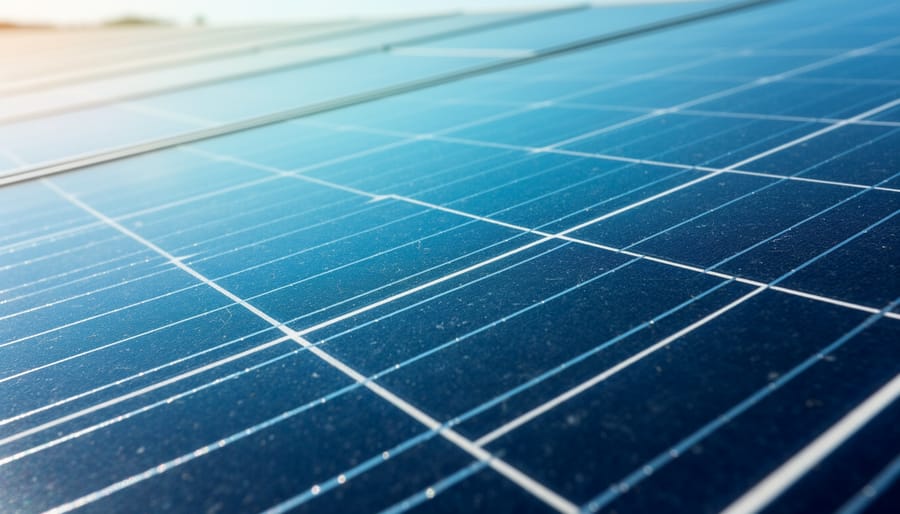
Photovoltaic materials are specialized substances, primarily semiconductors, that convert light energy directly into electrical energy through a phenomenon called the photovoltaic effect. Think of them as the active ingredient in solar panels, the part that does the actual work of turning sunshine into power. These materials sit at the core of every solar cell, forming thin layers that capture photons from sunlight and release electrons to create an electric current.
- Photovoltaic Effect
- The process by which certain materials generate electrical voltage when exposed to light, discovered in 1839 by French physicist Edmond Becquerel.
- Semiconductor
- A material with electrical conductivity between that of a conductor and an insulator, allowing precise control of electron flow when exposed to energy such as light.
- Solar Cell
- The basic unit of a solar panel, typically a thin wafer of photovoltaic material that converts sunlight into electricity.
- Conversion Efficiency
- The percentage of sunlight energy that a photovoltaic material can transform into usable electrical power, ranging from about 15% to over 40% depending on the material and technology.
Not all photovoltaic materials perform equally. Some absorb light more effectively, others generate more electrical current per photon, and many differ in how they respond to temperature changes or cloudy conditions, factors that matter considerably in Illinois’s variable climate. The material you choose determines how many panels you’ll need to meet your energy goals, how well your system performs during winter months, and ultimately how quickly your investment pays for itself.
Material choice also affects durability and lifespan. Silicon-based materials, for instance, have decades of proven performance data, while newer materials may offer higher efficiency but less long-term track record. For Illinois homeowners and business owners, understanding these materials helps demystify solar quotes and makes it easier to evaluate which technology best fits your roof, your budget, and your energy needs.
How Photovoltaic Materials Work
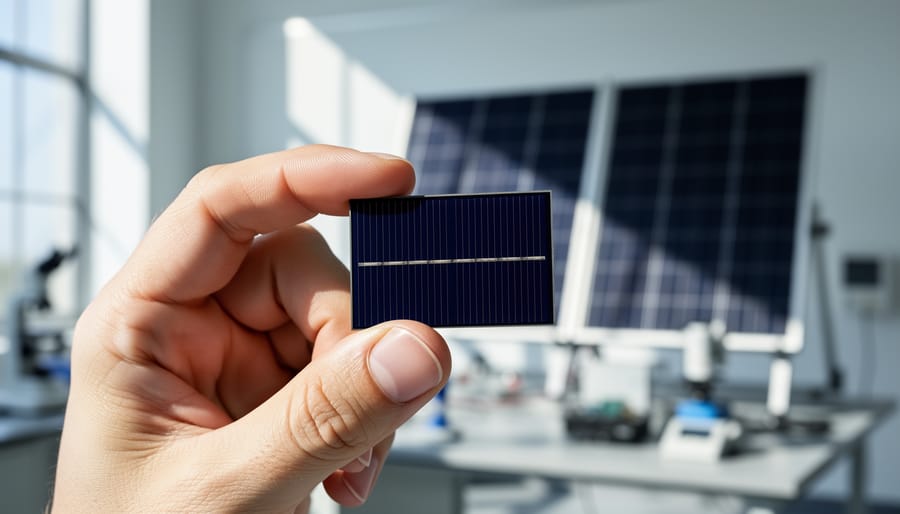
Photovoltaic materials transform sunlight into electricity through a process that happens at the atomic level. When sunlight hits a solar panel, you’re witnessing millions of tiny interactions between light particles and the material’s atomic structure.
Here’s how it works: Sunlight travels to Earth as photons, which are packets of energy. When these photons strike a photovoltaic material like silicon, they transfer their energy to electrons in the material’s atoms. Think of electrons as tiny particles that normally orbit the nucleus of an atom, held in place by atomic forces. The photon’s energy kicks these electrons loose from their normal positions, setting them free to move.
But knocking electrons loose isn’t enough to create electricity. The material needs a built-in “push” that directs those freed electrons in one direction rather than letting them wander randomly. This is where the atomic structure becomes critical. Photovoltaic materials are specially treated to create an electric field within the material itself. In silicon panels, this happens by introducing different elements to opposite sides of the silicon wafer, creating what scientists call a p-n junction.
One side gets an extra electron (the n-type side), while the other has one fewer electron, creating a “hole” that wants to be filled (the p-type side). This imbalance creates an internal electric field at the junction between the two sides. When photons free electrons from their atoms, this electric field immediately pushes them toward the n-type side and pulls the holes toward the p-type side. This separation of charges creates voltage.
Once you connect metal contacts to both sides of the material and link them with a wire, those pushed electrons have a path to flow. That flow of electrons is electric current. Connect that wire to your home’s electrical system, and you’re powering lights, appliances, and devices with sunlight.
The entire process happens incredibly fast. From the moment a photon strikes the material to when electricity flows through your circuits takes just a fraction of a second. As long as sunlight keeps hitting the panel, this cycle continues, generating steady electrical power throughout the day.
Types of Photovoltaic Materials
Silicon-Based Materials
Silicon powers roughly 95% of the solar panels installed today, including most systems across Illinois. Three forms of silicon dominate the residential and commercial market, each with distinct characteristics that affect performance and cost.
Monocrystalline silicon consists of a single, continuous crystal structure, giving these panels their characteristic uniform dark appearance. This pure structure allows electrons to move efficiently, producing the highest efficiency rates, typically 20-22% for residential panels, with premium models reaching 23-24%. These panels perform best in limited roof space where maximizing power output matters most. They also handle Illinois’s hot summer days slightly better than alternatives, losing less efficiency as temperatures climb. The trade-off is cost: monocrystalline panels command the highest price per watt, though that premium has narrowed considerably in recent years.
Polycrystalline silicon forms from multiple crystal fragments melted together, creating the distinctive blue, slightly speckled look many people recognize. The fragmented structure makes electron movement less efficient, resulting in 15-18% efficiency for most polycrystalline panels. However, the manufacturing process is simpler and less energy-intensive, which historically made these panels more affordable. For Illinois property owners with ample roof area and tighter budgets, polycrystalline offered solid performance at lower upfront cost. That said, as monocrystalline prices have dropped, polycrystalline’s market share has declined, it now represents a shrinking portion of new installations.
Amorphous silicon differs fundamentally from both crystalline types. Instead of a structured lattice, silicon atoms are deposited in a thin, non-crystalline layer. These thin-film panels are lightweight and flexible, making them useful for curved surfaces or applications where weight matters. Efficiency runs lower at 6-10%, and they degrade faster than crystalline silicon, which limits their use in permanent rooftop installations. You’ll occasionally see them in building-integrated photovoltaics or specialized applications, but they’re rarely the right choice for standard Illinois residential or commercial systems where maximizing long-term output is the goal.
Thin-Film Materials
Thin-film photovoltaic materials take a different approach than their crystalline silicon cousins. Instead of thick wafers of semiconductor material, manufacturers deposit ultra-thin layers, sometimes just micrometers thick, onto substrates like glass, metal, or even flexible plastic. This process creates lighter, more versatile panels that excel in certain applications.
Cadmium telluride (CdTe) stands as the most commercially successful thin-film material. These panels typically convert 16-18% of sunlight into electricity, somewhat less than crystalline silicon, but their manufacturing process uses less energy and fewer raw materials. You’ll often find CdTe panels in large utility-scale solar farms where their lower cost per watt matters more than space efficiency.
Copper indium gallium selenide (CIGS) offers another thin-film option with slightly higher efficiency potential, reaching 18-20% in commercial products. CIGS panels perform better than CdTe in low-light conditions, which gives them an edge during Illinois’s cloudy winter months. However, manufacturing costs remain higher than CdTe, limiting widespread residential adoption.
The real advantage of thin-film materials shows up in their flexibility and lightweight construction. Because you can deposit these materials on flexible substrates, manufacturers can create bendable solar panels for curved surfaces, portable applications, or building-integrated installations where traditional rigid panels won’t work.
Current limitations keep thin-film materials from dominating residential installations. Lower efficiency means you need more roof space to generate the same power as crystalline silicon panels. They also degrade slightly faster over time, though modern versions still carry 20-25 year warranties. For most Illinois homeowners with limited roof space, the higher efficiency of silicon-based panels makes more practical sense, but thin-film technologies continue improving and filling specialized niches.
Advanced and Emerging Materials
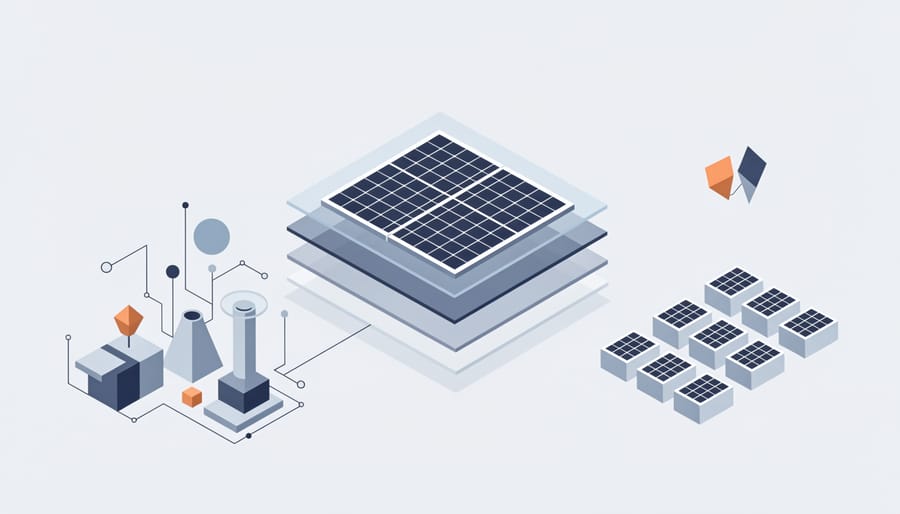
While silicon dominates today’s solar market, researchers worldwide are developing advanced photovoltaic materials that could reshape the industry. These emerging technologies promise higher efficiencies, lower manufacturing costs, and new applications that current materials can’t address. Understanding what’s on the horizon helps Illinois property owners make informed decisions about when to invest in solar.
Perovskite solar cells have generated significant excitement in the research community. These materials use a crystal structure that can be manufactured at low temperatures using solution-based processes, potentially reducing production costs dramatically compared to silicon. Laboratory versions have achieved record efficiencies across technologies approaching those of the best silicon cells, and researchers continue pushing these numbers higher. The challenge lies in stability: perovskites degrade faster than silicon when exposed to moisture and heat, making them impractical for outdoor installations in variable climates like Illinois’s. Scientists are working on encapsulation techniques and more stable formulations to address these durability concerns.
Organic photovoltaics use carbon-based materials that can be printed onto flexible substrates. They’re lightweight, potentially inexpensive to produce, and work on curved or irregular surfaces where rigid panels won’t fit. Current efficiency levels remain below silicon, but improvements continue. These materials might eventually power portable devices, building-integrated applications, or specialized installations rather than replacing rooftop panels.
Multi-junction cells stack multiple materials together, each capturing different wavelengths of light. This approach has achieved the highest laboratory efficiencies recorded, exceeding 47 percent in concentrated sunlight applications. The complexity and cost currently limit their use to space applications and concentrated solar systems. As manufacturing processes improve, simplified versions may become viable for terrestrial installations.
Quantum dots represent another frontier. These nanoscale semiconductor particles can be tuned to absorb specific light wavelengths by adjusting their size. Researchers are exploring ways to use quantum dots to boost silicon cell efficiency or create entirely new cell designs. The technology remains primarily in the laboratory stage.
For Illinois property owners considering solar in 2026, these advanced materials represent future possibilities rather than current options. Silicon technology continues improving incrementally while offering proven performance, established warranties, and predictable long-term behavior in Midwest weather conditions. The innovations in advanced materials will eventually trickle down to residential markets, potentially offering better performance at lower costs, but that transition will happen gradually as durability and manufacturing challenges get solved.
How Photovoltaic Materials Are Used in Solar Energy Systems
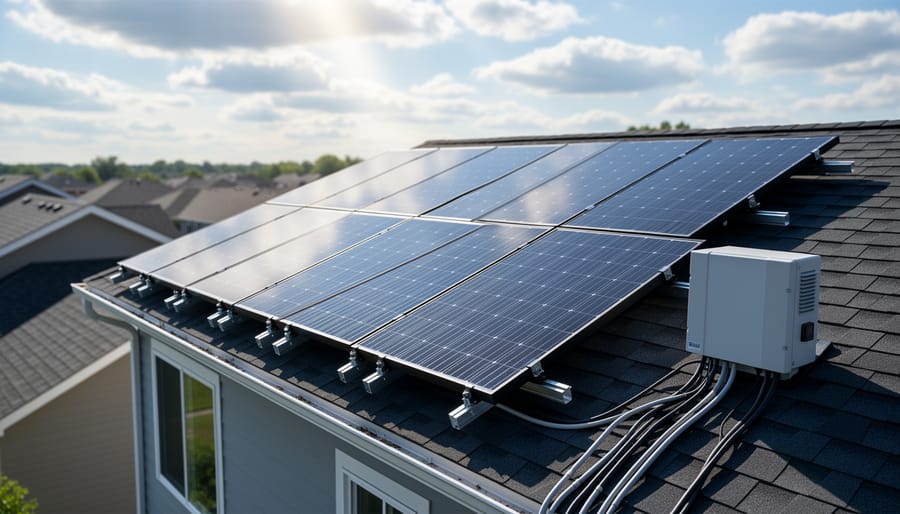
The photovoltaic materials we’ve examined don’t exist in isolation, they form the active layer in solar panels installed across rooftops, farms, and commercial properties throughout Illinois. Understanding how these materials translate into real-world performance helps property owners make informed decisions about their solar investments.
Residential installations typically use monocrystalline silicon panels because their higher efficiency means more power generation per square foot of roof space. This matters in Illinois, where roof area and orientation vary considerably from property to property. A suburban home with a south-facing roof might install twenty-four 400-watt monocrystalline panels to offset most electricity consumption, while a smaller urban property with shade challenges might choose high-efficiency panels that maximize output in limited space.
Commercial and industrial applications deploy photovoltaic materials at larger scales. Warehouse roofs often accommodate hundreds of panels using polycrystalline silicon for cost-effective coverage across extensive flat surfaces. Ground-mounted systems on agricultural land might mix panel types based on budget and energy targets. Solar farms use whatever material delivers the best long-term economics for that site’s specific conditions.
Photovoltaic materials find applications in:
- Rooftop residential arrays for household power generation
- Commercial building installations offsetting business electricity costs
- Ground-mount systems on open land or agricultural properties
- Solar farms providing utility-scale electricity production
- Building-integrated photovoltaics (BIPV) incorporated into architecture
- Portable and specialized uses like RV systems or remote power
Material choice affects how panels handle Illinois’s climate variations. Silicon-based materials maintain reasonable solar power benefits even during overcast conditions common in winter months, though all materials experience some limitations in winter due to shorter days and lower sun angles. Monocrystalline panels typically outperform polycrystalline alternatives in low-light conditions, making them worth the premium for many Illinois installations.
Total system cost reflects both material expenses and long-term performance. Cheaper polycrystalline panels might cost less initially but require more roof space for equivalent output. High-efficiency monocrystalline materials reduce installation complexity and potentially avoid structural upgrades needed for heavier arrays. Property owners should evaluate these trade-offs based on their specific site constraints, energy goals, and budget realities rather than choosing materials based solely on upfront price.
What Material Advances Mean for Illinois Solar Customers
Material advances in photovoltaics translate directly to better value and performance for Illinois property owners. These improvements matter in our state’s specific climate, where shorter winter days and variable cloud cover affect system performance throughout the year.
Higher efficiency ratings mean you need fewer panels to meet your energy goals. Where a 15-percent-efficient system might require 30 panels to power a typical Illinois home, today’s 22-percent-efficient modules can deliver the same output with just 20 panels. That translates to lower installation costs, less roof space required, and reduced structural requirements for your mounting system.
Improved low-light performance addresses one of Illinois’s biggest solar challenges. Advanced materials capture more energy during overcast conditions and winter months when sunlight strikes at lower angles. Properties across Illinois now generate meaningful power even on gray December days, extending productive hours throughout the year.
Cost reductions make solar accessible to more homeowners and businesses. As manufacturing processes improve and economies of scale increase, the price per watt continues dropping. Advanced materials that seemed experimental five years ago now appear in mainstream residential panels at competitive prices.
Extended lifespans improve your return on investment. Today’s panels routinely carry 25-year warranties, with many systems producing power for 30 years or longer. Better materials resist degradation from temperature swings, moisture, and UV exposure, all factors that affect panels on Illinois roofs.
Illinois Renewables stays current on material developments to recommend systems that perform reliably in our climate. We evaluate how different materials respond to our temperature extremes, humidity levels, and seasonal sunlight patterns, ensuring your installation delivers optimal long-term value.
Common Questions About Photovoltaic Materials
Which photovoltaic material lasts longest?
Monocrystalline silicon panels typically offer the longest lifespan, often 25-30 years or more with minimal degradation. Most manufacturers back these with warranties reflecting their durability, while thin-film materials generally have slightly shorter lifespans but are improving.
Do different materials work better in cold climates?
Silicon-based materials actually perform more efficiently in cold temperatures, making them well-suited for Illinois winters. The concern in our climate is snow coverage rather than temperature, and monocrystalline panels handle both winter efficiency and year-round performance effectively.
Are advanced materials like perovskites available for residential installations?
Not yet for widespread residential use. Most emerging materials are still in research or pilot phases, and the solar panels available for Illinois homes today use proven silicon or thin-film technologies that offer reliable, warrantied performance.
How do I know which material is in my solar quote?
Reputable installers specify the panel manufacturer, model number, and cell type (monocrystalline, polycrystalline, or thin-film) in their proposals. If this information isn’t clear, ask directly, the material type affects both upfront cost and long-term performance.
Beyond these common questions, homeowners often wonder whether it’s worth waiting for next-generation materials before committing to solar. The reality is that today’s silicon panels already deliver strong returns on investment with 20-30 year lifespans, and efficiency improvements in newer models tend to be incremental rather than revolutionary. Delaying installation means missing years of energy savings and utility bill reductions.
When evaluating material quality across quotes, focus on the manufacturer’s track record and warranty terms rather than getting caught up in efficiency percentage differences of one or two points. A 20% efficient panel from a reputable company with a solid 25-year warranty often outperforms a 22% efficient panel from an unknown manufacturer. Illinois Renewables works with established panel makers whose materials have proven performance records in Midwest conditions, and we can walk you through exactly what you’re getting and why it’s the right choice for your property.
Photovoltaic materials remain the fundamental technology that makes solar energy possible, converting Illinois sunlight into clean electricity for your home or business. Whether you choose proven silicon panels or newer thin-film options, these materials have reached a level of reliability and efficiency that makes solar a smart investment right now.
The landscape continues improving. Perovskites and other advanced materials promise even better performance in the years ahead, but you don’t need to wait for tomorrow’s breakthroughs. Today’s silicon-based systems deliver consistent results across Illinois’s varied climate, from bright summer days to cloudy winter conditions. They’re backed by decades of field testing and warranties that protect your investment.
Choosing the right photovoltaic material for your property depends on your roof characteristics, energy needs, budget, and long-term goals. Illinois Renewables brings local expertise to this decision. We’ve installed solar systems across the state and understand which materials perform best in our climate. Our team can evaluate your specific situation and recommend solutions that balance current efficiency with proven durability.
Ready to explore how photovoltaic materials can power your property? Contact Illinois Renewables for a consultation tailored to your needs.
