
Renewable Energy Companies in New York City: What They Do and What Illinois Businesses Can Learn
New York City is one of the most active renewable energy markets in the United States, and businesses there rarely go it alone: they work with solar developers, community solar providers, energy service companies, and power purchase agreement specialists to cut costs and meet sustainability commitments. Understanding what these companies actually do — and how businesses engage them — is useful well beyond the five boroughs, because the same models are taking root across the Midwest.
Key Takeaway: Businesses in New York City access renewable energy through a handful of well-established routes: on-site solar installation, community solar subscriptions that require no rooftop at all, energy service contracts, and power purchase agreements. Each model has an Illinois counterpart, so the lessons from the NYC market translate directly to businesses here at home.
The Renewable Energy Landscape in New York City
New York State’s Climate Leadership and Community Protection Act set a target of 70 percent renewable electricity by 2030, and that policy pressure has built a crowded, competitive market for clean energy services in the city. The state energy agency, NYSERDA, runs incentive programs such as NY-Sun that reduce the up-front cost of solar projects, while Con Edison, the utility serving most of the city, administers the billing credits that make shared solar projects work.
The city adds its own push. Local Law 97, part of New York’s Climate Mobilization Act, places carbon emissions caps on most large buildings, with penalties for exceeding them. That has made clean electricity and energy efficiency a compliance matter for building owners, not just a branding choice — and it keeps demand for renewable energy providers strong.
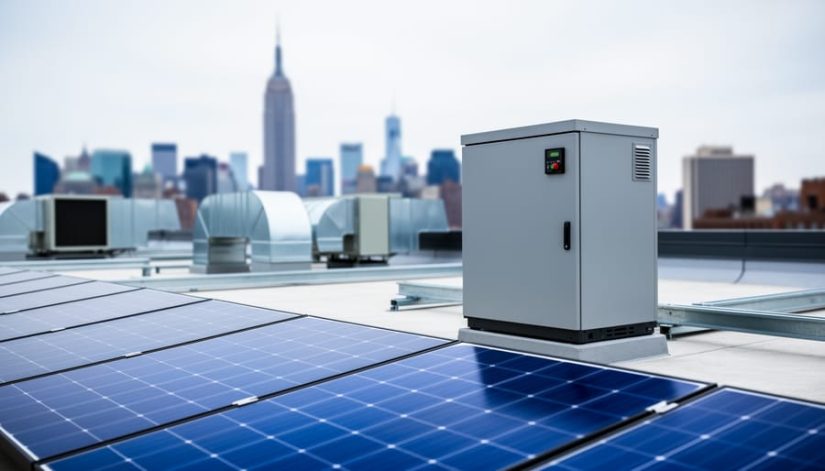
Density shapes the market in one more way: most NYC businesses do not have a roof suitable for solar panels. As a result, models that separate the project site from the customer — community solar and off-site power purchase agreements — play a bigger role there than almost anywhere else.
What NYC Renewable Energy Companies Actually Offer Businesses
The companies serving this market generally fall into four groups, and most businesses end up working with more than one of them.
Rooftop and on-site solar developers design, permit, and install systems on buildings that can support them. Ownership structures vary: some businesses buy systems outright, while others host a system a developer owns and buy the electricity it produces.
Community solar providers operate shared projects — in New York these fall under the state’s Community Distributed Generation rules. A business subscribes to a share of a project located elsewhere and receives credits on its utility bill for that share of the project’s output. No rooftop, construction, or capital outlay is required, which is why community solar has become the most accessible entry point for small and mid-sized businesses.
Energy service companies focus on the demand side: efficiency upgrades, heating and cooling electrification, and demand management. Many businesses pair an efficiency contract with a renewable supply arrangement, since the cheapest kilowatt-hour is the one not used.
Power purchase agreement providers serve larger energy buyers. Under a PPA — or its financial cousin, the virtual PPA — a business commits to buy the output of a renewable project over a multi-year term. These contracts require meaningful energy volumes and careful legal review, and their terms vary widely from provider to provider.
How Businesses Typically Engage a Provider
There is no formal application or eligibility regime for working with renewable energy companies — it is an ordinary commercial relationship. The typical path starts with a review of twelve months of utility bills so providers can size a proposal against real usage. Businesses then compare proposals from several providers, paying attention to contract length, any annual price escalators, how bill credits or energy prices are calculated, and what happens if the business moves or its usage changes.
For owners of large buildings, Local Law 97 compliance deadlines often set the timetable. For everyone else, the decision usually comes down to economics: community solar subscriptions in New York frequently offer a discount against the credits they generate, making them a low-risk first step while larger projects are evaluated.
What Illinois Businesses Can Learn From the NYC Market
Every model above has an Illinois counterpart, and in some respects the economics here are more favorable — commercial rooftop space is easier to come by in the Midwest than in Manhattan.
Illinois Shines, the state’s solar incentive program, plays a role similar to NY-Sun, supporting both on-site systems and community solar projects. The Climate and Equitable Jobs Act of 2021 set Illinois on a path of 40 percent renewable energy by 2030 and 100 percent clean energy by 2050, creating the same sustained policy tailwind that built New York’s market. Community solar is available to businesses in both the ComEd and Ameren service territories, and net metering and bill-credit rules make the subscription math straightforward to evaluate.
The practical lesson from New York is about process, not geography: understand your usage first, get multiple proposals, scrutinize contract terms, and match the model — rooftop, community solar, efficiency work, or a PPA — to your building and your budget rather than forcing one model to fit.
Working With a Local Partner
Locally owned providers like Illinois Renewables exist precisely to guide that process. We help businesses assess their energy usage patterns, compare the options available in their utility territory, and choose projects that make financial sense — whether that is a rooftop system, a community solar subscription, or an efficiency-first plan. The NYC market shows what mature business renewable adoption looks like; Illinois businesses can get there with less friction and often better economics.
Common Questions About Business Renewable Energy
Does a business need its own roof to use renewable energy?
No. Community solar subscriptions credit a share of an off-site project’s output against your utility bill, and virtual power purchase agreements settle financially without any physical connection. Rooftop solar is only one of several routes.
Are these options only for large companies?
No. Power purchase agreements do favor large energy buyers, but community solar subscriptions and efficiency contracts are designed to work for small and mid-sized businesses, usually with no capital outlay.
Do the models used in New York City exist in Illinois?
Yes. Illinois Shines supports solar development much as NY-Sun does in New York, community solar operates in both ComEd and Ameren territories, and the Climate and Equitable Jobs Act provides the long-term policy commitment that gives providers and customers confidence in multi-year contracts.
Where should a business start?
Gather a year of utility bills, then request proposals from more than one provider. Comparing real numbers against your real usage — contract length, price escalators, and credit calculations included — is the single most reliable way to judge whether a renewable energy offer is a good deal.
