

Perovskite Solar Cells Could Slash Your Energy Bills (Here’s What Illinois Property Owners Need to Know)
The solar energy landscape is shifting beneath our feet, and Illinois homeowners and businesses stand at a remarkable crossroads. Perovskite solar cells—a revolutionary technology using crystal structures originally discovered in the 19th century—are poised to transform how we think about solar investment decisions in 2024 and beyond.
Unlike the silicon panels currently dominating rooftops across Illinois, perovskite solar cells offer a fundamentally different approach to converting sunlight into electricity. These next-generation solar panels use a special class of materials that can be manufactured at room temperature, printed onto flexible surfaces, and potentially layered on top of existing silicon cells to capture more of the sun’s energy spectrum.
Recent breakthroughs have pushed perovskite efficiency ratings past 26 percent in laboratory settings, rivaling traditional silicon while promising lower production costs and versatile applications. For Illinois property owners considering solar investments, this raises critical questions: Should you wait for perovskite technology to reach the market, or move forward with proven silicon systems today?
This technology matters because it addresses real limitations facing solar adopters in our state—from the challenge of maximizing energy production during shorter winter days to finding cost-effective solutions for commercial buildings with weight-restricted roofs. Understanding perovskite innovations helps you make informed decisions about timing your solar investment, evaluating emerging options, and positioning your property for the energy transition ahead.
What Makes Perovskite Solar Cells Different
The Perovskite Advantage: Lighter, Flexible, and More Efficient
Perovskite solar technology represents a significant leap forward from traditional silicon panels, offering several compelling advantages that could transform solar energy adoption in Illinois and beyond.
One of the most striking benefits is weight reduction. Perovskite solar cells are remarkably lighter than conventional silicon panels, making them ideal for rooftops with weight restrictions or older buildings where structural reinforcement would otherwise be necessary. This lighter profile expands installation possibilities for both residential and commercial properties.
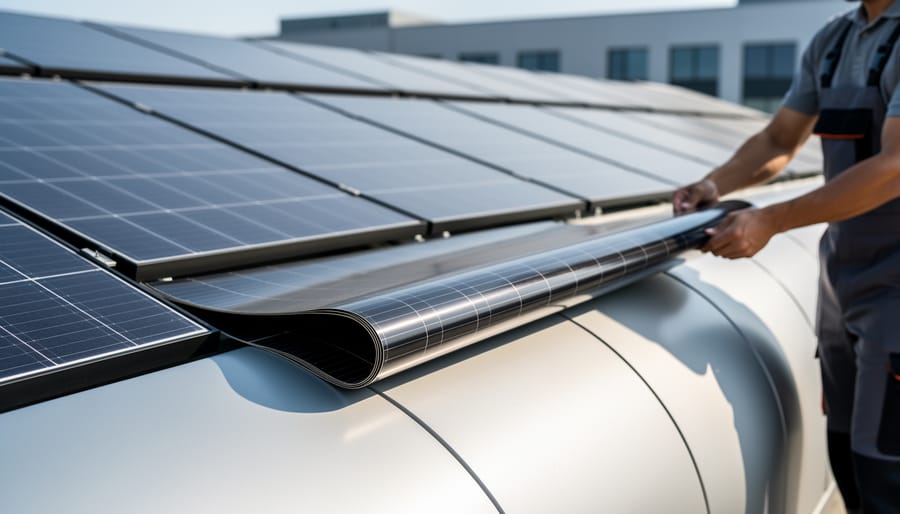
Flexibility is another game-changing feature. Unlike rigid silicon panels, perovskite materials can be manufactured on flexible solar panels that conform to curved surfaces. This opens up entirely new applications, from integration into building materials to installation on irregular roof shapes that traditional panels cannot accommodate.
Manufacturing costs present perhaps the most exciting advantage. Perovskite cells can be produced using simpler, less energy-intensive processes than silicon panels require. This cost efficiency could make solar energy more accessible to Illinois homeowners and businesses operating within tighter budgets.
Efficiency potential is equally impressive. Laboratory tests have achieved conversion rates exceeding 25 percent, with tandem configurations combining perovskite and silicon layers reaching over 30 percent efficiency. While real-world applications are still developing, these figures suggest perovskite technology could generate more electricity from the same roof space, maximizing your investment in Illinois’s variable climate conditions.
How Perovskite Technology Captures More Sunlight
Perovskite solar cells work differently than traditional silicon panels, making them particularly effective at capturing a broader spectrum of sunlight. The crystal structure of perovskite materials allows them to absorb light more efficiently across various wavelengths, converting photons into electrical current with less energy loss during the process.
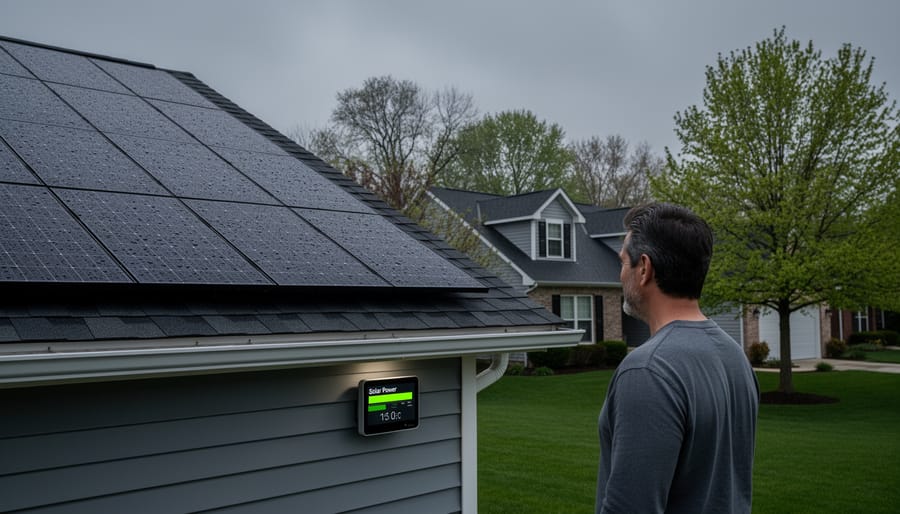
What makes perovskite technology especially promising for Illinois is its superior performance in low-light and cloudy conditions. While conventional solar panels experience significant efficiency drops on overcast days, perovskite cells maintain stronger output because they’re better at capturing diffuse and indirect light. This characteristic addresses one of the main concerns Illinois property owners have about solar energy—our frequently cloudy weather, particularly during fall and winter months.
The technology also excels at handling temperature variations. Perovskite materials are less affected by heat than traditional silicon, meaning they maintain consistent performance during Illinois’s hot summers. Additionally, researchers have developed tandem designs that layer perovskite cells with silicon, capturing different light wavelengths simultaneously. This dual-layer approach can potentially achieve conversion efficiencies exceeding 30 percent, significantly higher than today’s standard panels, maximizing energy production even when conditions aren’t ideal.
Recent Breakthroughs Bringing Perovskite Panels Closer to Market
Solving the Durability Challenge
For years, the biggest obstacle preventing perovskite solar cells from reaching your rooftop was their tendency to break down when exposed to moisture, heat, and oxygen. Traditional perovskite materials would degrade within weeks or months outdoors, making them impractical for long-term energy generation. However, recent scientific breakthroughs have dramatically changed this picture.
Researchers have developed protective encapsulation techniques that shield perovskite layers from environmental damage. These barrier coatings work much like weatherproofing on your home’s exterior, keeping moisture and air away from sensitive materials. Some newer formulations incorporate more stable chemical compositions that naturally resist degradation, replacing elements that were vulnerable to water damage with more robust alternatives.
One particularly promising advance involves tandem cell designs that pair perovskite with traditional silicon. In these configurations, the silicon layer provides structural stability while the perovskite boosts efficiency. This partnership addresses durability concerns while delivering performance gains.
Testing standards have also improved significantly. Modern perovskite cells are now passing accelerated aging tests that simulate years of Illinois weather conditions, including temperature swings, humidity, and UV exposure. While commercially available perovskite panels still haven’t matched the 25-year warranties common with conventional silicon panels, several manufacturers are projecting 20-year lifespans for products expected to reach the market within the next few years.
These stability improvements represent the critical bridge between laboratory promise and practical residential and commercial applications throughout Illinois.
Tandem Solar Cells: Combining the Best of Both Worlds
While traditional silicon solar panels have served us well for decades, researchers have discovered that combining them with perovskite materials creates something even more powerful. These tandem solar cells stack a thin perovskite layer on top of a silicon base, allowing each material to capture different parts of the light spectrum that silicon alone would miss.
Here’s how it works: the perovskite top layer absorbs high-energy blue and green light wavelengths, while the silicon bottom layer captures the red and infrared wavelengths that pass through. By working together, these materials convert more sunlight into electricity than either could achieve independently.
The results are impressive. Standard silicon panels typically convert 18-22% of sunlight into electricity. Tandem perovskite-silicon cells have already demonstrated efficiency rates exceeding 33% in laboratory settings, with some researchers achieving over 34%. This means significantly more energy production from the same rooftop space, which is particularly valuable for Illinois homeowners and businesses with limited installation areas.
For practical applications, this increased efficiency translates to fewer panels needed to meet your energy goals. A home that might require 20 traditional panels could potentially achieve the same output with just 13-15 tandem panels. This reduces installation costs, minimizes roof space requirements, and can be especially beneficial during Illinois winters when every bit of energy production counts.
Several manufacturers are now moving tandem cells from research labs into production facilities. While these hybrid panels aren’t yet widely available for residential installation, industry experts predict commercial availability within the next few years. This timeline gives Illinois property owners an opportunity to stay informed about this technology while making current solar decisions based on proven, available options.
What Perovskite Solar Cells Mean for Illinois Property Owners
Potential Cost Savings and ROI Improvements
Perovskite solar technology promises significant financial advantages for Illinois property owners considering solar investments. The simplified manufacturing process for perovskite cells requires lower temperatures and less energy compared to traditional silicon panels, which could translate to reduced production costs. Industry experts project that once perovskite technology reaches commercial scale, manufacturing expenses could drop by 30-50% compared to conventional panels.
These lower production costs combined with higher efficiency ratings mean homeowners and businesses could see faster payback periods on their solar investments. Current silicon panels typically require 6-10 years to recoup initial costs in Illinois, but perovskite panels could potentially reduce this timeline to 4-7 years. The improved efficiency means you’ll need fewer panels to generate the same amount of electricity, reducing both material and installation expenses.
For commercial properties with limited roof space, the higher efficiency per square foot becomes particularly valuable. You can generate more power from the same area, maximizing your return on investment without expanding your installation footprint. When paired with energy storage solutions, perovskite panels could further enhance savings by capturing excess energy during peak production hours.
While these cost projections remain promising, it’s important to note that widespread commercial availability will determine actual pricing. As locally owned solar experts serving Illinois, we’re monitoring these developments closely to help our customers make informed investment decisions that align with both current needs and future technology trends.
Better Performance in Illinois Weather Conditions
Illinois homeowners and businesses know all too well that our state doesn’t always cooperate with solar energy production. With an average of only 189 sunny days per year and notoriously cloudy winters, traditional solar panels can struggle to maintain consistent energy output during those gray months from November through March.
This is where perovskite solar technology shows particular promise for our region. Unlike conventional silicon panels that experience significant efficiency drops in overcast conditions, perovskite cells demonstrate superior low-light performance. Their unique crystalline structure allows them to capture and convert diffuse light—the kind that filters through cloud cover—more effectively than traditional photovoltaic technology.
Research has shown that perovskite panels can maintain higher efficiency rates even when direct sunlight is limited. This means that during those stretches of overcast winter days that are common across Illinois, perovskite-based systems could continue generating meaningful electricity when silicon panels would produce minimal output.
Additionally, perovskite technology shows improved performance across varying temperatures, which is valuable in Illinois where we experience dramatic seasonal temperature swings. While traditional panels can lose efficiency in extreme cold or heat, perovskite cells maintain more stable performance throughout our temperature ranges.
For Illinois property owners considering solar investments, this enhanced performance in less-than-ideal weather conditions could translate to more consistent year-round energy production and potentially faster return on investment, particularly as this technology becomes commercially available and cost-competitive with existing solar solutions.
Current Limitations and What to Expect
When Will Perovskite Panels Be Available for Your Property?
While perovskite solar technology shows tremendous promise, it’s important to set realistic expectations about when you’ll be able to install these panels on your Illinois property. Currently, perovskite solar cells remain primarily in the research and development phase, with limited commercial products available.
Most experts predict that perovskite panels won’t be widely available for residential and commercial installation until 2027-2030. Several critical stages must be completed first. Manufacturers need to achieve consistent production at scale, which means moving from laboratory settings to factory floors. Long-term durability testing is ongoing, as perovskite materials must prove they can withstand 25-30 years of real-world conditions, including Illinois’s varied climate with hot summers, cold winters, and moisture exposure.
Regulatory approvals and industry certifications also take time. Before widespread adoption, perovskite panels must meet rigorous safety and performance standards.
For Illinois property owners considering solar now, traditional silicon panels remain the proven, reliable choice. As a locally owned solar provider with expertise in solar energy, we’re monitoring perovskite developments closely. When this technology becomes commercially viable and demonstrates the durability our customers deserve, we’ll be ready to offer informed guidance on whether it’s the right fit for your energy needs.
Environmental and Safety Considerations
One important consideration with perovskite solar technology involves the materials used in their construction. Many current perovskite designs contain lead, which raises legitimate environmental and health concerns. If panels were to break or degrade improperly, lead could potentially leak into the environment. However, researchers are actively addressing this challenge through multiple approaches.
Scientists are developing lead-free perovskite alternatives using materials like tin, bismuth, and antimony. While these alternatives currently offer slightly lower efficiency, they’re improving rapidly. Additionally, manufacturers are working on advanced encapsulation techniques that seal lead-containing cells more effectively, preventing any material release even if the panel’s outer glass breaks.
For Illinois homeowners and businesses considering solar investments, it’s worth noting that perovskite panels aren’t yet commercially available for residential or commercial installation. By the time they reach the market, safety standards and recycling protocols will likely be well-established. The solar industry already has experience managing hazardous materials safely—traditional panels contain small amounts of lead in solder connections—and similar handling procedures would apply. As locally owned solar experts, we’re monitoring these developments closely to ensure any future technology we recommend meets the highest environmental and safety standards for our Illinois communities.
Should You Wait for Perovskite or Install Solar Now?
The decision to install solar panels now or wait for perovskite technology depends on your specific energy goals and timeline. For most Illinois homeowners and business owners, waiting isn’t the practical choice.
Current solar technology already delivers excellent returns on investment, with proven durability lasting 25-30 years. Today’s silicon panels efficiently convert Illinois sunlight into electricity year-round, and federal tax credits combined with state incentives make installation financially attractive right now. Every month you wait means missed savings on your energy bills and delayed progress toward energy independence.
Perovskite solar panels, while promising, won’t likely be widely available for residential installation for another 5-10 years. Researchers are still addressing durability challenges and scaling up production. When they do arrive, they’ll complement rather than completely replace existing technology, possibly appearing first in specialized applications or hybrid configurations.
Consider this practical approach: install quality silicon panels now through a locally owned solar provider with expertise in solar energy. You’ll immediately start reducing energy costs and carbon emissions. When perovskite technology matures and becomes commercially viable, you can potentially add it to your existing system or incorporate it during future upgrades.
The financial math strongly favors acting now. With current incentives, proven technology, and rising electricity rates, delaying your solar investment means losing years of savings while waiting for technology that remains in development. The best time to go solar in Illinois is when you’re ready to commit, and today’s technology is more than capable of delivering long-term value.

Perovskite solar technology represents an exciting frontier in renewable energy, offering the potential for higher efficiency, lower costs, and greater versatility than traditional silicon panels. While this advanced solar technology is still developing, recent breakthroughs in stability and manufacturing are bringing it closer to commercial reality. For Illinois homeowners and businesses considering solar investments today, understanding these innovations helps put current options in perspective while planning for future upgrades.
The key takeaway is that proven silicon solar panels remain the smart choice for most installations right now, delivering reliable performance and immediate energy savings. However, staying informed about perovskite developments ensures you’ll be ready when tandem cells and other hybrid technologies reach the market in the coming years.
At Illinois Renewables, our locally owned team stays current with emerging solar innovations while focusing on solutions that work for Illinois conditions today. We understand that choosing solar technology involves balancing cutting-edge potential with practical reliability and proven return on investment. Whether you’re exploring your first solar installation or planning future system expansions, our expertise helps you make informed decisions tailored to your specific energy goals and timeline.
Contact Illinois Renewables to discuss how current solar technology can meet your needs while keeping future innovations in mind.
