

How to Build a Team Crisis Management Plan for Solar Customer Support
When a solar panel system fails during a heat wave or a botched installation threatens regulatory compliance, your customer support team needs a clear protocol to coordinate response, protect customers, and contain reputational damage. Effective team crisis management in solar operations means designating role-based accountability, establishing verified communication channels, and executing staged response workflows that address both immediate safety concerns and long-term customer trust.
For solar companies operating in Illinois, crisis scenarios fall into three categories: technical failures that disrupt power generation, installation emergencies that create safety hazards, and regulatory or permitting issues that delay project completion. Each demands a different response cadence, but all share the same foundation. A coordinated team response starts before the crisis hits, with documented escalation paths, vendor contact lists, and authority matrices that eliminate confusion when seconds count.
The difference between a contained incident and a cascading disaster often comes down to preparation. Teams that train together, maintain updated emergency contact trees, and rehearse handoff protocols between field technicians, customer service representatives, and compliance staff resolve critical issues faster and with less customer fallout. This playbook walks through the essential tools, safety parameters, step-by-step coordination workflows, and verification procedures you need to build a crisis-ready support team. You’ll learn how to structure your response framework, assign accountability under pressure, and validate resolution before closing the loop with affected customers.
Every minute of delay erodes customer confidence. The protocols that follow ensure your team acts with clarity, speed, and consistency when crisis strikes.
What Qualifies as a Customer Support Crisis in Solar Energy
Not every customer complaint needs a full team response. A customer support crisis in solar energy occurs when a situation threatens safety, creates extended system downtime, risks regulatory compliance, or endangers a high-value customer relationship beyond what routine support can handle. The difference between a standard service call and a true crisis comes down to impact severity, time sensitivity, and resolution complexity.
In Illinois solar installations, several scenarios cross the crisis threshold and demand immediate team coordination:
- Active electrical hazards from damaged wiring, exposed connections, or arcing equipment requiring immediate system shutdown
- Complete system failures lasting more than 24 hours, especially during peak summer or winter when energy costs spike
- Permitting or interconnection approval delays from municipalities or ComEd that jeopardize tax credit deadlines or financing terms
- Installation defects discovered after final inspection that require permit re-opening and potential structural repairs
- Storm damage from Illinois winter ice storms or summer severe weather affecting roof integrity or panel mounting
- Third-party failures when your financing partner withdraws, equipment supplier ships defective inverters, or subcontractor abandons a project mid-installation
Context matters when classifying severity. A monitoring system showing 15% production loss might be routine troubleshooting in July, but becomes a crisis in December when the customer’s annual production warranty threshold is at risk. Similarly, a two-week ComEd interconnection delay is normal bureaucracy in March, but it’s a crisis in November when your customer needs the system operational before year-end to claim federal tax credits.
Routine service calls involve single-point fixes that one technician can resolve within normal business hours: inverter resets, monitoring portal access issues, minor performance optimization, or basic customer education. Crises require coordinating multiple team members, external vendors, regulatory bodies, or executive decision-making because the resolution path isn’t straightforward and the consequences of delayed response compound rapidly. When you’re uncertain whether a situation qualifies as a crisis, consider this test: if waiting until tomorrow significantly worsens the customer outcome or your liability exposure, treat it as a crisis now.
Essential Tools and Resources for Solar Crisis Response

Your crisis response capacity depends on having the right resources ready before emergencies strike. Solar support teams need both digital infrastructure and physical tools to coordinate effectively when system failures, storm damage, or installation emergencies threaten customer satisfaction.
Start with communication platforms that enable instant team coordination. Dedicated crisis channels in Slack or Microsoft Teams allow rapid information sharing without getting lost in routine messages. A separate crisis hotline number, distinct from your standard support line, ensures critical calls reach decision-makers immediately. Many Illinois solar companies maintain an after-hours emergency number that forwards to on-call technical staff and project managers.
Your customer relationship management system must track crisis status in real time. Configure tags for crisis severity levels, assigned responders, and resolution timelines so everyone sees current status at a glance. Modern solar support technology integrates monitoring alerts directly with customer records, triggering automatic escalation when system performance drops below acceptable thresholds.
Build comprehensive contact lists before you need them. Emergency vendor contacts should include licensed electricians familiar with solar systems, roofing contractors who work with panel mounting, equipment suppliers with next-day delivery capabilities, and engineering firms for structural assessments. For Illinois-specific regulatory needs, maintain current contact information for the Illinois Commerce Commission, your local Authority Having Jurisdiction for permitting questions, and utility interconnection coordinators at ComEd, Ameren Illinois, or your municipal utility.
Physical response tools matter as much as digital ones. Mobile diagnostic equipment, multimeters, thermal imaging cameras, irradiance meters, allows technicians to assess problems on-site without return trips for specialized gear. Keep backup inverter components and common replacement parts in local inventory to eliminate shipping delays during crises.
Pre-written communication templates accelerate customer contact. Draft scripts for common crisis scenarios, complete system outages, storm damage assessments, permitting delays, interconnection disputes, so your team delivers consistent, professional messaging under pressure. Templates should include spaces for specific details while maintaining calm, solution-focused tone.
Document everything in a shared crisis log accessible to all response team members. This accountability trail supports warranty claims, regulatory filings, and process improvement after resolution.
Safety Warnings and Red Lines in Crisis Response
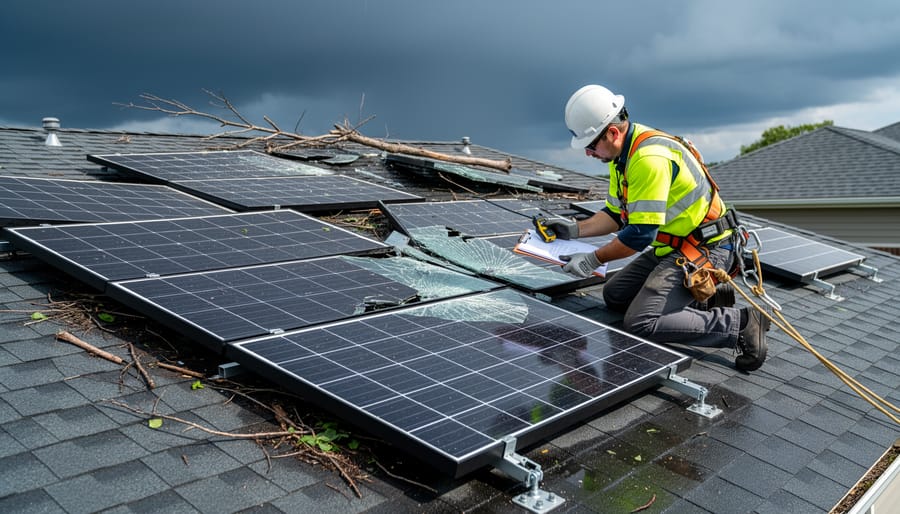
Not every crisis can or should be handled by your customer support team, some situations demand immediate escalation to licensed professionals or authorities. Recognizing these red lines protects your team, your customers, and your business from liability and harm.
Active Electrical Hazards
If a customer reports visible arcing, burning smells, smoke, or sparking from their solar system, inverter, or electrical panel, this is not a troubleshooting opportunity. Instruct the customer to immediately switch off their system at the inverter disconnect and main breaker if safe to do so, then dispatch a licensed electrician before any solar technician approaches the site. Never send support staff to diagnose active electrical failures, even experienced solar installers should defer to electrical contractors when live hazards are present.
Structural and Weather-Related Red Lines
Roof damage that compromises structural integrity, sagging sections, visible cracks in decking, or displaced mounting hardware after storms, requires a structural engineer’s assessment before any solar work proceeds. Similarly, active severe weather conditions (thunderstorms, high winds, ice accumulation) mean no on-site response until conditions clear, regardless of customer urgency. Illinois winter storms create particular risk when ice-covered panels or snow loads combine with electrical systems.
Customer Behavior and Threatening Situations
When a customer becomes verbally abusive, threatens legal action during the crisis call, or creates an unsafe environment for technicians, pause the standard response process. Escalate to management, document all communications, and consider requiring a third party present for any site visits. These scenarios often benefit from the transparency that customer confidence tools provide, detailed system monitoring and documentation can defuse disputes before they escalate.
Establishing these clear stop conditions ensures your team knows when standard crisis protocols give way to professional intervention, protecting everyone involved while maintaining resolution pathways.
Step-by-Step Team Crisis Management Process
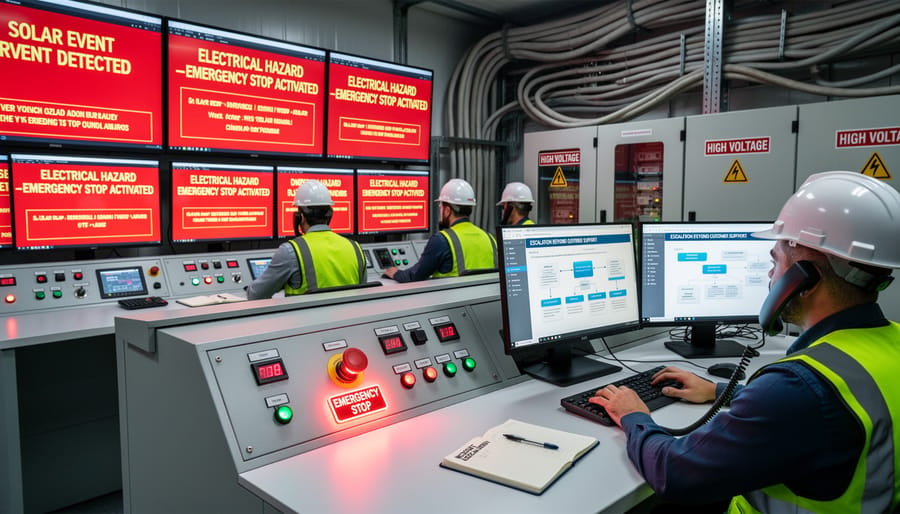
Step 1: Rapid Assessment and Classification
The first responder, whether answering a customer call, receiving a monitoring alert, or arriving on-site, must quickly determine what level of crisis they’re facing. Start by asking three immediate questions: Is anyone’s safety at risk? Is the solar system completely non-functional? Is there a time-sensitive deadline about to be missed?
Safety emergencies trigger the highest-priority response. If you identify exposed wiring, smoke, roof damage, or any electrical hazard, stop the assessment and immediately escalate to a licensed electrician while advising the customer to avoid the system. These situations require professional intervention, not remote troubleshooting.
For system performance issues, partial output drops, inverter errors, or connectivity problems, classify based on impact. A complete system failure producing zero power escalates faster than a 20% efficiency dip. Modern monitoring and clarity tools help quantify the severity within minutes.
Timeline crises include looming interconnection deadlines, expiring tax credit qualification windows, or financing contingencies. These demand immediate project manager involvement even if the technical issue seems minor.
Customer relations crises, threats of legal action, social media complaints, or high-value client dissatisfaction, require executive notification regardless of the underlying technical severity. Document the classification and timestamp it before moving to team assembly.
Step 2: Assemble Your Crisis Response Team
The moment you classify a crisis, activate your response team according to the specific threat. For system failures or equipment malfunctions, immediately notify your technical lead, the person who can diagnose inverter errors, wiring issues, or component defects. Installation delays or permitting roadblocks require your project manager, who understands timelines, contractor coordination, and regulatory processes. When payment disputes, tax credit complications, or financing breakdowns emerge, loop in your finance coordinator. High-value accounts, potential legal exposure, or situations threatening your business reputation demand executive involvement from the start.
Once notified, assign four critical roles. The incident commander owns the overall response, makes final decisions, and coordinates all team members. Your customer liaison becomes the single point of contact for the affected homeowner or business, preventing confusion from multiple voices. The technical resolver handles the actual fix, whether that means dispatching to the site, ordering replacement parts, or engaging subcontractors. The documentation lead captures every action, timestamp, and communication in your incident log.
Clear role assignment prevents duplication, ensures accountability, and accelerates resolution when minutes matter.
Step 3: Immediate Customer Communication
Once your crisis team is assembled, contact the customer within two hours maximum, sooner for safety emergencies. Lead with acknowledgment: “We’re aware your system stopped producing power this morning, and we’re actively working on a solution.” State what you know, even if incomplete, rather than making them wonder if anyone’s paying attention.
Provide a concrete timeline: “Our technician will arrive between 2-4 PM today” or “We’ll have a diagnostic report and next steps by 5 PM.” If you can’t promise resolution yet, commit to the next update: “I’ll call you by noon tomorrow with our repair plan, regardless of whether parts have arrived.” This removes uncertainty.
Offer interim solutions when possible: temporary grid power guidance for critical loads, real-time solar updates through your monitoring platform, or loaner equipment for extended outages. Name their single point of contact, one person, one phone number, so they’re not repeating their story to multiple team members. Keep the tone calm and ownership-focused: “We’re handling this” beats “Unfortunately, there’s an issue.” Skip apologies that don’t include action.
Step 4: Coordinate Internal Response and Deployment
Once your crisis team is assembled and the customer informed, shift immediately into coordinated deployment mode. The incident commander assigns parallel tasks to compress resolution time, one person schedules the emergency site visit while another sources replacement equipment, and a third contacts the utility or permitting authority if needed.
For system failures requiring parts, your technical lead should simultaneously check inventory, contact equipment suppliers, and identify workaround solutions. Don’t wait to exhaust Option A before exploring Option B. If a failed inverter needs replacement, order the part while also investigating temporary grid-disconnect procedures or battery backup options the customer can use during the repair window.
When subcontractors are necessary, licensed electricians for service panel work, roofers for structural issues, or ComEd for meter problems, engage them immediately with clear scope and urgency level. Your established vendor relationships make this possible; crisis time is not when you start vetting contractors.
Use your project management platform to track each task’s status in real time. The incident commander monitors progress across all workstreams, adjusts resource allocation as bottlenecks emerge, and keeps the customer liaison updated for next-contact timing. This parallel execution turns a potential three-day resolution into same-day or next-day service.
Step 5: Execute Resolution and Document Actions
With your crisis team deployed and a plan in action, execution becomes the make-or-break moment. Your technical lead performs the actual fix, whether that’s replacing a failed inverter, repairing storm-damaged racking, or coordinating emergency utility reconnection. The project manager handles any necessary regulatory filings with Illinois ICC or local building departments if work alters the permitted installation. Your finance coordinator processes refunds, service credits, or insurance claims as warranted.
Here’s the critical parallel task: while your team executes the solution, your documentation lead captures everything in real-time. Record exact actions taken, parts replaced (serial numbers included), who performed each task, timestamps for all communications, customer statements, and any deviations from standard procedures. This incident log protects your business in warranty disputes, proves regulatory compliance, and creates a learning record for future prevention. Don’t wait until after resolution, memories fade and details get lost. Assign someone specifically to document while others fix the problem, because incomplete records turn resolved crises into liability risks months later.
Step 6: Customer Follow-Up and Relationship Repair
Once your team has implemented the fix, contact the customer within 24 hours to confirm resolution and rebuild trust. Explain what caused the crisis in plain language, avoid technical jargon that might confuse homeowners unfamiliar with inverter protocols or utility interconnection procedures. For significant disruptions (extended outages, missed production windows, installation delays beyond a week), consider goodwill gestures: service credits, extended monitoring coverage, or priority scheduling for future maintenance. These investments cost less than losing referrals or managing negative reviews. Ask directly how the experience could have been better. Modern customer portals enable better post-crisis transparency through real-time status updates and documentation access. This follow-up transforms a potentially relationship-ending event into proof that your team stands behind its work when challenges arise.
Verification and Quality Control After Crisis Resolution
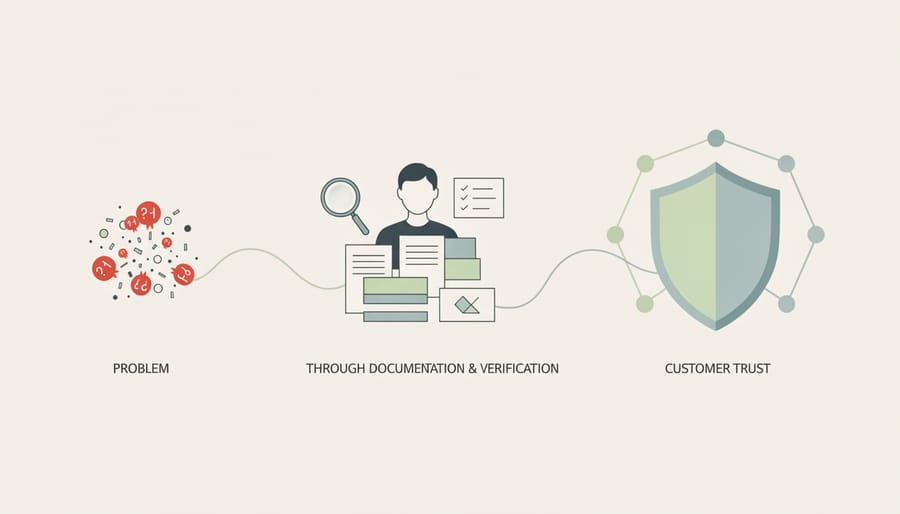
Confirming a crisis is resolved requires more than fixing the immediate problem. Your team must verify the solution works, the customer is satisfied, and all administrative loose ends are tied. Skip this verification phase and you risk the crisis reigniting days later, often with greater customer frustration.
Start with these essential post-resolution verification steps:
- Run comprehensive system performance tests comparing current output to baseline metrics, checking all components affected by the crisis, and confirming monitoring systems show normal operation
- Place a direct customer confirmation call within 24 hours to verify they understand the resolution, confirm their system operates as expected, and address any lingering concerns
- Review all incident documentation for completeness, technician reports, communication logs, parts replaced, warranty updates, ensuring nothing is missing for future reference
- Complete financial reconciliation including invoice adjustments, warranty claims, goodwill credits, and reimbursement processing, with clear records of cost responsibility
- Schedule a team debrief within 48 hours while details remain fresh, examining what worked, what failed, and what protocol changes would prevent recurrence
Beyond immediate checks, establish a structured follow-up timeline. Conduct a 7-day performance review analyzing system production data to catch any degradation patterns that emerged post-repair. This catches intermittent issues before they become new crises. At 30 days, assess the relationship health through a brief customer survey or call, crises handled well often strengthen trust, but you need to verify that outcome rather than assume it.
For Illinois installations involving utility interconnection or permitting issues, secure written confirmation from ComEd or the local authority having jurisdiction that all regulatory requirements are satisfied. These sign-offs protect you from compliance disputes months later when memories fade and documentation becomes your only defense.
The debrief phase matters as much as the initial response. Your team should identify specific protocol improvements, update crisis templates based on what actually worked, and recognize individuals who performed exceptionally under pressure. This transforms each crisis into institutional learning rather than a one-time scramble.
Building Team Capacity Before Crises Strike
The difference between managing a crisis well and fumbling through it comes down to what you built before the phone rang. Solar companies can’t wait until a system fails during a polar vortex to figure out who calls the electrician or how to explain interconnection delays to an angry customer. Pre-crisis preparation transforms panic into coordinated response.
Start with monthly crisis simulation drills tailored to scenarios your Illinois team will actually face. Walk through a complete system failure on a subzero January morning: who takes the initial call, how quickly the technical lead gets notified, what the customer hears within the first hour, and how you coordinate an emergency site visit when roads are iced over. Simulate a ComEd interconnection rejection two weeks before a customer’s financing deadline expires. Role-play a roof leak discovered during installation when your usual contractor is booked solid. These rehearsals expose gaps in your protocols while the stakes are zero, and they train muscle memory for when adrenaline hits.
Cross-train your support staff so technical knowledge doesn’t live in one person’s head and customer relations skills aren’t siloed in another department. Your monitoring specialist should understand enough about customer psychology to de-escalate anxiety during system alerts. Your sales team should know basic troubleshooting so they can triage issues before escalating. This redundancy prevents single points of failure when your lead technician is unreachable or your customer service manager is out sick during a crisis surge.
Establish vendor relationships now, not during the emergency. Identify three backup electricians, two roofing contractors, and alternate equipment suppliers who serve your Illinois territory. Meet them, negotiate emergency response terms, and add them to your crisis contact list. When a critical component fails and your primary supplier has a two-week lead time, you need someone who already knows your company and will prioritize your call.
Create decision authority guidelines that spell out who can authorize emergency expenditures, offer service credits, or commit to specific resolution timelines. Waiting for executive approval while a customer’s solar system sits dead for three days destroys trust faster than the crisis itself. Empower your incident commanders with clear boundaries and the authority to act.
Develop communication templates for the crises you’re most likely to encounter, but train your team to adapt them with empathy rather than read them robotically. A template gets the essential information out fast; human judgment makes the customer feel heard rather than processed.
Illinois Renewables’ locally owned structure makes this preparation more effective than what national installers can match. Local teams build relationships with the same electricians, inspectors, and utility contacts they’ll need during crises. They know which AHJs move fast and which require extra documentation. That embedded knowledge becomes capacity when trouble hits.
Common Mistakes in Solar Crisis Management
The most damaging mistake in solar crisis management is delayed customer notification. When a system failure or installation issue emerges, teams that wait to contact the customer until they have a complete solution often find the situation has escalated. Customers who discover problems themselves, through monitoring apps or lack of expected savings, lose trust immediately. In Illinois’s competitive solar market, that lost trust translates directly to negative reviews and withdrawn referrals. Aim for initial contact within two hours of identifying a crisis, even if you’re still gathering information.
Single-point-of-failure communication creates unnecessary vulnerability. When only one person knows how to access critical systems, contact key vendors, or communicate with utilities like ComEd, their absence during a crisis paralyzes response. Solar companies need redundant communication pathways and cross-trained team members who can step into crisis roles without delay.
Inadequate documentation haunts teams long after resolution. Without detailed incident logs, warranty claims become disputed, regulatory inquiries turn contentious, and learning opportunities vanish. Document every customer interaction, repair action, and decision in real time, not from memory days later.
Blame-shifting between installation crews, manufacturers, and support staff destroys both team cohesion and customer confidence. Customers don’t care whose fault it is; they need their system working. Present a unified front, own the problem collectively, and sort accountability internally after resolution.
Over-promising resolution timelines sets teams up for repeated failures. Weather delays, equipment shipping, utility coordination, and permitting all introduce variables beyond your control. Build buffer time into estimates rather than committing to best-case scenarios that rarely materialize.
Neglecting regulatory notification requirements carries real penalties. Illinois Commerce Commission rules and local building departments often require incident reporting for safety hazards or interconnection issues. Missing these notifications can trigger fines and complicate future permitting.
Finally, teams that skip post-crisis debriefs repeat the same mistakes. Every crisis offers lessons about process gaps, training needs, or vendor reliability. Schedule a team review within 48 hours of resolution to capture those insights while they’re fresh.
Frequently Asked Questions
Solar customer support teams face unique challenges that don’t fit standard service desk playbooks. When a homeowner’s system goes offline during a heat wave or a commercial installation hits a permitting wall days before a tax credit deadline, clear answers about protocols and responsibilities become critical. These questions address the practical realities of managing crises in Illinois solar operations.
How quickly should we respond to a customer crisis?
Initial acknowledgment should happen within one to two hours during business hours, with after-hours emergencies getting response within four hours. Safety-related crises (electrical hazards, fire risk, structural damage) require immediate response and may need utility disconnection or emergency services before your team arrives.
Who should lead crisis response for different problem types?
System performance failures need your technical lead, installation delays or permitting issues require the project manager, and financing or incentive complications belong to your finance coordinator. High-value accounts, legal exposure, or regulatory violations should involve executives from the start.
When do after-hours issues actually constitute emergencies?
True after-hours emergencies include active electrical hazards, fire risk, storm damage creating safety concerns, or complete system failure during extreme weather when the customer has no backup power. Monitoring alerts showing reduced production or non-urgent service questions can wait until morning with acknowledgment that you’ve received the notification.
How does crisis management differ from regular support escalation?
Crisis management activates a cross-functional team with defined incident command, compresses normal resolution timelines, and prioritizes that customer above the queue. Standard escalation moves an issue up the support hierarchy within normal workflows, while crisis response treats the situation as an organizational priority requiring coordinated deployment of multiple resources simultaneously.
Cost responsibility depends on warranty status and root cause. Equipment failures under manufacturer warranty get handled through those channels, though you absorb the coordination labor and expedited shipping. Installation errors your team caused are your responsibility entirely. Weather damage, utility equipment failures, or issues outside anyone’s control require case-by-case decisions, often splitting costs or offering service credits to maintain the relationship even when you’re not strictly liable.
The distinction between crisis and escalation matters for resource allocation. A frustrated customer with a legitimate complaint might escalate to a supervisor, but that’s a service recovery conversation, not a crisis mobilization. Reserve full crisis protocols for situations threatening safety, significant financial loss, regulatory standing, or catastrophic reputation damage. Overusing crisis response burns out your team and dilutes the urgency when genuine emergencies arise.
Illinois Renewables’ local ownership structure allows faster decision-making during crises compared to national installers routing requests through corporate hierarchies. When a crisis hits on Friday afternoon, having decision-makers in the same time zone and community means authorization for emergency repairs or cost concessions happens in minutes, not Monday morning after weekend voicemails pile up at a distant headquarters.
Effective team crisis management isn’t just damage control, it’s how solar companies prove their worth when customers need them most. A system failure at midnight or storm damage on a weekend reveals whether your support infrastructure is genuine or just marketing copy. For Illinois Renewables and similar providers, the ability to mobilize coordinated response quickly directly determines whether a crisis becomes a lost customer or a loyalty-building moment.
The locally owned advantage matters here in ways that quarterly investor calls never capture. When your crisis response team lives in the same communities they serve, they understand that every unresolved emergency ripples through local reputation networks. Regional solar providers can dispatch technicians within hours rather than navigating national call center queues and distant field service territories. Decision authority rests with people who have direct accountability to Illinois customers, not corporate risk management protocols designed for fifty states.
Building your crisis management protocols now, before the next major winter storm or grid interconnection dispute, separates prepared companies from reactive ones in 2026’s competitive solar market. The installers who document their response workflows, train their teams on solar-specific emergency scenarios, and maintain active vendor relationships are the ones homeowners and businesses trust with six-figure energy investments.
Crisis management excellence is no longer optional for solar customer support. It’s the foundation of sustainable growth and the clearest differentiator when customers research who to trust with their energy future.
