
Your Energy Bill Is Wrong—Here’s How Illinois Law Protects You
Review your energy bill carefully each month for unexplained charges, rate increases, or billing errors that don’t align with your actual usage patterns. Illinois law protects consumers through the Public Utilities Act and the Consumer Fraud and Deceptive Business Practices Act, giving you specific rights when disputing charges with your utility provider or energy supplier.
Document everything when a billing dispute arises. Take photos of your meter readings, save all correspondence with your energy company, and maintain records of your payment history. Illinois utilities must investigate disputes within 30 days and provide written explanations of their findings, so thorough documentation strengthens your position throughout the resolution process.
Contact your utility’s customer service department first to resolve discrepancies informally. If this fails, file a formal complaint with the Illinois Commerce Commission, which oversees utility practices and enforces consumer protection standards. The ICC can investigate billing errors, unauthorized charges, and unfair business practices at no cost to you.
For solar customers, understand that net metering disputes fall under specific regulatory frameworks in Illinois. Your solar installation agreement should clearly outline billing credits for excess energy production. If your utility incorrectly calculates these credits or fails to apply them properly, you have legal recourse through both the ICC and civil remedies under Illinois consumer protection statutes.
Know that Illinois prohibits utilities from disconnecting service during dispute investigations, protecting you from shutoffs while seeking resolution. These advocacy laws exist specifically to balance the power dynamic between large energy companies and individual consumers, ensuring fair treatment and transparent billing practices.
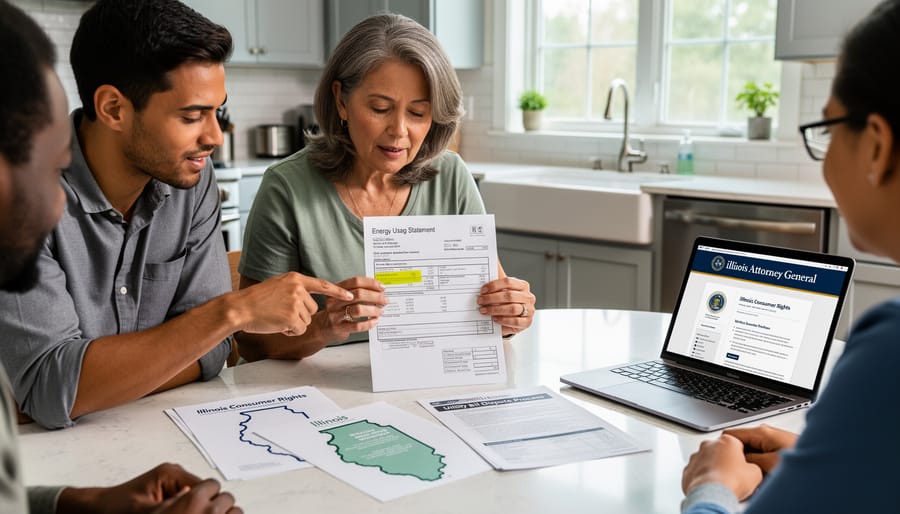
Understanding Your Rights Under Illinois Consumer Advocacy Laws
The Illinois Public Utilities Act and Your Energy Bills
The Illinois Public Utilities Act serves as the cornerstone of consumer protection for energy customers throughout the state. Enacted to regulate utility companies and protect residents from unfair practices, this comprehensive law establishes critical safeguards that directly impact your monthly energy bills.
Under this Act, utility companies must provide transparent billing statements that clearly itemize all charges. You have the right to understand exactly what you’re paying for, whether it’s electricity supply, delivery charges, or additional fees. The law prohibits utilities from implementing arbitrary rate increases without proper regulatory approval from the Illinois Commerce Commission, ensuring that any price changes undergo thorough review and justification.
For homeowners and businesses investing in solar energy, the Public Utilities Act also governs net metering arrangements. This means utilities must accurately credit you for excess electricity your solar panels generate and send back to the grid. The Act requires utilities to maintain accurate metering equipment and conduct regular inspections to prevent billing errors.
If you notice billing discrepancies or suspect unfair charges, the Act grants you the right to dispute these charges and request detailed explanations. Utilities must respond to consumer inquiries within specific timeframes and maintain proper records of all transactions. This foundational protection ensures that whether you’re relying on conventional energy sources or transitioning to solar solutions, your rights as an Illinois energy consumer remain protected.
Illinois Commerce Commission: Your Advocacy Watchdog
The Illinois Commerce Commission (ICC) serves as your primary advocate when disputes arise with utility companies, including electric and gas providers. This state agency has the authority to regulate energy utilities, ensuring they follow fair billing practices and maintain service standards that protect Illinois consumers.
When you encounter questionable charges on your energy bill, the ICC provides a structured complaint process. You can file a formal complaint through their website or by phone, and the Commission will investigate your concerns. The ICC examines billing errors, unauthorized charges, meter accuracy issues, and service quality problems. Their investigation process includes reviewing utility records, analyzing your billing history, and requiring utilities to provide documentation justifying their charges.
The ICC enforces specific consumer protections outlined in Illinois law. These include requirements for clear billing statements, accurate meter readings, and proper notification before service disconnection. For solar customers, the ICC oversees net metering regulations, ensuring utilities properly credit you for excess energy your system produces.
Beyond individual complaints, the ICC conducts formal hearings on utility rate increases and policy changes. These public proceedings give consumers and advocacy groups opportunities to voice concerns about proposed changes that could impact your energy costs. The Commission’s decisions directly affect what Illinois utilities can charge and how they serve customers throughout the state.
Common Energy Bill Disputes (And How Laws Address Them)
Incorrect Meter Readings and Estimated Bills
Illinois law requires utility companies to provide accurate billing based on actual meter readings, not estimates. Under the Illinois Public Utilities Act, utilities must read meters at regular intervals and can only use estimated bills when actual readings are temporarily unavailable. If you receive multiple consecutive estimated bills, you have the right to request an actual meter reading at no charge.
For solar customers with net metering agreements, accurate smart meter readings are especially critical. These readings track both the electricity you consume from the grid and the excess solar energy you send back, determining your credits. Estimated bills can significantly undervalue your solar production, potentially costing you money and delaying proper credit application.
The Illinois Commerce Commission mandates that if an estimated bill results in a substantial overcharge once actual readings are obtained, utilities must issue prompt refunds or credits. You can dispute estimated bills by contacting your utility provider and requesting verification of meter accuracy. Document all estimated bills and compare them against your solar system’s production data to identify discrepancies that warrant investigation.
Net Metering Credit Disputes
Illinois net metering laws provide solar customers with valuable credits when their systems generate more electricity than they consume, feeding the excess back into the grid. Under state regulations, utility companies must credit these contributions at the retail electricity rate, ensuring fair compensation for your solar investment. However, billing errors and credit calculation mistakes do occur, sometimes resulting in homeowners and businesses receiving less credit than they’re entitled to.
If you notice discrepancies in your net metering credits, Illinois law protects your right to accurate billing. Start by reviewing your utility statement carefully, comparing your system’s production data with the credits applied. Your solar installer can help verify these calculations, particularly if you’re working with a locally owned provider familiar with Illinois-specific requirements.
When disputes arise, document everything: production records, billing statements, and all correspondence with your utility company. File a formal complaint with your utility first, providing clear evidence of the discrepancy. If the issue remains unresolved, the Illinois Commerce Commission offers a complaint process specifically designed to address billing disputes, including net metering credit issues. As a solar customer, you have the right to receive every kilowatt-hour credit you’ve earned, and these consumer protections ensure utilities honor their obligations under Illinois net metering regulations.
Unexplained Rate Increases and Fee Disputes
Illinois law requires utility companies to provide advance written notice before implementing rate increases, typically 30 days for residential customers. If you notice unexpected changes to Illinois utility rates on your energy bill, you have the right to request a detailed explanation from your provider.
When you spot questionable fees or charges, start by reviewing your billing statement carefully. Look for unfamiliar line items, duplicate charges, or fees that weren’t disclosed in your service agreement. Solar customers should pay particular attention to interconnection fees, net metering credits, and any charges related to grid connection.
You have the right to dispute charges you believe are unjustified. Contact your utility company’s customer service department first to request an itemized explanation. Document all communications, including dates, representatives’ names, and reference numbers. If the utility cannot adequately justify the charges, file a formal complaint.
For unresolved disputes, the Illinois Commerce Commission provides a consumer services division that investigates billing complaints. You can submit complaints online or by phone, and the ICC will review your case and work toward a resolution, ensuring your consumer protections are upheld throughout the process.
Step-by-Step: How to Use Consumer Advocacy for Energy Bill Dispute Resolution
Start With Your Utility Company
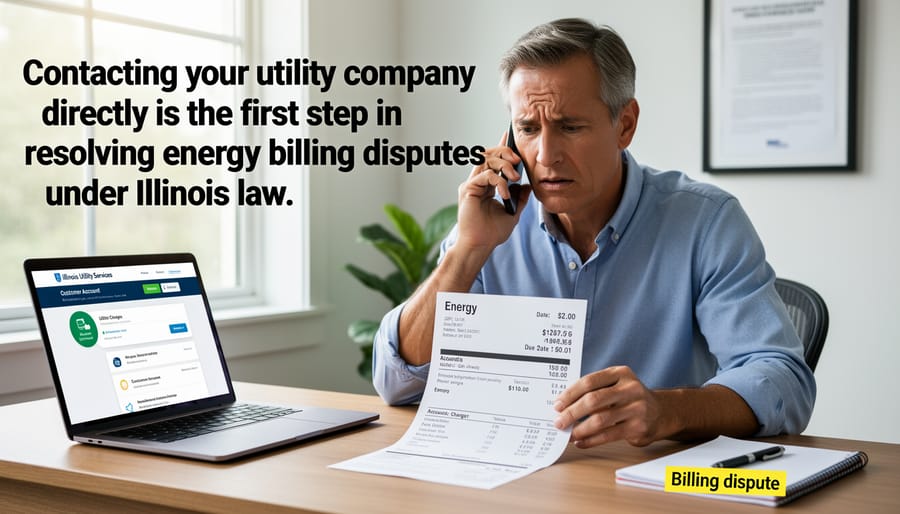
When you notice an error on your energy bill, your first step is contacting your utility company directly before pursuing legal action. Illinois law requires utilities to provide clear dispute resolution procedures, and starting here can often resolve issues quickly.
Begin by gathering documentation that supports your claim. This includes previous bills, payment records, meter readings, and photos if applicable. For solar customers, net metering statements and production data from your system are particularly valuable. Keep a detailed log of all communications with your utility provider, noting dates, representative names, and conversation summaries.
Contact your utility’s customer service department and formally request a bill review. Under Illinois regulations, utility companies must acknowledge your dispute within a specific timeframe and cannot disconnect service while investigating a legitimate billing dispute. Request confirmation in writing that your complaint has been received.
Most utilities must provide a written response to billing disputes within 30 days, though exact timelines vary by provider. During this period, you may need to pay the undisputed portion of your bill to maintain good standing. The utility should explain their findings clearly and adjust your account if errors are confirmed. If you’re not satisfied with their response, this documentation becomes essential for escalating your case to regulatory agencies or pursuing further action through consumer advocacy channels.
Filing a Formal Complaint With the Illinois Commerce Commission
If informal resolution attempts haven’t resolved your energy billing dispute, you can file a formal complaint with the Illinois Commerce Commission. The ICC oversees utility companies and solar providers operating in Illinois, ensuring they comply with state regulations and treat customers fairly.
To begin the process, visit the ICC’s website or call their Consumer Services Division at 1-800-524-0795. You can file complaints online, by mail, or by phone. When submitting your complaint, include your account number, utility provider’s name, detailed description of the billing issue, copies of relevant bills and correspondence, dates of previous contact attempts with your provider, and your desired resolution. The more documentation you provide, the stronger your case becomes.
Once filed, the ICC assigns your complaint a tracking number and forwards it to your utility company, which typically has 10 business days to investigate and respond. During this period, an ICC representative may contact you for additional information. The commission reviews both your complaint and the company’s response to determine if regulatory violations occurred.
For straightforward billing errors, resolution often occurs within 30 to 45 days. More complex disputes involving solar net metering calculations or interconnection issues may take 60 to 90 days. Throughout the process, the ICC serves as an impartial mediator, ensuring Illinois consumer protection laws are upheld.
Keep copies of all communications and document every interaction with both your provider and the ICC. This creates a comprehensive record should further action become necessary.
Leveraging Additional Consumer Advocacy Resources
When you’re facing energy billing disputes in Illinois, you don’t have to navigate the process alone. Several organizations beyond your utility company and the Illinois Commerce Commission can provide valuable assistance and support.
The Illinois Attorney General’s Consumer Protection Division handles complaints related to unfair business practices and can investigate billing discrepancies. Their office maintains a consumer fraud hotline and offers free resources to help you understand your rights. For homeowners and businesses dealing with solar-related billing issues, this office can address concerns about misrepresentation or contract disputes with solar installers.
Legal aid organizations throughout Illinois provide free or low-cost assistance to qualifying individuals. Prairie State Legal Services and Land of Lincoln Legal Aid offer representation and advice for energy-related matters, particularly for low-income households struggling with utility disputes. These organizations can help you understand complex billing statements and advocate on your behalf.
The Citizens Utility Board (CUB) serves as Illinois’s leading consumer advocacy groups for utility issues. CUB provides free information, investigates complaints, and represents consumer interests before regulatory bodies. Their experts can explain net metering credits, interconnection agreements, and other solar-specific billing components.
Community organizations like the Environmental Law and Policy Center also advocate for renewable energy consumers, offering guidance on regulatory matters and policy issues affecting solar customers. These resources ensure you have multiple avenues for support when resolving energy billing disputes.
Special Protections for Solar Energy Customers in Illinois
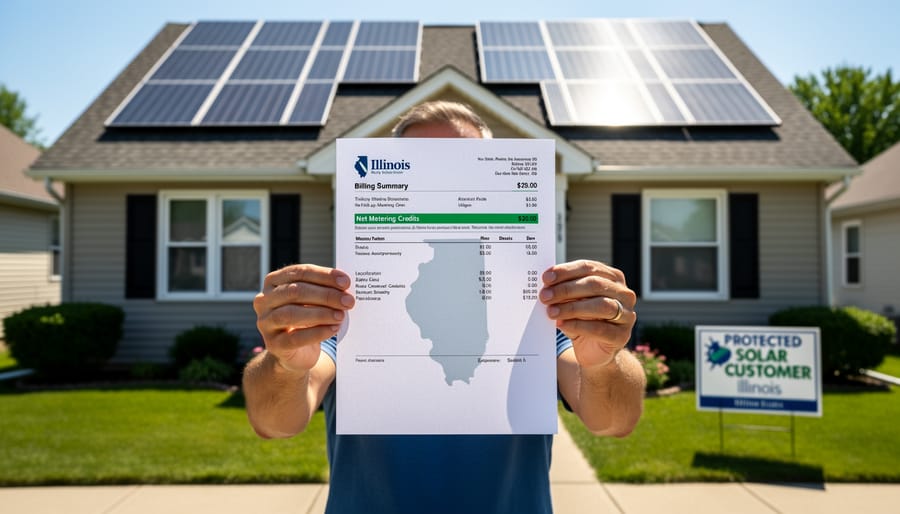
Your Net Metering Rights Under Illinois Law
Illinois law guarantees strong net metering protections for solar energy system owners, ensuring you receive fair credit for excess electricity your system sends to the grid. Under the Illinois Power Agency Act and utility regulations, electric utilities must offer net metering to eligible customers with renewable energy systems up to 2,000 kilowatts for residential and commercial properties.
Your utility company is legally required to credit your account at the full retail electricity rate for surplus energy your solar panels generate. This means every kilowatt-hour you send back to the grid reduces your bill by the same amount you would pay for purchased electricity. These credits typically roll over month to month, allowing you to build a bank of credits during high-production summer months to offset winter usage.
To ensure compliance, regularly review your electric bills to verify that net metering credits appear correctly. Your bill should clearly show energy consumed from the grid, energy exported to the grid, and net usage after applying credits. If you notice discrepancies or missing credits, contact your utility immediately with your account information and solar system production data.
Illinois utilities must also provide transparent information about how net metering credits are calculated. If your utility fails to properly credit your account or refuses to honor net metering requirements, you can file a formal complaint with the Illinois Commerce Commission. Understanding these protections helps you maximize benefits similar to community solar savings opportunities available throughout the state.
Protection Against Discriminatory Billing Practices
Illinois law provides important protections for solar energy customers against discriminatory billing practices that unfairly target them compared to traditional utility customers. Under state consumer protection regulations, utilities cannot impose special fees, surcharges, or connection charges solely because a customer generates their own solar power. This means you shouldn’t face penalty charges simply for installing solar panels on your property.
The Illinois Power Agency Act and related regulations ensure that solar customers receive equitable treatment in billing structures. Utilities must apply standard rate structures fairly and cannot create punitive fees designed to discourage solar adoption. For example, if a utility attempts to charge you excessive interconnection fees or standby charges that don’t reflect actual costs, these practices may violate Illinois consumer protection laws.
If you notice unusual charges on your bill after installing solar panels, document everything and compare your rates with standard utility customers. You have the right to request a detailed explanation of any charges and challenge discriminatory fees through the Illinois Commerce Commission. As a locally owned solar provider with expertise in solar energy, we help Illinois homeowners and business owners understand their billing rights and identify potentially unfair charges before they become larger disputes.
Preventing Future Billing Disputes: What Illinois Law Requires From Utilities
Illinois law establishes clear obligations for utility companies to protect consumers from billing disputes and ensure transparency in their operations. Under the Illinois Public Utilities Act, utilities must maintain accurate metering systems and conduct regular testing to verify billing precision. These requirements apply to all energy providers, including those serving customers with solar installations.
Utilities operating in Illinois must provide itemized bills that clearly break down charges, showing the cost per kilowatt-hour, delivery fees, taxes, and any applicable credits. For solar customers, this includes net metering credits that reflect energy sent back to the grid. The Illinois Commerce Commission requires utilities to explain rate changes in plain language and provide advance notice before implementing increases, giving consumers time to understand how their bills will be affected.
Customer service standards mandate that utilities maintain accessible communication channels and respond to inquiries within specific timeframes. Companies must offer payment plan options for customers experiencing financial hardship and cannot disconnect service without proper notice and an opportunity to resolve outstanding balances. These protections extend to participants in energy efficiency incentive programs, ensuring that rebates and credits are properly applied.
The Public Utilities Act also requires utilities to maintain detailed records of meter readings, billing calculations, and customer interactions. These records become essential if disputes arise, as they provide documentation for regulatory reviews. For solar customers, utilities must accurately track both consumption and generation, ensuring that renewable energy credits are properly calculated and applied to monthly statements.
Understanding these legal requirements empowers Illinois consumers to recognize when utilities fail to meet their obligations and take appropriate action when billing problems occur.
Illinois consumers benefit from comprehensive legal protections when facing energy bill disputes, giving you significant leverage to resolve billing issues fairly and efficiently. Understanding these consumer advocacy laws empowers you to take decisive action when problems arise, whether you’re dealing with estimated billing, incorrect charges, or solar net metering discrepancies.
The key to successful dispute resolution lies in acting quickly and knowing which resources are available to you. Illinois law provides multiple avenues for addressing billing concerns, from informal utility company complaints to formal ICC investigations. By documenting your concerns thoroughly and following the proper escalation procedures, you significantly increase your chances of a favorable outcome.
For solar customers, understanding your rights under net metering regulations and interconnection agreements is particularly important. Billing complications often stem from miscommunication between utilities and solar installations, which is why working with experienced, locally owned solar providers makes such a difference. At Illinois Renewables, our expertise in solar energy extends beyond installation to ensuring proper utility coordination and system configuration, helping prevent billing issues before they start.
Don’t hesitate to leverage consumer advocacy resources when you encounter billing disputes. Organizations like the Citizens Utility Board and the Illinois Attorney General’s office exist specifically to support consumers like you. Combined with the protections provided by Illinois law and guidance from knowledgeable solar professionals, you have the tools needed to protect your financial interests and ensure accurate, fair billing for your energy consumption.
