

What Is Tesamorelin (and How Does a Modified GHRH Fragment Work)?
Tesamorelin is a synthetic version of growth hormone-releasing hormone (GHRH), the natural signal your brain sends to the pituitary gland to release growth hormone. Scientists modified the original 44-amino-acid hormone by attaching a small chemical tail, which helps it last longer in the body than the unaltered version. That single design change is why tesamorelin gets so much attention in lab settings, including among those who source tesamorelin research vials for study.
Understanding how a tweaked fragment of a natural hormone produces a measurable effect matters, because it shows how researchers think about stability, signaling, and precision. In the same way a well-designed solar system depends on every component doing its job, a peptide depends on its structure.
This article explains what tesamorelin is, how its modified structure works, and how scientists evaluate it, including the kinds of studies behind it. Our locally owned Illinois team brings solar expertise to energy, but we like clear explanations on any technical topic. For lab reference only, tesamorelin is offered for research use. This content is educational and not medical advice.
What Tesamorelin Means: A Plain-Language Definition
From Natural GHRH to a Modified Fragment
Natural GHRH is a chain of 44 amino acids that the brain’s hypothalamus releases to tell the pituitary gland to make growth hormone. Tesamorelin keeps that same 44-amino-acid chain, then adds one small chemical piece, a trans-3-hexenoyl group, to the front end of the molecule.
Think of it like swapping a standard bolt for a coated, reinforced one. It fits in the same spot and does the same job, but it holds up much longer under demanding conditions. Natural GHRH gets chopped up by enzymes in the blood within minutes. The added group helps shield tesamorelin from that rapid breakdown, so it stays intact long enough to deliver its signal.
A few terms come up often when scientists describe this:
- Amino acid
- A small building block that links with others to form peptides and proteins.
- Peptide
- A short chain of amino acids, smaller than a full protein.
- Pituitary gland
- A pea-sized gland at the base of the brain that releases many of the body’s key hormones.
- Growth hormone (GH)
- A hormone made by the pituitary that supports growth, repair, and metabolism.
With those basics in place, the next step is seeing how this reinforced molecule actually does its work.
How Tesamorelin Works in the Body
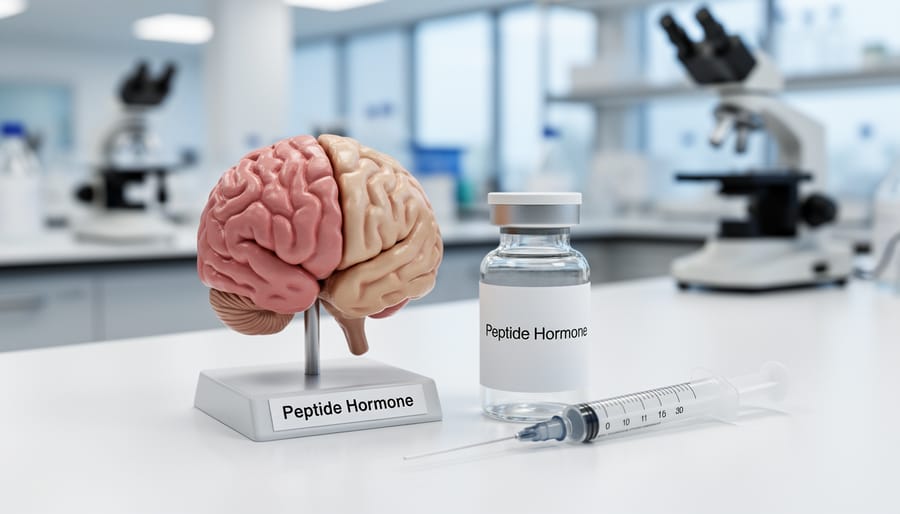
Why the Modification Matters

Natural GHRH has a short working life. The body’s enzymes, especially dipeptidyl peptidase IV (DPP-IV), snip off the first two amino acids of the chain within minutes, and a clipped molecule no longer delivers the same signal. That is a real problem if you want to study a molecule or have it do its job.
Tesamorelin’s added trans-3-hexenoyl group sits at the front of the chain, right where DPP-IV tends to strike. It acts like a shield, slowing the cleavage so the molecule stays intact and active longer. Because it lasts longer, researchers can measure it more reliably and observe a clearer pharmacodynamic response meaning what the body actually does after the molecule arrives.
Stability is a central goal across peptide science for exactly this reason. Many promising peptides break down too quickly to be useful, so designers often tweak their structure to extend their lifespan without changing the message they carry. Tesamorelin is a well-known example of that careful, targeted engineering.
How Researchers Study a Modified GHRH Fragment

Studying a molecule like tesamorelin is a layered process, and each layer answers a different question. Think of it the way an engineer tests a new solar panel: first on a bench, then in controlled conditions, then in the real world over time. If you’re curious about how science testing works in a very different field, the same step-by-step logic applies.
It starts in the lab. Scientists check whether the modified fragment actually attaches to GHRH receptors on pituitary cells, and how strongly. From there, pharmacokinetic studies track what the body does to the molecule: how it’s absorbed, how it’s distributed, and how quickly it’s broken down and cleared. Pharmacodynamic studies flip the question around and ask what the molecule does to the body, usually by measuring growth hormone (GH) and IGF-1 levels in blood samples taken at set times.
Here’s a quick look at the common methods and what each one reveals:
- Receptor-binding assays show whether, and how tightly, the fragment attaches to its target receptor.
- Pharmacokinetic studies reveal how the molecule is absorbed, processed, and cleared over time.
- Hormone-response measurements capture changes in GH and IGF-1 after exposure.
- Randomized controlled trials compare outcomes in treated and comparison groups to separate real effects from chance.
- Long-term safety follow-up looks for effects that only appear after extended use.
Human clinical trials then move through phases, starting small to focus on safety and gradually widening to test effectiveness. In studies of visceral fat, researchers often use CT scans to measure the fat deep in the abdomen, since it’s hard to judge by sight or a bathroom scale. Because the same measurement is repeated on every participant, the results stay comparable.
Careful comparison is what makes the findings trustworthy. Control groups, often receiving a placebo, let researchers see what changes because of the molecule and what would have changed anyway. Throughout, safety monitoring never stops, with regular check-ins and lab work to catch any concerns early. Just as measuring study results depends on consistent, accurate data, good science depends on measuring the same things the same way, every time.
Where Tesamorelin Is Used and Studied
Tesamorelin’s best-established use is a narrow one. It is prescribed to reduce excess abdominal fat in certain adults with HIV-associated lipodystrophy, a condition where fat builds up around the organs in the midsection. In this setting, a licensed prescriber decides whether it fits a patient’s situation and monitors the person throughout. Studies for this use typically track visceral fat with imaging, along with hormone levels and safety markers. That approach reflects the broader regulatory approval process where a therapy has to show consistent results and an acceptable safety profile before it reaches patients.
Beyond that approved use, scientists continue to explore how GHRH-based molecules affect metabolism and body composition in other groups. Some of this work looks at how growth hormone signaling relates to liver fat, cognition, and aging. These questions are still being investigated, and early findings should not be read as proof of benefit. Interest in a topic is not the same as an established treatment.
If you have questions about whether any prescription therapy is appropriate for you, the right step is a conversation with a licensed healthcare provider. Information like this can help you understand the science, but it can’t replace personal medical guidance.
Common Questions About Tesamorelin and Its Study
Readers tend to ask the same handful of questions when they first meet this peptide. Here are plain answers to the most common ones.
How is tesamorelin different from growth hormone itself?
Growth hormone is the end-product hormone. Tesamorelin is a signaling molecule that prompts the pituitary gland to release the body’s own growth hormone, so the natural feedback system stays involved.
Why is only a fragment of GHRH used?
The first 44 amino acids of natural GHRH carry the part of the message that activates the receptor. A shorter chain is also simpler to manufacture and easier to stabilize.
Is tesamorelin a supplement or a prescription medication?
It is an FDA-approved prescription medication for a specific medical condition. It is not a dietary supplement, and products sold as “research peptides” are not the same thing as an approved, regulated drug.
Who oversees its use?
A licensed healthcare provider decides whether it is appropriate and monitors the person using it. That oversight is why this article stays educational and offers no personal-use direction.
As for where to read more, start with sources that are accountable for accuracy. The FDA’s drug labeling and prescribing information, peer-reviewed journals indexed in PubMed, and your own physician or pharmacist are all dependable. Be cautious with forums and marketing pages, since they often blur the line between established findings and promotional claims.
Tesamorelin is a lab-made version of the first 44 amino acids of natural GHRH, with one small chemical tweak that helps it resist breakdown. It signals the pituitary to release the body’s own growth hormone, and researchers check that process through receptor studies, pharmacokinetic and pharmacodynamic measurements, and carefully monitored clinical trials. Each layer of testing answers a different question, and together they build a trustworthy picture. As always, any decision about a prescription therapy belongs with a licensed healthcare provider.
That layered, evidence-first approach is something we appreciate at Illinois Renewables. As a locally owned team with deep solar expertise, we rely on clear data and proven methods to help Illinois homeowners and businesses make confident energy decisions. If you’re curious about solar design, installation, financing, or roofing projects, reach out to our team. We’d be glad to walk you through your options, one clear step at a time.
